
“Take your hands off my mother right now.”
The command cut through the hospital lobby like a blade. Every head turned.
Victoria Hale stood in the entrance, rain still dripping from the hem of her black trench coat. She didn’t hurry. Rushing implies panic, and she had buried panic long ago.
The rhythmic crack of her heels against Italian marble was the only sound in the room.
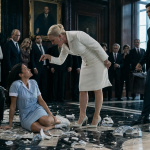
Moments earlier, nobody had moved. They had watched a seventy-year-old woman be humiliated in a wheelchair, and done nothing.
Brenda, the Head Nurse, had been mid-sentence when the silence landed on her like a fist. “—so if you can’t manage a simple billing cycle, then this facility cannot—”
She stopped.
Behind the intake desk, the senior receptionist went the color of raw dough. A passing cardiologist froze, lowered his head, and took one careful step backward. A young resident clutching a clipboard whispered into the dead air, “Oh God. That’s Victoria Hale.”
Brenda’s mouth opened. Her mouth closed.
Vicky didn’t acknowledge her yet. She walked straight to the wheelchair and knelt in front of her mother. With fingers she kept surgically steady, she picked up the photograph that had skidded across the floor. The glass was cracked clean through.
“Mama,” she whispered. “Who touched you?”
Clara Hale pressed one trembling, blue-veined hand against the red mark blooming on her cheek. “Vicky, sweetheart… please. Don’t make trouble.”
Vicky rose slowly, and the room seemed to shrink around her.
“No one helped her?” she asked. Her voice was not raised. It was the quiet that precedes a verdict.
The lobby swallowed its own sound.
She turned and looked at Brenda. The woman who had, moments ago, physically struck a seventy-year-old woman in a wheelchair because a billing payment was twelve hours overdue.
Brenda forced a laugh—thin and desperate as tissue paper. “Ms. Hale! This is all a misunderstanding. Your mother became agitated and—”
“Aggressive,” Vicky interrupted, letting the word sit alone.
She took one deliberate step forward.
Brenda stepped back, her rubber soles squeaking.
“My seventy-year-old mother, who has arthritis, was sitting in a wheelchair.” Every syllable landed with the weight of a closing gavel. “And you struck her.”
Smartphones glinted throughout the lobby. Patients recording, staff staring. Good, Vicky thought. Let them all see.
She held out the broken picture frame.
“Pick it up,” she said.
Brenda blinked. “I’m sorry?”
“The frame. You cracked the glass when you hit her. Pick it up.”
Brenda’s hands shook so badly she looked like she was vibrating. She took the frame. Through the cracked glass, a photograph: a younger Clara, exhausted and smiling, holding the hand of a small girl in oversized yellow rain boots.
Vicky’s voice, when it came, carried to every corner of the room.
“She worked three minimum-wage jobs to keep a roof over my head. She scrubbed floors until her knuckles bled so I could have textbooks. And today—today—you physically assaulted her over a billing delay worth less than my morning coffee.”
Brenda’s knees buckled visibly.
“I… I didn’t know who she was.”
“You didn’t know she was my mother,” Vicky corrected. “Which means this is exactly how you treat people who don’t have billionaires protecting them.”
She pivoted toward the knot of administrators gathering near the elevator banks.
“Effective immediately,” she announced, her voice reaching the back walls without effort, “every employee involved in this incident—including the guard who stood there and watched—is suspended without pay, pending a criminal investigation for elder abuse.”
A collective gasp broke the silence.
But before Vicky could continue, she felt her mother’s fingers dig into her sleeve with unexpected, urgent strength.
“Vicky.” Clara’s voice had dropped to a raw, fractured thread. “Don’t look at the staff. You have to go upstairs.”
“I’m taking you home, Mama.”
“No.” Clara’s grip tightened. “He’s here. Room 814. He sent a message down.” She pulled Vicky’s ear close to her lips. “He said if you didn’t come up alone, he would release the files.”
Vicky frowned. “Who is in 814?”
Her mother let out a choked sob.
“Your father.”
The lobby sound—ringing phones, murmured voices, rain—vanished. A roaring silence replaced it. The one kind of silence that comes only with genuine terror.
Because Arthur Hale had not abandoned them.
He had burned to death in a chemical factory fire twenty years ago. Vicky had buried his ashes herself.
She was still for exactly two seconds. Then the iron came back into her spine.
“David,” she said quietly.
Her head of security materialized at her side.
“Lock down this lobby,” she told him. “Nobody leaves. Hand my mother to Dr. Aris—only Aris. Penthouse suite. Four men on the door.”
“Boss,” David said carefully, “where are you going?”
“Upstairs.”
The private elevator was mirrored on all sides. As the doors slid shut, Vicky watched her own face and gave herself three seconds—three full seconds—to feel the fear. The nausea. The vertigo of twenty years cracking open.
Then she smoothed the front of her coat, and the CEO walked over the child’s grave.
The 8th floor was wrong the moment the doors opened.
Too quiet. No nurses at the station. No doctors on rounds. The monitors were blinking, but the floor had been cleared—deliberately, professionally, at significant cost.
Someone had bought this silence.
She walked the long corridor, her heels silent on the carpet, past dark and closed doors, until she reached the one that wasn’t. Room 814 stood slightly open, a blade of pale light cutting across the floor.
She pushed it open.
The room was large. Full of machines she had personally authorized the purchase of.
Propped against white pillows in the center of the room was an old man. White-haired, weathered, thin in the way of someone who had eaten badly for a long time and was now compensating too late. An IV threaded into one arm. Oxygen beneath his nose.
But his eyes—steel gray and predatory and utterly familiar—found her immediately.
Arthur Hale smiled. It was the smile of a trap snapping shut.
“Hello, Vicky,” he rasped. “You grew up to look just like the money I always wanted.”
She said nothing. She crossed to the foot of the bed and gripped the steel railing until her knuckles went white.
“You’re dead,” she said. “I buried you at St. Jude’s.”
He chuckled—a rattling, dry sound. “You buried thirty pounds of industrial slag and a very convincing dental record. Cost me twenty thousand to bribe the coroner’s assistant. A bargain, honestly. Fresh starts usually cost more.”
“People died in that fire, Arthur.”
“Collateral damage.” He waved one trembling hand. “The company was already going under. I just… provided the spark. The plan was to collect the life insurance through a proxy and live well in Costa Rica.”
“But the policy didn’t pay out.”
A flash of genuine rage crossed his face. “Gross negligence clause. Left me stranded with nothing for twenty years while you were up here building your little empire.” He gestured around the room—at the gleaming equipment, the hospital itself, the empire represented by every surface. “And here I am. Ready to collect.”
Vicky stared at him without recognition. Not as her father. Just as a thing that needed to be categorized and neutralized.
“The display downstairs,” she said flatly. “Brenda. That was yours.”
“Six months on my payroll.” He almost looked proud. “I needed you here personally. Angry, distracted, and without your legal team. I needed you cornered.” He slid a thick manila envelope across the rolling tray. “Open it.”
She didn’t move.
“Open it,” he repeated, “or I press this button and an email goes to the Wall Street Journal, the SEC, and the FBI field office.”
She picked up the envelope. Pulled out the documents.
Her blood temperature dropped four degrees.
Financial records. Bank transfers. Shell company registrations going back to her first clinic. They were immaculate—professionally forged, with the kind of detail that only comes from someone who had access to real data.
“What is this,” she said. Not a question.
“A fabricated paper trail proving that the seed money for Hale Medical came from my offshore accounts,” he said, savoring each word. “That your entire company was built on the proceeds of insurance fraud, arson, and blood money.”
“It’s fabricated.”
“Doesn’t matter.” His smile broadened. “Your stock crashes by morning. Your board ousts you by noon. The feds freeze your assets and you spend the next decade in litigation. Your empire turns to ash.” He produced a fountain pen from the pocket of his hospital gown. “Sign fifty-one percent of your voting shares over to the Vanguard Trust—a blind trust I control—and I burn every copy. You keep the title. You keep forty-nine percent. I retire in comfort.”
He slid the contract across the tray table until it bumped against her chest.
“Sign it, Vicky. Or everything you built burns.”
She looked at the contract.
She thought about the nights she had studied under a streetlamp because the electricity was cut. She thought about her mother’s blistered, red hands. She thought about the sound—that small, wounded sound—her mother made when the wheelchair was jerked backward downstairs.
She picked up the pen.
The metal was cold and heavy in her fingers. She pressed the gold nib to the signature line. Black ink pooled into the paper, spreading slowly.
Arthur leaned forward. His entire body was vibrating. Twenty years of waiting, concentrated into one focal point.
“Sign it,” he breathed. “Be a good girl.”
Vicky stopped writing.
She gripped both ends of the pen.
With a single, controlled twist of both wrists, she snapped it in half.
Black ink exploded across the contract, splattering her fingers, dripping onto the white blanket covering his legs.
Arthur recoiled. “What—what are you doing? I’ll release everything—”
She dropped the broken halves onto his lap.
“You’re old, Arthur,” she said. Her voice had dropped to a tone reserved for closing statements. “Old, tired, and catastrophically out of touch with how the world actually works.”
“I’ll destroy you!” He grabbed for the phone on the bedside table.
“Stop.”
He froze.
She reached into the pocket of her trench coat and withdrew her phone. She tapped the screen once.
“You thought you were clever using Brenda downstairs,” she said, pacing slowly. “You thought humiliating her in public would blind me with rage. And it did—for about three minutes. But when my mother whispered your name in my ear, you didn’t trigger my surrender.”
She looked at him.
“You triggered Aegis.”
Arthur’s face twisted. “What the hell is Aegis?”
“A proprietary AI system my tech division built three years ago,” she explained pleasantly, the way a professor delivers a final exam result. “Designed to monitor corporate espionage. The moment the microphone in my smartwatch picked up the name ‘Arthur Hale’ spoken in a tone of biometric distress by my mother—Aegis went to work.”
She held up her phone. “While you were sitting here rehearsing this conversation, my AI cross-referenced every facial recognition camera in Seattle, accessed the hospital’s internal network, and traced the encrypted burner phone you used to contact Brenda.”
She pressed play.
Arthur’s own voice filled the room—low, rasping, unmistakable:
“Make the old woman cry. Make sure the daughter sees it. I need her upstairs, rattled and alone.”
The heart monitor beside him spiked. The beeping accelerated, an arrhythmic, panicked percussion.
“That’s illegal wiretapping,” Arthur stammered.
“It gets considerably worse for you.” She let a cold smile surface—the kind that doesn’t reach the eyes at all. “Aegis identified your voice print and ran it against the global financial grid. Four minutes. That’s how long it took to locate the shadow accounts you established in the Caymans under the Vanguard Trust. The gambling funds. The hush money. The long-term laundering architecture you’ve been building since you washed up broke from Costa Rica.”
She tapped the screen.
A green checkmark appeared.
She leaned forward until her face was inches from his.
“As of thirty seconds ago,” she whispered, “every offshore account linked to your DNA, your voice print, or the Vanguard Trust has been permanently frozen by my team in Silicon Valley.” She straightened. “You are as broke as the day you faked your death.”
Arthur’s chest heaved. The gown twisted around him. “You can’t… that’s not legal…”
“The documents?” She gestured at the scattered papers. “Go ahead and release them. Aegis has already generated a cryptographic audit trail proving they were created on a server in Bogotá two weeks ago—long after I incorporated Hale Medical. The SEC won’t charge me. The Wall Street Journal will publish a feature on how pathetically you tried.”
“You ungrateful—”
“I learned from the best,” she said. “But here’s the last piece. Did you genuinely believe I walked up here alone?”
His eyes darted to the door.
“When I gave David the lockdown order,” she said softly, “I also sent a direct ping to the FBI field office downtown. A federal agent happens to be the godfather of my chief counsel. They owe me a favor.”
Outside, through the storm, the first sirens began to wail—distant, then closer, then everywhere at once, wrapping the building.
Arthur’s face emptied. He looked like a man watching a ceiling collapse.
“Fraud. Extortion. Conspiracy to commit elder abuse. Arson resulting in multiple deaths. And faking your own death to evade creditors.” She listed each charge with the boredom of someone reading a grocery list. “Federal supermax, Arthur. And I will personally see to it that every remaining day is uncomfortable.”
Boots thundered down the hall. The silence of the 8th floor shattered—agents shouting, security announcing, the controlled chaos of an arrest already in motion.
Vicky turned her back on the man in the bed and walked toward the door.
“Wait,” Arthur wheezed.
She paused, her hand on the brass knob.
Behind her, he let out a sound—wet, ragged, and unmistakably like a laugh. The kind that costs blood.
“You think you beat me, Vicky,” he coughed. “You didn’t look close enough at the Vanguard Trust.”
She frowned over her shoulder. “You’re delirious.”
“The accounts,” he gasped, his eyes beginning to roll with the strain his failing heart was placing on the rest of him. “I set them up. But I don’t own the voting rights.”
The door burst open. FBI tactical—four agents, gear, shouting—flooded the room, shoved past her, descended on the bed.
Vicky stepped into the hallway.
She watched them cuff the wrists of a man hooked to life support while she stood in the corridor, and the victory turned to ash in her mouth before she could swallow it.
If he didn’t own the Vanguard Trust… who did?
The aftermath came in flashes. Red and blue light through rain-slicked windows. The chemical smell of iodine. The relentless pop of press cameras from the lobby below, where Brenda was being marched out in handcuffs, mascara dissolved, career destroyed in the span of a single hour.
Arthur Hale left on a stretcher, under federal custody, connected to a portable life-support unit he would likely spend what remained of his life attached to—in a room with no windows.
Vicky didn’t give a statement. She let her PR team handle the wolves outside.
She took the private elevator to the penthouse suite.
The room was warm. It smelled like fresh lilies. Her mother was sitting up in a plush bed, a cup of tea wrapped in both hands, a bruise forming on one cheek. The terror was gone from her eyes, replaced by the deep exhaustion that comes after fear finally lets go.
Dr. Aris nodded and quietly left.
Vicky sat on the edge of the bed. She took her mother’s hands in hers. They were warm.
“Is it over, Vicky?” Clara whispered.
“It’s over, Mama.” She pressed her lips to her mother’s knuckles. “He’s gone. He can never hurt you again. Nobody will ever hurt you again.”
Clara smiled—small, tired—and leaned back against the pillows. Within minutes she was asleep, her chest rising and falling in the soft light.
Vicky sat with her for a long time.
Then she stood, adjusted her suit, and walked out.
David was in the corridor, a wall of professionalism and quiet loyalty.
“Four men on this door,” she said. “Biometric authorization only.”
“Yes, ma’am.”
She walked toward the private rooftop helipad. The storm had broken. Seattle gleamed below like shattered glass catching distant light. Her helicopter waited on the pad, rotors beginning to turn.
She pushed open the heavy metal door. The roar of the blades and the cold, clean post-storm air hit her simultaneously.
Her phone buzzed.
It was David—her executive assistant, not the security chief. The nervous, brilliant young man who had numbers the way others had instincts.
“Speak,” she answered sharply.
“Ms. Hale.” His voice was wrong. Too thin. Trembling at the edges. “I ran the deep dive into the Vanguard Trust. The data Aegis pulled.”
“Who holds the voting rights?” she said, pitching her voice over the rotors. “Who was Arthur working for?”
A pause so long it felt like a door slamming in a long hallway.
“Ms. Hale,” David said finally, as though delivering a sentence. “The registered beneficiary of the Vanguard Trust—the person who would have assumed control of your fifty-one percent—”
“Say the name.”
“It’s Marcus Thorne, ma’am. Your lead board member.”
She stopped walking.
The wind pulled at her hair. The helicopter rotors beat steadily overhead. Below, the city glittered, indifferent.
Marcus Thorne. The man who had handed her the first serious loan when no bank would look at her. The man who had sat at her right hand through every board meeting for fifteen years, who had toasted her victories and quietly steered her through every crisis, who had shaped her—she realized now, with the cold clarity of a diagnosis—the way a jeweler shapes a stone. Not to admire it. To sell it.
He hadn’t been supporting her.
He had been fattening her for the slaughter, using a dead man as his instrument, waiting for the asset to mature.
The ghost was in federal custody.
The architect was in the boardroom.
She disconnected the call. She looked out at the skyline—at the city she owned pieces of, the hospital with her name above the entrance, the empire she had built from hunger and fury and her mother’s blistered hands.
Then she straightened her coat, turned to her helicopter, and stepped in.
The war had just begun. And this time, she knew exactly where it was being fought.
Original fictional stories. AI-assisted creative content.