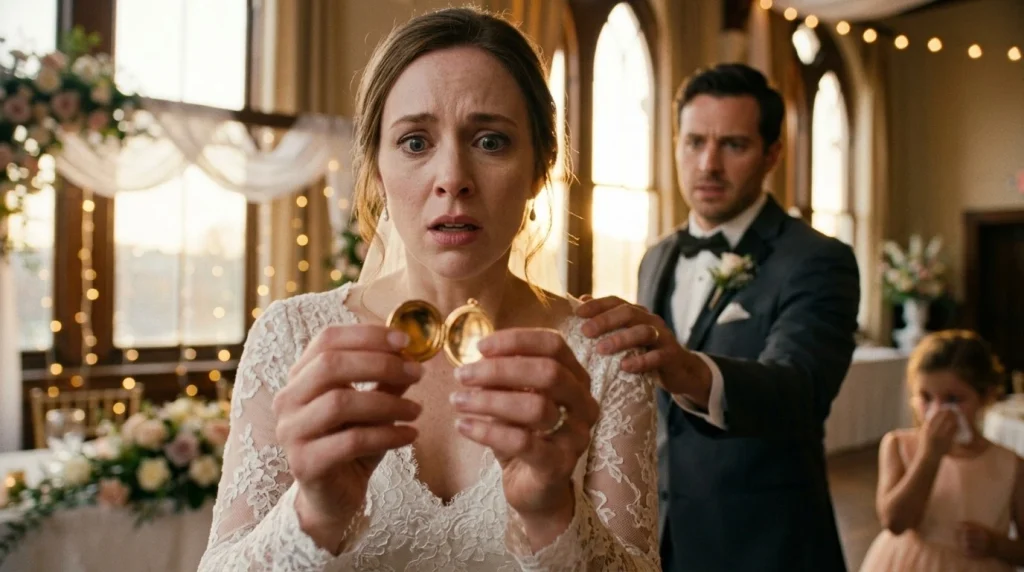

The chain snapped in Vivian’s hand.
The little girl stumbled into the wall, one palm pressed to her throat.
“What are you doing?” Daniel’s voice cut across the room.
He crossed the floor in three strides and stood between his bride and the crying child.
Vivian held up the broken locket, her whole arm shaking.
“She stole it.”
The girl shook her head hard enough to loosen the flowers pinned in her hair.
“I didn’t.”
“It was my mother’s.” Vivian’s voice cracked down the middle. “It was my mother’s.”
Daniel crouched in front of the girl, keeping his back to Vivian like a wall.
“Lily. How did you get this?”
Lily stared at the floor.
Her lips trembled before the words came out.
“She gave it to me.”
The room went quiet enough to hear the string quartet still tuning in the next hall.
Daniel turned back to Vivian slowly.
“Your mother died.”
Vivian stopped breathing.
Lily looked down at the locket sitting in her open palm like it had teeth.
Then she whispered, “You have to open it.”
Vivian’s fingers shook so badly it took her three tries to find the latch.
The locket opened.
Whatever was inside drained every ounce of anger from her face in under a second.
Her skin went the color of the tablecloths.
“Where did you see her?” Vivian whispered.
Lily didn’t answer.
Not right away.
She looked at Vivian the way a kid looks at a stove someone just told her was hot.
Daniel stepped closer.
“What’s inside?”
Vivian snapped the locket shut. Too fast, too hard, the hinge clicking like a gunshot in the quiet room.
“Nothing.”
“That was not nothing, Viv.”
Lily wiped her face with both hands, smearing her eyeliner sideways.
“She told me you’d be angry.”
Vivian’s breath caught somewhere in her throat.
“Who told you?”
Lily glanced past her, toward the hallway where half the wedding party was now frozen mid-conversation, champagne flutes forgotten in their hands.
“She said not to tell anyone until you opened it.”
Vivian took one slow step forward, the beading on her dress hissing against the floor.
“Where. Did you see her.”
Lily’s eyes filled again.
“At the bus station.”
Vivian shook her head like she could shake the sentence out of the air.
“No.”
Daniel put a hand on her arm and she pulled away from him without looking.
“My mother was buried eleven years ago.”
Lily’s face folded into confusion, then fear.
“But she knew your name. She knew everything about you. She knew about the dress.”
Vivian went rigid.
Nobody in that room had seen the dress except the seamstress, Vivian, and — she realized with a cold drop in her stomach — the one person who’d insisted on choosing the fabric.
Her father’s wife.
Diane.
Lily reached into the pocket sewn into her flower-girl dress.
“I have something else.”
Her small hand closed around something Vivian couldn’t see.
“What?” Vivian’s voice had gone to a whisper.
Lily looked up at her, and for a seven-year-old, her eyes were suddenly very old.
“Proof she’s still alive.”
She held out a folded photograph, corners soft from being carried too long in a small pocket.
Vivian took it with both hands because one wasn’t steady enough.
A woman stood at what looked like a gas station counter, holding up a newspaper toward the camera the way people do in kidnapping movies to prove a date.
Vivian recognized the newspaper masthead. Recognized the date. Six days ago.
She recognized the woman’s face more than she wanted to.
It was her mother’s face, aged eleven years, but unmistakably, impossibly her mother’s face.
“Oh my God.” Daniel had leaned over her shoulder and gone pale himself. “Viv, that’s—”
“I know who that is.” Vivian’s voice barely made it out of her chest.
The string quartet had stopped playing.
She hadn’t noticed when.
Twenty minutes earlier, before any of this happened, Vivian had been standing in the bridal suite while her stepmother Diane fastened the back of her veil.
“Nervous?” Diane had asked, smoothing invisible wrinkles from Vivian’s shoulders.
“Not about Daniel.”
Diane’s hands had stilled for half a second, then continued.
“Your father will walk you down in ten minutes. Try to look happy about it.”
“I am happy.”
“You don’t look it.”
Vivian had caught Diane’s eyes in the mirror and something in them — some flicker of calculation — made her skin prickle, though she couldn’t have said why.
She hadn’t thought about it again.
Not until the photograph in her hands started rearranging every memory she had of the last eleven years.
“Someone needs to explain this to me.” Daniel’s voice had dropped into the register he used when he meant it. “Right now.”
Vivian looked at Lily.
“Where exactly did you meet this woman?”
“The bus station on Fifth. Two days ago. My mom does flowers for weddings and my mom was picking up the arrangements and the lady just — she came up to me. She knew my dress size for today. She knew I’d be the flower girl before my mom even told her.”
Vivian’s stomach turned over.
“What did she look like? Besides — besides the photo.”
“Tired. She kept looking over her shoulder like somebody was gonna grab her.” Lily hesitated. “She said if I gave this to you and you got scared, I should tell you one more thing.”
“What.”
Lily swallowed.
“She said, ‘Tell her the accident wasn’t real. Tell her to ask her father about the second death certificate.'”
The room, which had already gone quiet, went to a kind of silence that had weight to it.
Vivian’s father chose that exact moment to walk through the double doors in his tuxedo, smiling the practiced smile of a man who owned three companies and one very large ego.
“What’s taking so — ” Richard Ashford stopped mid-sentence when he saw his daughter’s face.
He saw the locket in her hand.
He saw the photograph.
And for one unguarded second, before he rebuilt his expression into something calm, Vivian saw real fear cross her father’s face.
“Dad.” Her voice had gone flat and cold. “What is a second death certificate?”
Richard Ashford had spent thirty years building a reputation for never flinching in a negotiation.
He didn’t flinch now, but his jaw worked once, twice, like he was chewing on a decision.
“Vivian, sweetheart, whatever this is, it’s not the time—”
“You told me she drowned. You told me they found her car at the bottom of Miller’s Creek. You told me there was nothing left to bury so we buried an empty box.”
“Because that’s what happened.”
“Then why does a seven-year-old have a photo of her taken six days ago holding a newspaper with today’s date on the front page?”
The guests near the doorway had started to edge closer, phones lowering from where people had been filming the ceremony prep, curiosity winning over politeness.
Diane appeared behind Richard, still holding a champagne flute, her face arranging itself into concern a half second too late to be convincing.
“Vivian, honey, is everything—”
“Did you know?” Vivian turned on her. “Did you know my mother was alive this whole time?”
Diane’s champagne glass trembled just slightly.
“That is an insane question.”
“Is it?”
Daniel stepped in, keeping his voice level in a way Vivian was grateful for because her own voice had stopped working correctly.
“Mr. Ashford. Someone needs to explain, right now, why there might be two death certificates for Eleanor Ashford.”
Richard’s eyes cut toward the guests gathering in the doorway.
“Not here.”
“Here,” Vivian said. “Now. In front of everyone, since apparently everyone but me already knew something.”
They moved it to the small side room off the main hall, the one meant for the bride and groom to catch their breath between ceremony and reception.
Richard shut the door.
Diane stood near the window, arms crossed too tightly.
Lily had been ushered off gently by her mother, the florist, who looked nearly as shaken as Vivian felt.
“Talk,” Vivian said.
Richard sat down heavily in a velvet chair that suddenly seemed too small for him.
“Your mother didn’t drown.”
Vivian’s knees nearly gave out. Daniel caught her elbow.
“She left. Eleven years ago. She left both of us.”
“That’s not what you told me.”
“Because the truth was worse for a sixteen-year-old to hear than a clean tragedy.”
“The truth was that my mother was alive and you let me grieve her for eleven years?”
Richard’s face hardened.
“She was going to take you from me, Vivian. She’d hired a lawyer. She had documents. She was going to expose—”
He stopped himself.
Too late.
“Expose what?” Daniel asked quietly.
Richard’s mouth closed like a door.
Diane spoke instead, too fast, the way people talk when they’re trying to fill a silence before someone else fills it worse.
“It doesn’t matter now. It was a business dispute. Your mother was unstable, Vivian, she was making accusations that weren’t—”
“What accusations.”
Nobody answered.
Vivian looked between her father’s frozen face and her stepmother’s overly bright one, and something clicked into place with the sick certainty of a key turning in a lock she hadn’t known existed.
“You paid someone,” she said slowly. “You paid someone to say she was dead. And you paid someone else to make sure she stayed gone.”
“That’s enough,” Richard snapped.
“Is it true?”
He didn’t answer that either, and the silence answered for him.
The knock on the door came four minutes later.
It wasn’t a guest.
It was a woman in a gray coat, flanked by a hotel security guard who looked deeply unsure about his role in whatever was happening.
“I’m sorry to interrupt,” the woman said. “I was told there was a disturbance involving a missing persons case I’ve been quietly working for the last several months.”
She held up a badge.
“Detective Marlene Ruiz. And I think,” she looked directly at Richard, “you and I have some things to discuss, Mr. Ashford.”
Vivian’s mouth went dry.
“You’ve been investigating my father?”
“I’ve been investigating a woman named Eleanor Voss who came to my precinct eight weeks ago claiming her identity had been legally erased by her ex-husband, using falsified medical and coroner documentation, so that he could gain full control of a family trust that required her to be deceased in order for the terms to transfer entirely to him.”
The room felt like it tilted.
“She’s alive,” Vivian whispered, and this time it wasn’t a question, it was a fact settling into her bones. “She’s actually alive.”
“She’s alive,” Detective Ruiz confirmed. “And she’s been trying to reach you for two months, Ms. Ashford, through channels that kept getting blocked. Your father’s legal team filed three restraining orders against a woman he insisted was a mentally unstable impersonator.”
Richard stood up fast enough to knock the velvet chair backward.
“This is outrageous. That woman abandoned her own daughter—”
“According to bank records we’ve already subpoenaed,” Ruiz said, calm as still water, “Eleanor Voss’s accounts were drained and closed the same month she was declared deceased. According to the coroner’s office in three counties, no death certificate under that name and date of birth exists in any official database prior to the one your legal team filed. Which means, Mr. Ashford, you filed a fraudulent certificate to accelerate an $11 million trust transfer that was contingent on your late wife’s death — except she wasn’t dead. She just stopped being allowed to prove she was alive.”
Diane had gone the color of the wallpaper.
“Richard, you told me the paperwork was clean.”
“Shut up, Diane.”
“You told me—”
“I said shut up.”
Vivian watched her father’s carefully built world come apart in real time, in a room full of wedding flowers that were starting to wilt at the edges.
“Where is she?” Vivian asked the detective. “Where is my mother right now?”
Detective Ruiz glanced toward the hallway.
“Outside. She’s been outside for the last hour. She didn’t want to come in and ruin your wedding day. She only agreed to let the little girl deliver the locket because she was terrified that if she waited any longer, you’d never believe her, or your father would find a way to bury the truth again before she got the chance.”
Vivian’s hand found the doorframe to steady herself.
“Can I see her?”
“That’s entirely up to you.”
Daniel squeezed her hand once.
“Go,” he said. “I’m not going anywhere.”
The parking lot lights had come on, throwing long orange bars across the asphalt.
A woman stood near a rental car at the edge of the lot, arms wrapped around herself, looking like she might bolt at any second.
Eleven years had changed her. Gray had crept into hair that used to be dark. Lines had settled into a face Vivian used to trace with her fingers as a child, memorizing it the way kids memorize the things they think will always be there.
“Mom?”
The word came out smaller than Vivian meant it to.
Eleanor’s face crumpled.
“I didn’t want to do it like this. I swear to you, I didn’t want your wedding day to be—”
“You’re alive.” Vivian’s voice broke completely now, the anger draining out and leaving something rawer underneath. “You’ve been alive this whole time.”
“I tried to reach you so many times. Letters got returned. Calls got blocked. Your father had lawyers on retainer whose entire job was making sure I stayed a ghost.”
“Why didn’t you fight harder?”
“I did fight.” Eleanor’s hands were shaking. “For four years I fought, until he had a judge convinced I was unstable, dangerous, obsessed with a family that had already grieved and moved on. I lost everything trying to reach you, Vivian. My name. My accounts. Eventually, almost my mind.”
“Then why now? Why today, of all days?”
Eleanor reached into her coat and pulled out a worn manila envelope, edges soft from handling.
“Because two months ago, a bank compliance officer flagged an $11 million trust disbursement scheduled to finalize the week of your wedding, contingent on my proven death. Someone needed my death to be final before that money moved permanently out of any court’s reach. I wasn’t just fighting to see you anymore. I was fighting because if I didn’t come forward before that transfer cleared, it would have been buried so deep no one could have undone it. Not even you.”
Vivian stared at the envelope like it might bite her.
“What’s in there?”
“Everything. The real coroner reports. The falsified one your father filed. Bank transfers. A sworn statement from the doctor he paid to sign off on a death that never happened.”
Vivian’s hands closed around the envelope like it was the only solid thing left in the world.
“I believed you were dead for eleven years.”
“I know.” Eleanor’s voice broke. “And I am so sorry that the only way I could prove I wasn’t was by nearly ruining the one day you were supposed to remember for the rest of your life.”
Vivian looked back toward the reception hall, lit gold through the windows, guests visible in silhouette, the wreckage of the last hour still settling behind those doors.
Then she looked at her mother.
Really looked at her, the way you look at something you were told didn’t exist anymore.
“You didn’t ruin it,” Vivian said quietly. “He did. Eleven years ago. Today’s just the day it finally caught up with him.”
Inside, Detective Ruiz had already placed a call.
By the time Vivian and Eleanor walked back through the side door, two uniformed officers were standing near the gift table, and Richard Ashford’s face had gone the color of old paper.
“Richard Ashford,” Ruiz said, stepping forward with the flat, unhurried authority of someone who had done this a hundred times, “you’re under arrest for felony fraud, forgery of a government document, and obstruction related to the falsification of a death certificate.”
“This is insane.” Richard’s voice pitched higher than Vivian had ever heard it. “Do you know who I am?”
“I know exactly who you are,” Ruiz said. “You’re the man who erased his wife’s identity to protect eleven million dollars.”
The cuffs clicked shut with a sound that carried through the entire hall.
Diane had already backed toward the door, phone pressed to her ear, whispering urgently to someone about lawyers, about getting ahead of this, about damage control — words that meant nothing anymore to anyone standing in that room.
“Diane Ashford,” Ruiz added, almost as an afterthought, “we’ll need a statement from you as well. Your name is on three of the wire transfers connected to the falsified paperwork.”
Diane’s face went white.
The champagne flute she’d been holding since the ceremony finally slipped from her fingers and shattered on the marble.
Vivian stood in the doorway of the hall in her wedding dress, watching her father get led out past tables of untouched wedding cake and wilting centerpieces, and felt something inside her chest finally unclench after eleven years of carrying a grief that had never actually needed to exist.
Daniel found her hand again.
“Are you okay?”
“I don’t know yet.” Vivian looked over at her mother, who stood a few feet away, uncertain whether she was allowed to stay or expected to go. “But I think I will be.”
She held out her free hand toward Eleanor.
“Stay. Please.”
Eleanor’s eyes filled.
“Are you sure? This is your wedding, Vivian. Not the day you should be spending in a police statement room.”
“My wedding day already happened the second Daniel walked into that room and stood between me and a little girl he’d never even met, because he wasn’t going to let anyone get hurt in front of him.” Vivian’s voice steadied for the first time in an hour. “Everything after that has just been the truth finally showing up on time.”
Lily’s mother found Vivian near the gift table an hour later, once the police cars had cleared out and the guests, stunned but oddly reverent, had quietly begun putting the reception back together out of some instinct that the day still deserved to end in something good.
“I am so sorry,” Lily’s mother said. “Eleanor found me through a mutual friend two weeks ago. She begged me to help her get that locket to you today, in whatever way I could. I didn’t know it would turn into all of this. I would never have put Lily in the middle of something like that if I’d known.”
Vivian crouched down to where Lily was sitting on a folding chair, still visibly shaken, clutching a cup of lemonade someone had given her.
“Hey.”
Lily looked up warily.
“Am I in trouble?”
“No.” Vivian’s voice cracked. “You did something incredibly brave today. Braver than most adults I know.”
“She just seemed really scared,” Lily said quietly. “The lady at the bus station. She kept saying it was the only way you’d believe her.”
“She was right.” Vivian took the girl’s small hand. “Thank you.”
The reception ended up happening after all, hours later than planned, smaller than planned, but somehow more honest than the version that had been scheduled that morning.
Eleanor sat at the family table, still in her travel clothes, still looking like she half expected someone to tell her she had to leave.
Vivian raised her glass toward her mother from across the room, and for the first time in eleven years, Eleanor Voss raised a glass back to her daughter without anyone stopping her.
Three months later, Richard Ashford pleaded guilty to fraud and forgery charges rather than risk trial, in exchange for a reduced sentence that still kept him behind bars for the next several years. Diane testified against him in return for immunity on the wire transfer charges, though she lost her house, her accounts, and every friend who’d once called her generous at charity galas that had, it turned out, been funded by money that was never legally hers to give away.
The $11 million trust, once the entire motive behind erasing a living woman from her own life, was released in full to its rightful, very much alive beneficiary.
Eleanor used a portion of it to help other women trapped in cases exactly like her own — women who’d been declared unstable, unreliable, or simply gone, by men with better lawyers and worse consciences.
Vivian kept the locket.
The chain had been repaired the week after the wedding, and she wore it every single day, the photograph of her mother holding a newspaper still folded carefully behind the small oval frame where a different photo used to sit.
Sometimes, at dinner, Daniel would catch her touching it without realizing she was doing it, and he’d reach over and take her other hand instead, and she’d smile, because for the first time in eleven years, there was nothing left to grieve.
Just a mother back at the table.
A father finally where he belonged.
And a little girl in a flower dress who’d been braver, that one afternoon, than anyone twice her age.
END.
Original fictional stories. AI-assisted creative content.