
The wheelchair tipped before anyone screamed.
One front wheel caught the edge of the boutique carpet. The elderly woman’s body jerked forward. Her worn brown coat slid off one shoulder as the manager shoved the chair toward the exit.
For one horrible second, she was falling.
Then a young worker in a blue uniform lunged across the marble floor. He caught the chair with both hands.
The whole store went silent.
Diamonds glittered behind glass cases. Rich customers turned to stare. The manager’s face tightened into a hard, painted smile.
“Do not touch her.”
The young man ignored her.
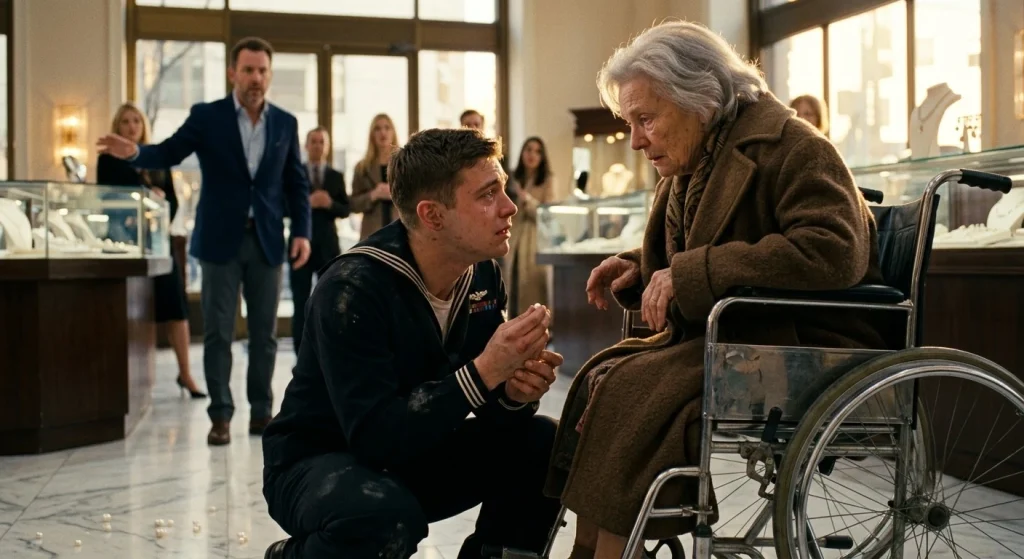
He dropped to one knee in front of the old woman, breath shaking, checking her hands, her knees, the fear still trapped in her eyes.
“Are you okay?”
She tried to answer.
But the pearl necklace around her throat snapped.
Pearls scattered across the marble like tiny white tears.
No one bent down.
Only he did.
One by one, he picked them up with dirty, trembling hands while the manager rolled her eyes.
The old woman watched him closely. Then whispered, “No one else bent down.”
The manager reached for the wheelchair handle again.
This time, the old woman raised one frail hand and stopped her.
A pearl rolled against the young worker’s shoe. He picked it up.
It split open in his palm.
Inside was a tiny gold key.
The manager froze. Her voice became a whisper. “The vault key.”
The young worker looked from the key to the locked private showroom door. Then back at the woman.
“Who are you?”
The elderly woman’s tears caught the chandelier light. Her smile was suddenly steady.
“I came to choose the next owner.”
The manager stepped back like the gold key had turned into a weapon.
“You can’t be serious.”
The elderly woman rolled her chair slowly toward the private showroom door. The young worker walked beside her, the pearls cupped carefully in both hands.
“I am very serious,” she said.
Her voice was soft. That made the room listen harder.
The manager’s polished smile cracked. “Ma’am, he is floor staff.”
The elderly woman stopped.
“No.”
She turned her head.
“He is the only person in this store who still remembered the floor existed.”
The customers looked down at the marble, ashamed.
The young worker swallowed hard. “I don’t understand.”
The old woman lifted the broken necklace from her lap.
“My husband made this necklace the year we opened our first shop. We were poor. There were no diamonds then. Only fake pearls, borrowed lights, and a promise.”
Her fingers closed around the hidden key.
“He told me, if this business ever becomes too rich to kneel for someone, give it to the person who still can.”
The young worker’s eyes filled.
The manager whispered, “I’ve worked here twelve years.”
The elderly woman looked at her.
“And in twelve seconds, you nearly threw me from my chair.”
No one moved. The security camera blinked above them.
The old woman turned the key in the showroom lock.
Click.
Behind the door were not jewels.
There were old photographs. A street stall. A young couple smiling beside a tiny glass case. A wall covered in handwritten employee names.
The elderly woman looked at the young worker.
“What is your name?”
“Mateo,” he whispered.
She smiled. “There is a place for it.”
The manager’s face collapsed. “Please. I didn’t know it was you.”
The old woman looked at the scattered pearls still shining on the marble.
“That was never the test.”
Mateo stood there with wet eyes, still holding every pearl he had picked up for a stranger.
The old woman took one pearl from his hand and pressed it into his palm.
“Diamonds show what people can buy,” she whispered. Then she looked around the store. “Pearls show what pain can become when someone protects it.”
Mateo began to cry.
The store did not open the next morning.
A hand-written sign hung on the glass door: CLOSED FOR PRIVATE INVENTORY.
Inside, Mateo sat across from a lawyer he had never met, in the private showroom that still smelled like old paper and cedar. The elderly woman sat beside him, her hands folded over the broken necklace in her lap.
The lawyer opened a leather folder.
“My name is Harold Voss. I represent the estate of Eleanor Whitfield.” He looked at Mateo. “You have no idea who she is, do you.”
“No, sir.”
Eleanor answered for him. “Good. That’s why I chose him.”
Harold slid a document across the table.
“This store — Whitfield & Cole Fine Jewelers — has operated under corporate management for six years. Since my husband passed.”
Mateo’s mouth went dry. “The company that owns this whole building?”
“I own the company,” Eleanor said quietly. “I simply stopped visiting. I let them believe otherwise.”
Harold tapped the page. “Mrs. Whitfield has spent the last four months visiting every location under this name. Unannounced. In the chair.”
Mateo’s eyes widened. “You did this on purpose. The fall—”
“I did not fake the fall,” Eleanor said sharply. “The floor is uneven by the entrance. I have complained about it in writing for a year. No one repaired it because no one believed an old woman in a wheelchair mattered enough to fix a carpet edge.”
Her voice cracked, just slightly.
“But I have learned more about my own company by almost falling in it than I ever learned sitting behind a desk.”
Mateo looked down at the pearl still in his pocket.
“What happens now?”
Harold answered. “Now we talk about the manager.”
Her name was Deborah Ashcroft. Twelve years at Whitfield & Cole. Regional manager for three locations.
By the time Harold finished reading the incident report aloud, Mateo understood two things had happened in that store, not one.
An old woman had nearly been hurt.
And someone had been quietly stealing from her for a long time.
“Six months ago,” Harold said, “inventory audits at this location began showing discrepancies. Small ones. A missing bracelet here. A ‘damaged’ pendant written off there. Never enough to trigger a formal investigation. Just enough to add up.”
He slid a second folder across the table.
“Two hundred and eleven thousand dollars. Over three years.”
Mateo stared at the number.
Eleanor’s jaw tightened. “I suspected Deborah for a year. I could never prove it. She was careful.”
“So today wasn’t only about the wheelchair,” Mateo said slowly.
“No,” Eleanor admitted. “Today I came to catch a thief. I did not expect to also find a witness.”
“Me?”
“You didn’t hesitate,” she said. “Everyone else in that room did the math before they moved. You didn’t do math. You moved.”
Harold closed the folder. “That kind of instinct can’t be trained into a manager. It can only be recognized.”
Mateo sat back, his head spinning. “You’re saying you want me to run this store.”
“I’m saying,” Eleanor said, “that tomorrow morning, Deborah Ashcroft will be escorted from this building by store security, and you will be standing at the front desk when it happens.”
Mateo did not sleep that night.
He lay on the thin mattress in the one-bedroom apartment he shared with his mother, staring at the water stain shaped like a country he’d never visited.
In the next room, his mother coughed — the same dry, rattling cough she’d had for eight months, the one the free clinic called “manageable” because manageable was cheaper than treatable.
He had taken the boutique job because it paid two dollars more an hour than the warehouse. He had never once imagined that a woman in a wheelchair would change his life in the time it took a necklace to break.
At 3 a.m., his phone buzzed.
A text from an unknown number.
DEBORAH: I know it was you who told her about the audit gaps. You’re going to regret this.
Mateo sat up in the dark.
He had never spoken to Eleanor about any audit. He hadn’t even known there was one until that afternoon.
Someone inside the company had leaked his name to Deborah already.
He typed back with shaking hands.
MATEO: I don’t know what you’re talking about.
DEBORAH: Cute. Enjoy your promotion. It won’t last the week.
He didn’t sleep after that.
The next morning, Mateo arrived forty minutes early.
Deborah was already there, standing behind the register in a navy blazer, lipstick perfect, eyes hard as glass.
“You couldn’t wait to take my job,” she said, not looking up from the register drawer.
“I didn’t take anything.”
“You picked up some pearls and suddenly you’re the golden boy.” She slammed the drawer shut. “Do you know how many years I gave this place?”
“Twelve,” Mateo said quietly. “I heard.”
“Twelve years of double shifts. Twelve years of smiling at people who think diamonds make them better than the person selling them.” Her voice shook. “And an old woman in a wheelchair walks in and decides she likes your face better than my resume.”
“She didn’t fire you for your resume.”
Deborah’s eyes snapped to his. “Excuse me?”
Mateo’s heart pounded, but he made himself keep his voice level.
“Two hundred and eleven thousand dollars, Deborah. Over three years.”
The color drained from her face.
“You don’t know what you’re talking about.”
“I know what Harold Voss read out loud in that room last night,” Mateo said. “And I know you texted me at three in the morning threatening me for something I didn’t even know existed until you just confirmed it.”
Deborah’s mouth opened. Nothing came out.
Behind them, the front door chimed.
Two uniformed security officers stepped inside, followed by Harold Voss, followed by Eleanor, wheeled in by a different aide this time, her spine straight, her eyes locked on Deborah like a closing door.
“Ms. Ashcroft,” Harold said. “We need you to come with us.”
Deborah did not go quietly.
“This is insane,” she snapped, backing toward the counter. “You’re going to believe him over me? He’s been here eight months. I built this branch.”
“You built a hole in this branch’s inventory,” Harold said. He held up a printed page. “Camera footage from the private vault access, three separate nights, all after closing, all logged under your employee code.”
Deborah’s face went white, then red.
“That footage was corrupted. IT told me—”
“IT works for me,” Eleanor said quietly. “Not for you.”
The room went cold.
Deborah’s eyes darted to Mateo, desperate now. “You don’t understand what it’s like. Twelve years, and they still see me as replaceable staff, not family. You think that old woman actually cares about you? You’re a prop for her guilty conscience.”
“Maybe,” Mateo said. “But I never stole from her.”
Deborah lunged — not at Mateo, but at the register, punching in a code with shaking fingers, trying to void a transaction, trying to erase something on the screen.
One of the security officers stepped forward and gently took her hand off the keyboard.
“Ma’am. Don’t make this worse.”
Deborah’s shoulders finally dropped. The fight went out of her all at once, like a string cut.
“I have a daughter in college,” she whispered. “I have a mortgage.”
“You had two hundred and eleven thousand reasons to think about that three years ago,” Harold said, not unkindly. “The company isn’t pressing criminal charges today. That decision is still being discussed. But you are terminated, effective immediately, and you are not to return to any Whitfield and Cole location.”
Deborah looked at Eleanor one last time.
“I hope he disappoints you,” she said. “The way everyone eventually does.”
Eleanor met her eyes without flinching.
“He already surprised me. That’s more than you ever did.”
Security walked Deborah out through the front doors, past the uneven carpet edge that had started all of it, into the gray morning light.
Mateo watched her go, feeling sick and relieved in the same breath.
By noon, the story was already moving faster than any of them could control.
A customer who had been in the boutique the day before had posted a shaky video online — Mateo catching the wheelchair, the pearls scattering, the manager’s cold voice saying do not touch her. Someone had captioned it: “Store manager tried to throw out an elderly customer. A cashier didn’t let her.”
By evening it had four hundred thousand views.
By the next morning, local news vans were parked outside the boutique.
Eleanor watched the coverage from her townhouse, sitting very still in her chair, the broken necklace resting in a small velvet box on the table beside her.
“They’re calling you a hero,” she told Mateo over the phone. “Reporters are asking for interviews.”
“I don’t want interviews,” Mateo said. “I want my mom to see a real doctor before this cough turns into something worse.”
There was a pause on the line.
“Then that,” Eleanor said, “is exactly what we will do first.”
Two days later, Mateo’s mother, Rosa, sat in an examination room at a private clinic that would have cost more than a month of Mateo’s old paycheck for a single visit.
The doctor came out holding a folder, and for one terrifying second Mateo braced for the worst.
“It’s a chronic bronchial infection,” the doctor said. “Untreated for too long, which made it look scarier than it needed to be. With the right medication, she’ll be fine within a few weeks.”
Rosa began to cry with relief. Mateo held her hand and said nothing, because his throat had closed around every word he owned.
Outside in the hallway, Eleanor waited in her chair.
“You didn’t have to do this,” Mateo said, his voice rough.
“I know,” Eleanor said. “That’s usually when it matters most.”
The company held a press conference the following week — not about Deborah, but about Eleanor, and the decision she had been quietly preparing for months before the wheelchair ever tipped.
Reporters packed into the main boutique, cameras aimed at a small podium set up near the private showroom door, the one that had opened onto old photographs and a wall of handwritten names.
Harold Voss stood beside Eleanor’s chair, reading from a prepared statement, though everyone in the room could tell Eleanor had written every word of it herself.
“Six years ago, after the death of my husband, I made a choice that I now regret,” Eleanor said, her voice carrying clearly through the microphone. “I stepped back from the company we built together. I let corporate management run stores I no longer visited, because grief made it easier to stay away than to walk back into a place full of his memory.”
She paused, looking down at the necklace box in her lap.
“In that absence, some people forgot what this company was built on. It was not built on marble floors or chandeliers. It was built on a folding table in a market, and a promise that no one who worked for us would ever be invisible.”
Her eyes lifted to the crowd, and then to Mateo, standing quietly near the counter in a uniform that no longer quite fit what he was about to become.
“Effective today, I am transferring operational ownership of this flagship location to Mateo Reyes, who has worked here for eight months as a sales associate. He will also join the board overseeing all fourteen Whitfield and Cole locations, representing the interests of frontline staff — a position that, frankly, should have existed years ago.”
The room erupted in questions, but Eleanor raised one hand, and just as it had in the boutique days earlier, the room went quiet for her.
“People will ask why I chose a stranger over experienced management,” she said. “I did not choose a stranger. I chose the only person in that store who still remembered why we started.”
The months that followed were not easy.
Mateo learned inventory systems late into the night, using textbooks Harold’s office sent over, while Rosa, healthier now, made him coffee and reminded him to eat.
Some employees resented him at first — a former sales associate now signing their schedules. A few quit. Most stayed, and slowly, something in the store began to change. The uneven carpet edge by the entrance was the first thing replaced. Mateo made sure of that personally, standing over the contractor himself.
He also did something no manager had done in six years: he asked every employee to write down one thing about their job that made them feel invisible. He read every single response. He fixed what he could.
Deborah Ashcroft was never criminally charged — Eleanor decided, in the end, that public exposure and the loss of everything she had built her identity around was consequence enough. But word travels fast in the industry. No jewelry company in the state would hire her again. Her daughter’s college fund, the one she’d claimed to be protecting, ran out within the year, and she was last seen managing a discount outlet two towns over, far from any chandelier.
One year to the day after the wheelchair had tipped, Eleanor returned to the boutique.
Mateo met her at the door, no longer in a blue uniform, but in a simple gray suit that still somehow looked like it belonged to someone who remembered kneeling.
“The carpet’s fixed,” he said, nodding toward the entrance.
“I noticed,” Eleanor said, smiling.
He wheeled her personally toward the private showroom, the one that now held not just old photographs, but a small new frame beside them — a photo from the press conference, Mateo kneeling beside her chair, the broken pearls between them.
“I want to show you something,” Mateo said.
He opened the showroom door.
Where the old handwritten wall of employee names had been, there was now a new addition — a small brass plaque, freshly installed, engraved with a single line beneath dozens of names collected over decades.
“For those who still remember the floor exists.”
Eleanor read it slowly, her hand trembling slightly against the arm of her chair.
“Your husband started this wall,” Mateo said quietly. “I thought it deserved an ending that matched the beginning.”
Eleanor reached into her coat pocket and pulled out the small velvet box — the one holding the pearl she had given him that very first day.
“Keep this pearl somewhere you can see it,” she said, pressing it into his palm again, exactly the way she had a year ago. “Diamonds will always be for sale in this store, Mateo. Pearls are not. Pearls are for people who already understand what this business is supposed to be.”
Mateo closed his hand around it.
Outside, through the boutique windows, late afternoon light spilled gold across the marble — the same marble where pearls had once scattered like tears, where a woman had once been pushed toward the exit by someone who mistook power for permission.
Now the floor held something else entirely: a store that finally belonged to someone who knew how to kneel, and a promise, kept, thirty years after it was first made.
Original fictional stories. AI-assisted creative content.