
The gavel hadn’t even fallen yet when the boy stood up.
He was small in that courtroom, swallowed by the tall wooden benches, but his voice carried anyway.
“Stop! It wasn’t her!”
Every head in the gallery turned.
At the center of the room, the young maid froze in her plain black uniform, tears already sliding down her face. She looked like breathing hurt.
The boy’s hand shot out, trembling, pointing straight at her.
“I saw everything!” he cried. “She was protecting me!”
A ripple of shock moved through the gallery. Someone gasped. A woman near the back covered her mouth.
The maid’s composure collapsed. She pressed both hands to her lips, sobbing, already begging him with her eyes to stop.
“Please… don’t,” she whispered.
But it was too late. The truth was already moving.
A man in a dark, expensive suit lunged from his seat and grabbed the boy’s arm.
“Sit down. Now.”
The boy flinched but didn’t stop fighting him.
“No!” he shouted, twisting against the grip. “She didn’t do it!”
The man’s fingers dug in harder, trying to force the boy’s arm down, trying to drag the moment back under his control.
“Enough, Noah.”
The boy wrenched free just enough to point again, tears burning down his cheeks.
“You’re punishing the wrong person!”
The maid was crying openly now, shaking where she stood. The whole room stared between the child and the man trying to silence him.
Noah looked at her one more time. His voice dropped, cracking.
“You saved me.”
The room went cold.
Even the man’s face flickered, just for a second, with something close to panic.
Then Noah turned to face the whole courtroom and shouted with everything he had left.
“The guilty one is in this room!”
The spectators recoiled.
The maid stared at him in horror.
The man lunged again, but Noah twisted free, raised his arm, and pointed with wide, certain eyes.
“It was—”
“Him!”
His finger locked on Richard Bennett.
The courtroom went dead silent.
For one terrible second nobody moved. Richard’s hand hung half-raised in the air, frozen mid-grab, his face draining of color.
The maid’s sob caught in her throat.
Noah stumbled back a step, breathing hard, but he didn’t lower his arm.
“He pushed her,” he said, voice shaking. “She tried to stop him from hurting me.”
A murmur broke through the gallery, spectators leaning forward, trying to process what they’d just heard.
Richard forced a smile that looked ugly and thin.
“He’s confused,” he snapped. “He’s a frightened child.”
Noah’s eyes filled more.
“I’m not confused.”
He reached into his pocket with shaking fingers and pulled out a small, dark, polished button.
It trembled between his fingertips.
“It came off when he grabbed me.”
Every eye in the room dropped to Richard’s suit jacket.
One button was missing from the cuff.
The maid — Marisol Reyes — pressed both hands over her mouth again, sobbing harder, because the truth she’d tried to bury to protect herself was standing in the middle of the room now, and it wasn’t going back in the ground.
Richard took a step backward.
Noah looked at her, devastated.
“She told me to run,” he said. “She said if I stayed, he’d hurt me too.”
That single sentence destroyed the room.
Marisol folded into herself. The spectators stared at Richard with rising horror. Whatever power he’d walked in with was gone, stripped away by an eight-year-old who had decided fear weighed less than the truth.
Judge Harmon leaned forward sharply, gavel still in hand but forgotten.
“Bailiff. Secure Mr. Bennett.”
“This is outrageous,” Richard said, his voice climbing. “He’s a child, Your Honor, he doesn’t understand—”
“Sit down, Mr. Bennett.”
For the first time since she’d been dragged to the center of that courtroom, Marisol wasn’t standing there alone.
Noah looked at her through his tears and said the one thing she never expected anyone to give her.
“I won’t let them blame you anymore.”
Recess was called eleven minutes later. It felt like eleven years.
Marisol sat in a hallway chair outside the courtroom, hands still shaking, a public defender crouched in front of her.
“You should have told me,” the lawyer said quietly. “About the button. About the boy.”
“I told you he wasn’t lying,” Marisol whispered. “I told you Richard hurt him. You said it was my word against a man with three lawyers.”
“It still might be.”
“Then why did that little boy just stand up in front of a judge?”
The lawyer didn’t have an answer.
Down the hall, Richard Bennett stood with his own attorneys in a tight, hissing circle.
“Fix this,” he said. “Now.”
“Richard, a child just accused you of assault in open court. There were forty witnesses.”
“He’s eight. He’s traumatized. Nobody’s going to take a hysterical kid’s word over mine.”
“They already are.”
Richard’s jaw tightened. His eyes cut down the hallway to where Noah sat wrapped in a blanket someone had draped over his shoulders, a victim’s advocate crouched beside him.
“Get me five minutes with the boy.”
“Absolutely not.”
Six months earlier, Marisol Reyes had walked into the Bennett estate with a single suitcase and a letter of reference from an agency that specialized in placing live-in household staff with grieving families.
The Bennetts had buried both of Noah’s parents eight months before that — a car accident on a rain-slicked overpass — and Richard, the boy’s uncle, had stepped in as legal guardian and trustee of an inheritance that made most people in that town’s eyes go a little glassy when they said the number out loud.
“He doesn’t talk much,” Richard had told her at the interview, sitting behind a desk twice the size he needed. “Lost his parents. You’ll manage the house, cook, keep an eye on him after school. Simple.”
“I understand grief, Mr. Bennett,” Marisol had said. “I lost my own mother young.”
“Good. Then you’ll know not to coddle him.”
She should have heard the warning in that sentence. She didn’t, not yet.
The first month, Noah barely spoke to her. He ate in silence, did his homework in silence, went to bed in silence. She left a plate of pan dulce on his desk one afternoon without a word, and the next morning the plate was empty and there was a drawing left in its place — a stick-figure woman and a stick-figure boy, standing in a kitchen.
“You made it warmer,” he told her, not looking up from his cereal. “The house. It’s warmer now.”
That was the first real thing he ever said to her.
The bruises started in month three.
Small ones, at first. A fingerprint-shaped mark on his upper arm that he said was from falling off his bike. A red mark along his jaw he said was from a dodgeball at school.
Marisol noticed. Marisol always noticed. It was the kind of noticing that came from growing up in a house with a stepfather whose moods you learned to read before he even opened his mouth.
“Noah,” she said one night, kneeling in front of him as she checked his homework. “Did somebody hurt you?”
His eyes went somewhere far away.
“No,” he said. Too fast.
“You can tell me. I promise I won’t let anything happen to you.”
He looked at her for a long moment, like he was weighing whether that promise was one adults actually kept.
“Uncle Richard gets mad sometimes,” he finally whispered. “About the money. About the trust. He says I owe him for taking care of me.”
Marisol’s stomach turned to ice.
“What does he do when he gets mad?”
Noah’s chin trembled.
“Please don’t tell him I said anything.”
“I won’t,” she said. “I promise.”
She started documenting everything that night — dates, marks, the things Noah let slip in unguarded moments. She didn’t know yet what she’d do with it. She just knew she couldn’t unknow it.
The night everything broke open was a Tuesday.
Marisol heard raised voices from Richard’s study and found the door half open. Noah was pressed against the bookshelf, and Richard had him by the collar, shouting about a school form that required a guardian’s signature releasing information about the trust fund’s disbursement schedule.
“You don’t ask questions about that money,” Richard snarled. “You understand me? Not to teachers, not to lawyers, not to anybody.”
“You’re hurting me,” Noah gasped.
“Richard, stop!” Marisol rushed in, grabbing his arm, trying to pull him back. “He’s a child!”
Richard rounded on her, his face contorted.
“Get out of my house.”
“Not until you let him go.”
He shoved her — hard, both hands — and she stumbled back into a side table, knocking a lamp to the floor. In the chaos, her hand caught the cuff of his jacket, and something small snapped free and skittered across the hardwood.
“Run, Noah,” Marisol said, scrambling back to her feet, putting her body between the boy and his uncle. “Go to your room. Lock the door. Now.”
Noah ran.
Richard turned on Marisol, breathing hard, eyes wild with something that looked less like anger now and more like fear of being caught.
“If either of you says one word,” he said quietly, “I will make sure nobody believes either of you. I have three lawyers and a dead brother’s estate behind me. You have a green card and a paycheck.”
That was the threat that should have terrified her into silence.
It didn’t.
The next morning, Richard called the police himself.
He told them his housekeeper had attacked him in a fit of rage, that she’d threatened him, that his young nephew — traumatized and confused after losing his parents — had witnessed the altercation and was too frightened to speak clearly about what happened.
It worked, at first. It always worked for men like Richard, because their version of events came wrapped in good tailoring and a trust fund’s worth of credibility.
Marisol was arrested that afternoon. Assault. Reckless endangerment of a minor, because Noah had been in the room.
“You have the right to remain silent,” the officer told her, snapping the cuffs shut.
She thought of Noah’s face in the doorway, watching them take her away, his small hands pressed flat against the glass.
For five months, the case crawled toward trial exactly the way Richard’s lawyers wanted it to. Marisol’s public defender was buried under four times the caseload any person should carry. Character witnesses for Richard lined up — teachers who barely knew him, a pastor who’d met him twice, a business partner who owed him money.
Nobody asked Noah what he saw. Not really. A court-appointed advocate interviewed him once, briefly, in a room with a two-way mirror, and Noah — coached for weeks by his uncle on what “helping” the family looked like — said almost nothing at all.
Marisol sat in a holding cell reading the same three books over and over, writing letters to a boy she wasn’t allowed to send them to, because a judge had ruled she couldn’t have contact with the minor at the center of the case.
She thought about giving up more than once. A plea deal sat on the table for months — eighteen months, reduced charges, an end to the waiting.
“Take it,” her lawyer urged her. “A jury might not believe you over him.”
“I didn’t do anything,” Marisol said.
“That’s not always the question that matters.”
She refused the deal three separate times.
What nobody in that courtroom knew — what even Marisol didn’t know until the trial was already underway — was that Noah had spent five months carrying a secret in the lining of his backpack.
The button.
He’d found it on the study floor the morning after, before the cleaning service came through, and some instinct in his eight-year-old body told him it mattered. He didn’t know why. He just knew Marisol had grabbed for that jacket right before she got hurt, and he knew his uncle had been the one to hurt her, and he knew that button was the only piece of that night that hadn’t come from either of their mouths.
He kept it wrapped in a sock in the bottom of his backpack for five months.
He didn’t tell anyone. Not his court-appointed advocate. Not his tutor. Not even the therapist his uncle had hired, because Richard sat in on half the sessions and Noah had learned, the way children in dangerous houses learn everything, exactly how much silence kept him safe.
But sitting in that courtroom gallery on the third day of trial, watching Marisol’s shoulders shake as the prosecutor — Richard’s private attorney, brought in as a “family friend” to assist — twisted her testimony into something ugly and violent, something in Noah cracked wide open.
He stood up before he decided to stand up.
His body moved before his fear caught up with it.
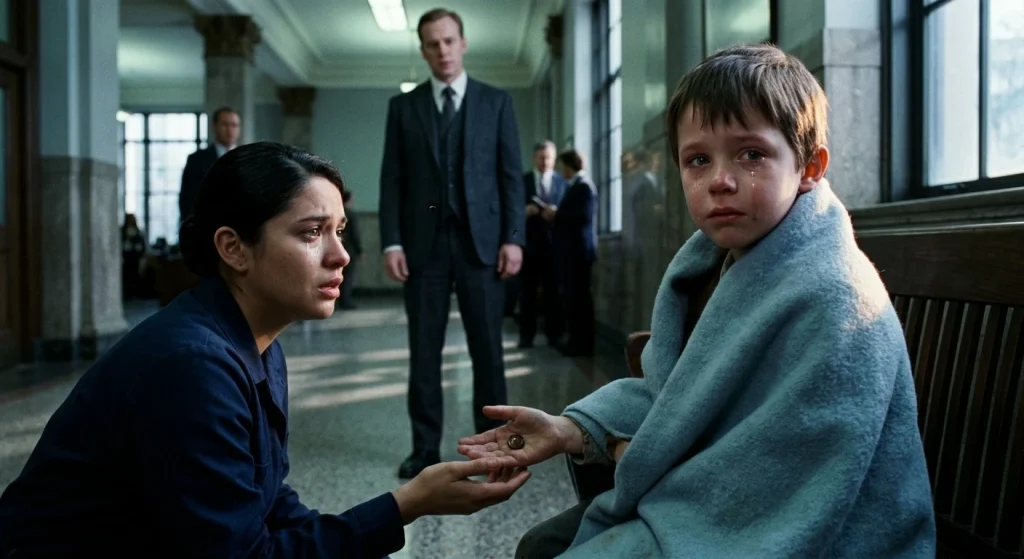
Now, in the recess hallway, that same boy sat wrapped in a scratchy blue blanket while a detective crouched in front of him with a notepad and the gentlest voice she owned.
“Noah, I need you to tell me exactly what you remember. Take your time.”
He told her everything. The bruises. The threats about the trust fund. The night in the study. The button.
The detective’s pen stopped moving halfway through.
“Where is the button now?”
Noah reached into his backpack and pulled out a small sock, unrolling it carefully like it held something sacred.
The button dropped into the detective’s gloved palm.
“I need this jacket,” she said into her radio. “The one Bennett’s wearing. Now.”
Richard’s own lawyers turned pale white when the forensic tech matched the thread pattern and the tear pattern on his cuff, under a microscope, in front of the judge, three days later.
But the button was only the beginning of what came apart.
Once the detective started pulling threads — literal and otherwise — the trust fund accounting followed. An independent auditor, appointed by the court once abuse allegations surfaced, spent two weeks going through five years of financial records.
What she found detonated the entire case.
Richard Bennett had been siphoning money from Noah’s inheritance since the month after his brother’s funeral — shell consulting fees, inflated guardian expense reimbursements, a “family business investment” that existed only on paper. Nearly nine hundred thousand dollars, gone.
The trust was set to fully transfer to Noah’s independent control at eighteen. Richard had ten more years to keep draining it — unless someone started asking questions about where the money went. Unless someone like Marisol, watching too closely, noticed too much, and had to be discredited before she could say anything to anyone who mattered.
“You didn’t attack him because he yelled at Noah,” the prosecutor said in the reconvened hearing, laying the audit report on the evidence table. “You attacked the version of events where Ms. Reyes reported what she’d seen. You needed her silenced, and a criminal record was cheaper than a lawsuit.”
Richard’s attorney objected. The judge overruled it before the words finished leaving her mouth.
The final day of the hearing, the courtroom was fuller than Marisol had ever seen it. Word had gotten out — a local reporter, then a wire service, then a headline that didn’t need embellishing because the truth already read like fiction.
Judge Harmon read the findings slowly, deliberately, letting every sentence land.
“The court finds that Richard Bennett engaged in a pattern of physical abuse against the minor, Noah Bennett, and that Marisol Reyes’s actions on the night in question constituted protective intervention, not assault. All charges against Ms. Reyes are dismissed with prejudice.”
The gallery erupted — not with the shocked gasps of the first day, but with something closer to relief breaking loose all at once.
Marisol’s knees nearly gave out. Her lawyer caught her arm.
“Additionally,” the judge continued, voice hardening, “given the findings of financial exploitation by Mr. Bennett as trustee, this court is referring the matter for immediate criminal prosecution on charges of embezzlement, child endangerment, and obstruction of justice. Mr. Bennett’s guardianship of the minor is revoked, effective immediately.”
Richard sat frozen, his lawyers whispering urgently on either side of him, but there was nothing left for them to whisper him out of.
Two bailiffs stepped forward.
“Richard Bennett, you’re under arrest.”
The cuffs that closed around his wrists made a sound Marisol would remember for the rest of her life — quiet, metallic, final.
He didn’t look at Noah as they led him out.
Noah didn’t look away from him, either. He watched every step, chin up, until the door closed behind his uncle for good.
Outside the courthouse, the January air was sharp and clean, and for the first time in five months, Marisol felt like she could actually breathe it.
Noah’s grandmother — Richard’s estranged mother-in-law, who’d fought her own losing battle for custody months earlier and lost to Richard’s lawyers and his money — was there on the steps, arms already open.
But Noah stopped in front of Marisol first.
“Are you allowed to come see me?” he asked, small and uncertain, like he was afraid the answer might be another rule stacked against him.
Marisol crouched down to his eye level, the way she used to when she checked his homework.
“Try and stop me,” she said.
He threw his arms around her neck so hard it nearly knocked her over, and this time neither of them tried to hold back the crying.
“I told them,” he whispered into her shoulder. “I told them it wasn’t you.”
“I know, mijo,” she whispered back. “I know. You saved me right back.”
Behind them, a photographer from the local paper caught the moment — a small boy in a rumpled blazer, holding on tight to the woman he’d nearly lost, both of them finally, completely safe.
The headline the next morning read simply: JUSTICE, DELAYED BUT DELIVERED. Richard Bennett’s booking photo ran beside it, stripped of every ounce of the polish that had gotten him this far.
He didn’t get another five months this time. He got twelve years.
Marisol got her name back, a public apology from the county, and a standing invitation — signed by a judge who rarely got emotional in her own courtroom — to visit Noah for as long as he wanted her in his life.
He wanted her in it for good.
END.
Original fictional stories. AI-assisted creative content.