
Emily Carter had been on her feet for six hours when he walked in.
She noticed him right away — the torn brown jacket, the trembling hands, the hollow eyes scanning the room like a man bracing for someone to tell him to leave. The other customers noticed him too. Just not in the way he needed.
“Can you believe they let that in here?” a man in a pressed suit muttered to his wife.
A woman near the window shifted her purse to her lap without looking up.
Emily grabbed her order pad and walked to the corner booth. “Hi there. Can I get you something warm?”
The man looked up slowly, like the question confused him. His name was Robert Whitman, though Emily had no way of knowing that. To her, he was just a man who hadn’t eaten.
“I don’t — ” he started. His voice was rough, unused. “I don’t have money.”
“That’s okay,” Emily said. “Give me two minutes.”
She walked back behind the counter, slipped into the kitchen, and came out carrying a plate: one hot dog, a cup of soup, a small coffee. She set it in front of him quietly. No announcement. No performance.
“Here you go, sir. I hope you enjoy it.”
Robert stared at the plate. His hands, still trembling, hovered over the table like he was afraid to reach for it. Then he looked up at her, and something moved in his eyes — the kind of thing a person tries to hold back when they’ve spent too long without kindness.
“Why?” he whispered.
Emily smiled softly. “Because everyone deserves to eat.”
That was when the footsteps came.
Brandon Pierce moved fast for a man in polished shoes. The diner manager had been watching from behind the register, arms crossed, jaw tight. He reached the booth in under ten seconds and stopped hard, staring at the plate like Emily had set a fire on the table.
“What is this?” he snapped.
Emily turned. “Mr. Pierce — “
“Did I authorize this?” He pointed at the plate. “Did you ask me before pulling food from my kitchen?”
“I was going to pay for it out of my tips — “
“Doesn’t matter.” Brandon grabbed the plate.
“Mr. Pierce, please don’t — “
He slammed it off the table.
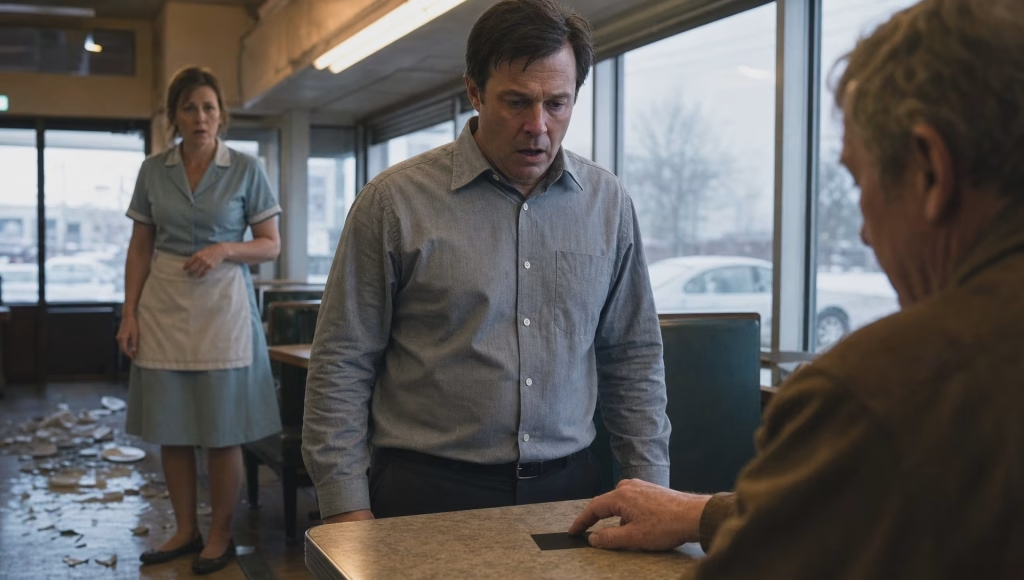
The plate hit the floor and shattered. Soup splashed across the tile. The hot dog rolled under the booth. The sound cracked through the diner like something had broken that couldn’t be fixed.
Forks stopped moving. Conversations died. A child at the far table looked up from her coloring book.
“This man is not a customer,” Brandon said, loud enough for the whole room to hear. “He’s a vagrant. He doesn’t belong here, and he doesn’t get fed for free.”
Emily stood frozen, tears pressing the backs of her eyes. Robert didn’t move.
“I said get out.” Brandon pointed at the door.
And then something changed.
Robert looked down at the ruined plate. At the food on the floor. At his own hands, which — for the first time since he’d sat down — had stopped trembling.
He straightened.
It was slow, quiet, unremarkable to anyone not watching carefully. But Emily watched. His back came up. His shoulders settled. The exhaustion left his face and something else took its place — something calm and certain and unmistakably in charge.
He stood.
Brandon sneered. “Sit down before I call the police.”
“You won’t need to,” Robert said.
“And why is that?”
Robert reached inside his dirty jacket and pulled out a slim black wallet. He opened it. Removed a card. Set it on the table with two fingers, flat and clean.
Brandon glanced down.
The color left his face like someone had pulled a plug.
The card read: Robert Whitman. Founder and Owner. Whitman Family Restaurants.
For three full seconds, nobody breathed.
“You’re — ” Brandon started.
“I’m the owner,” Robert said. “Of this building. This kitchen. That plate you just broke.”
Brandon’s mouth opened and closed. “Mr. Whitman. Sir. I didn’t know it was you. If I had known — “
“Stop,” Robert said.
The word wasn’t loud. It didn’t need to be.
“If you had known who I was,” Robert continued, “you would have treated me differently. That is the problem. That is the only problem I need to understand about you.”
Brandon’s face shifted — panic now, the real kind, not anger dressed up as authority. “I made a mistake. I — it was a bad day, I didn’t mean — “
“A mistake is giving the wrong order to table seven.” Robert looked at the soup still spreading across the tile. “What you did was show this room who you are.”
A few customers looked at each other. Someone put their phone face-down on the table — but not before the camera had been running for nearly a minute.
Brandon tried one more angle. He turned to Emily. “Tell him. Tell him I’m not normally like this.”
Emily’s jaw tightened. Her tears were gone now. “You made a fifteen-year-old boy leave last Tuesday because he only had quarters. You cut Marcus’s hours after he asked about the health policy. You threw out a woman with a stroller in February because she ‘took too long.'” She paused. “You are exactly like this.”
Brandon’s face crumpled.
Robert looked at the kitchen door, where three employees had gathered in silence — Marcus, the line cook; Jessica, the other floor server; and a young man named Deon who bussed tables and never spoke unless spoken to.
“Is she telling the truth?” Robert asked them.
Marcus nodded. “Every word, sir.”
Jessica stepped forward. “She buys meals for people out of her own tips. Has for two years. Never once asked us to cover for her.”
Robert looked at Emily. “Is that true?”
Emily shrugged, embarrassed. “Only when I can.”
Robert was quiet for a moment. Then he reached into his wallet again and removed a second card — this one with a handwritten number on the back. He placed it on the table in front of Emily.
“Starting Monday,” he said, “this location will be closed for seven days. Full staff review.
Management transition. Wage audit.”
Brandon went rigid. “Closed? Because of one — “
“You’ve had fourteen formal complaints in six months,” Robert said. “I came here today because the only thing they all had in common was one employee who still treated people like human beings.” He looked at Emily. “I needed to see if she was real.”
The diner was so quiet you could hear the coffee maker hissing behind the counter.
Brandon looked around the room — at the customers, at the staff, at the faces turned toward him. He found no allies. The same people who had once laughed at his jokes, said nothing when he humiliated staff, and moved their chairs when anyone poor came in — those same people were looking at their hands.
“Please,” Brandon said, and it came out small and strange from a man who had never said it before. “I have a family.” Robert let the words sit.
“So did the employees you scared into silence,” he said finally. “So did every person you turned away from that door.”
He nodded to the assistant manager, a quiet woman named Tara who had spent two years staring at her clipboard whenever Brandon acted out. “Please walk him to the office. Personal belongings only.”
Tara straightened. “Yes, sir.”
Brandon looked at her like she might save him. She didn’t.
He walked. The room watched. No one said a word until the office door clicked shut.
Robert looked down at the mess on the floor. Then he turned to the kitchen.
“Could someone bring a broom?” he asked. “Mr. Pierce will need to clean this up before he leaves.”
Marcus disappeared and came back with one in under thirty seconds. Tara walked it into the office.
From somewhere near the back, someone started clapping — slow, uncertain at first, then more of them, until half the diner was applauding something that hadn’t been planned or performed.
Just a moment that had gone the right way for once. Robert turned to Emily. “How long have you worked here?”
“Three years,” she said quietly.
“And in three years — has anyone ever told you that you were doing the right thing?”
Emily thought about it. Really thought. “Not out loud.”
Robert nodded slowly, like that was the answer he’d expected. He looked around the diner — at the customers, some of whom were still watching with the soft, blinking expression of people recalibrating something — and he spoke just loud enough for all of them to hear.
“My parents opened the first location of this restaurant in 1987. Before that, they slept in their car for three months. My father washed dishes. My mother served coffee. They fed people who couldn’t always pay because they remembered what it felt like to be hungry and invisible.” He paused. “I built everything that came after on the idea that this place should always feel like what it started as. Not an investment. Not a brand. A place where you could come in from the cold and be treated like you mattered.”
A man in a business suit — the same one who had muttered something cruel under his breath when Robert first walked in — folded his napkin carefully and said nothing.
Robert picked up Emily’s hand and pressed the card into it. “Effective immediately, you are the acting manager of this location.”
A gasp moved through the room.
Emily shook her head fast. “Sir, I’m just a waitress — “
“No,” Robert said. “You are the only person in this building who acted like a manager today. The title should follow the behavior.”
Marcus grinned. Jessica covered her mouth. Deon, who hadn’t spoken in months, said “Yes” under his breath like a reflex.
“I can’t run a diner,” Emily said.
“You already have been,” Robert told her. “You’ve been keeping the culture alive while someone else held the keys. Now you’ll have them too.”
He turned toward the counter. “Kitchen — can we get two hot dogs, two soups, and two coffees? One for me, and one for the new manager.”
Laughter broke through the room like a window opening.
Emily sat down across from Robert in the corner booth — the same one he’d chosen because it was out of the way, because nobody would bother a man they’d already decided not to see. This time, the whole diner faced them.
She picked up her coffee. He picked up his hot dog.
“You planned this,” she said.
“I planned to come in and observe,” he said. “I didn’t plan what I found.”
“What did you find?”
Robert looked at her steadily. “Someone who did the right thing in front of an audience that was actively telling her it was wrong.”
Emily stared at her plate. “I just didn’t want him to be hungry.”
“I know.” He took a bite. Chewed. Closed his eyes for a second. “Perfect,” he said.
She laughed, a real laugh. “It’s a hot dog.”
“Today,” Robert said, “it was the most important thing on the menu.”
Over the following week, the diner changed.
Brandon Pierce was removed from the company entirely. Every current employee was interviewed in private. Wages were reviewed and adjusted. A new framed notice appeared near the entrance — not a slogan, not a mission statement, just a single rule: No person will be denied basic dignity in this restaurant.
Emily received management training, a real salary, and a direct line to corporate that had never existed at this location before. Robert also established the Whitman Community Table — a program, named for his parents, that provided free meals daily at every location, funded by the company, protected by policy, with zero punishment for staff who served them.
Six months later, the diner was the highest-rated location in the chain.
People drove out of their way for it. Not just for the food — though the food was good — but for the feeling. The feeling that when you walked through the door, someone would look at you and mean it.
Emily kept one corner booth open every afternoon with a small reserved sign that said: For anyone who needs a place to sit.
Nobody ever asked who it was for. Somehow, the people who needed it always found it.
As for Robert Whitman, he never changed his method. Sometimes he came in a suit. Sometimes he came the way he’d come that first day — coat worn thin, hands in his pockets, eyes that carried too many miles.
At Emily’s diner, it made no difference.
Every single person who walked through that door got the same thing: warmth, a clean place to sit, and the simple words that had started everything —
“Here you go, sir. I hope you enjoy it.”
Original fictional stories. AI-assisted creative content.