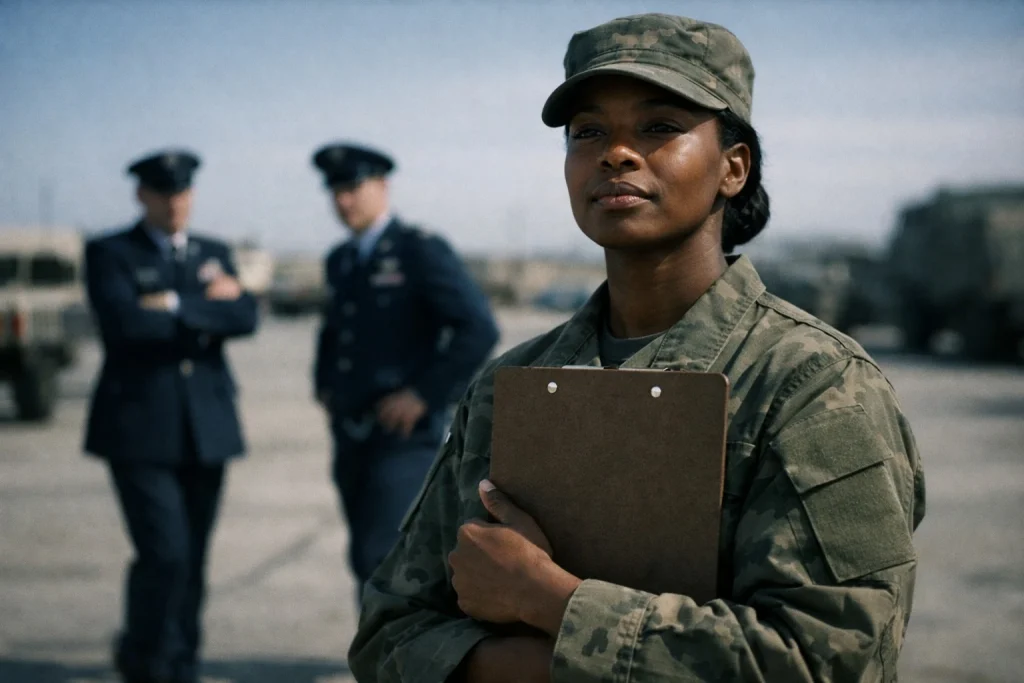

The concrete was cold when Naomi hit it.
She didn’t cry out. She didn’t reach for anyone. She just landed hard on her palms, heard the
clipboard skid across the yard, and stayed still for exactly one breath before she started getting
up.
Nobody moved to help her.
Around her, the yard was locked in that particular military stillness — bodies rigid, eyes straight,
minds pretending they hadn’t seen what they’d just seen. Forty soldiers at attention, and every
single one of them making the choice to be somewhere else in their heads.
Mason stood over her with his arms crossed. Reed was two steps back, already grinning at the
pavement like this was the punchline to a joke only he’d heard.
“Support staff uses the east entrance,” Mason said. “You want a map, or can you read?”
Naomi got to her feet without answering.
She straightened her uniform. She squared her shoulders. She let her eyes move across the yard
once — slow, deliberate, cataloguing everything — and then she looked at Mason the way a
surgeon looks at a problem before the first incision.
Reed stepped forward. “He asked you a question.”
She still didn’t answer.
That was when Mason made his mistake. Later, in the report, it would be written as physical
contact during a verbal engagement, which was the military’s careful way of saying he put both
hands on her shoulders and shoved her again.
She didn’t fall the second time. She planted.
The papers went everywhere. The clipboard bounced twice. And then the east gate opened.
The Adjutant walked into the yard the way a storm walks in — not fast, not loud, but with the
kind of gravity that rearranges the air around it. Two MPs flanked him. A captain from operations
was already on his tablet. Behind them, three senior officers Naomi had personally requested for
her first inspection followed in full dress.
Nobody announced her rank.
Nobody had to.
The Adjutant didn’t look at Mason. He didn’t look at Reed. He crossed the yard in twelve
measured steps, crouched, collected Naomi’s papers one by one, squared them against his knee,
and placed the clipboard back in her hands.
He didn’t say anything either.
He didn’t need to.
The gesture took four seconds. It cost Mason and Reed everything.
Mason’s mouth opened first. “Sir, I can explain—”
“You’ll have that opportunity,” the Adjutant said. “In writing. Under oath.”
The MPs were already moving to flank them.
Reed turned to look at his partner the way men look at each other when the story they’ve been
telling themselves collapses all at once. Mason’s jaw worked silently. The confident smirk that
had been on his face thirty seconds ago was gone so completely it was like it had never existed.
“I didn’t know who she was,” Mason said. The words came out soft, almost pleading. “She wasn’t
in rank. She should have identified herself.”
The Adjutant turned to him then. Full attention. Quiet.
“Lieutenant,” he said, “since when does uncertainty authorize assault?”
Mason had no answer.
The yard was completely silent.
The captain from operations didn’t wait for the silence to end. He stepped forward and read from
his tablet in the flat, administrative voice of someone who has practiced being expressionless.
“Sergeant Elkins, 4th Logistics. Filed a formal complaint six months ago — Lieutenant Mason
redirected her unit from the command wing, citing ‘operational aesthetic.’ Three witnesses.
Complaint stalled.”
He swiped.
“Medic Corporal Vargas. Submitted incident report — Lieutenant Mason removed him from a
priority line by force during a field exercise. No disciplinary action taken. Report closed without
review.”
He swiped again.
“Staff Sergeant Patel. Two complaints against Lieutenant Reed for verbal abuse and deliberate
misdirection of support personnel. Both complaints marked inactive. No investigation.”
Reed’s face had gone the color of old concrete.
Mason’s hands were shaking.
“This wasn’t a bad day,” the Adjutant said quietly. “This was a culture.”
He turned back to the yard. Forty soldiers, still at attention, still silent. But the silence had
changed. It wasn’t obedience anymore. It was something closer to relief.
“Colonel Smith entered this yard without rank displayed at her own request,” the Adjutant
continued. “She wanted to observe command culture before assuming formal control. What she
observed will be part of the official record.”
He let that land.
“Every soldier who witnessed today’s events will be asked to provide a written account. Every
account will be reviewed by the JAG office. The footage from yard cameras has already been
secured.”
Mason tried one more time. His voice had dropped to something private, almost intimate.
“Colonel — I didn’t know it was you. I swear to God, if I had known—”
Naomi spoke for the first time.
“That’s the problem, Lieutenant.”
Her voice was quiet. Not angry. Just precise.
“You didn’t know. And you did it anyway.”
She didn’t look at him again after that. She picked up her clipboard, turned to face the command
line, and addressed the yard.
“Effective immediately, this installation will undergo a full command-climate review. Scope:
abuse of authority, contempt for enlisted personnel, and systemic failure to investigate
misconduct complaints. All findings will be submitted to command within thirty days.” She
paused. “Lieutenants Mason and Reed are relieved of command-side access pending
investigation. MPs will escort them now.”
She didn’t say anything else.
She didn’t have to.
The MPs moved. Mason and Reed walked — not quite under arrest, but close enough that
everyone watching understood the distance between those two things was collapsing fast.
Reed said something quiet to Mason as they passed the east gate. Mason didn’t answer. His eyes
were on the ground, watching the concrete that had been under Naomi’s palms fifteen minutes
ago, as if some explanation for what had just happened might be written there.
It wasn’t.
Behind them, the yard realigned. Not visibly — nobody broke attention — but the quality of
stillness changed. The soldiers who had stood frozen while Naomi hit the ground were standing
differently now. Straighter. Less like men pretending not to see and more like men who had just
been reminded what they were supposed to be.
Sergeant Elkins was in the third row. She kept her eyes forward. But her jaw was set in a way it
hadn’t been in six months.
Naomi walked the command line without hurrying.
The officers who had enforced the culture Mason and Reed had built — the ones who’d filed the
paperwork away, who’d marked complaints inactive, who’d decided it wasn’t worth the friction
— lowered their eyes as she passed. Not out of respect. Out of recognition. They knew what was
coming. The review would find them. The findings would follow them. The record would be
honest in a way it hadn’t been before.
At the end of the line, the Adjutant fell into step beside her.
“Six complaints in eighteen months,” he said. “Both of them untouched.”
“Not anymore,” Naomi said.
He nodded. “Command wants to know how you want to handle the press.”
“Internally, for now.” She adjusted the clipboard under her arm. “The soldiers who filed those
complaints deserve answers before anyone else does.”
“Understood.”
She stopped at the command steps and turned back, once, to look at the yard.
Forty soldiers. Some of them had watched her fall and done nothing. Some of them had filed
paperwork that went nowhere. Some of them were Elkins, and Vargas, and Patel — people who
had told the truth and been ignored for so long they’d stopped expecting it to matter.
She looked at all of them equally.
“Dismissed,” she said.
The yard broke — orderly, precise — and as the soldiers moved, Sergeant Elkins passed close
enough that Naomi could hear her exhale. It wasn’t a word. It was just air leaving a body that had
been holding itself too tight for too long.
Naomi filed it away.
She had thirty days. She intended to use every hour of them.
Two weeks later, Mason’s access card was flagged at the system level — permanently. Reed’s
removal from the promotion list was processed without ceremony, one line in an administrative
update that nobody announced. The six inactive complaints were reopened, reviewed, and
resolved. Three soldiers who had transferred out specifically to escape the culture they’d
described received formal apologies from command.
The yard was quiet when it was all over.
The concrete looked the same as it always had. But the people walking across it were not the
same people, and what happened there — what had been seen and recorded and refused to be
buried — had done what Naomi always understood accountability was supposed to do.
It had made the silence honest
Original fictional stories. AI-assisted creative content.