
The rain on Route 19 didn’t wash things clean. It just made the grime slicker.
Officer Lucas Shaw pulled his cruiser to a slow roll at mile marker 8, lights off, engine low. The old
Petro-Stop rose out of the dark like a bad memory — rusted canopy, shattered pumps, graffiti that
read like the last words of a neighborhood that gave up.
“Routine check,” he muttered. “Sure it is.”
In the back, Rex — ninety pounds of German Shepherd with the emotional intelligence of a
trauma counselor — pressed his nose to the cage. His ears went flat. His body went rigid.
Lucas saw it before he heard it. A flicker of shadow behind the dumpster. Fast. Deliberate.
He stepped out, hand on his weapon.
“Police! Hands where I can see them!”
Nothing. Just sheet metal rattling in the wind.
He took three steps toward the shadow. That was when it happened — the same old ghost
showed up. The Bradford kid’s face. The Glock. The name that made the whole department
flinch. The hesitation that had lived in his gut for six months like a splinter too deep to pull.
Is it a weapon? Is it a kid? Is this another lawsuit?
CRACK.
The round hit his chest like a freight train. He flew backward and hit the wet asphalt hard, lungs
emptied in a single punch of air. His weapon skidded into the puddle beside him.
CRACK. CRACK.
One round sparked off the cruiser door. The other tore through his spine, and the world went
sideways in a single white flash. He screamed but nothing came out. Just a wet rasp. His legs
were gone. Not painful — gone. Like someone had cut the wires below his waist and walked away.
“Rex —” He tried to yell deployment. What came out was barely a whisper. “Rex… go.”
He didn’t need to say it twice.
The back latch was loose — had always been loose — and Rex hit that door at full speed. There
was a shriek from the darkness, real and human and full of panic. The sound of fabric tearing.
Footsteps fleeing hard into the tree line.
Then silence.
Rex trotted back. Limping. Something had grazed him, ricochet or otherwise, but he didn’t care.
He circled Lucas once, twice, then pressed his full weight against Lucas’s side. A living furnace
against the spreading cold.
“Hey… buddy.” Blood on Lucas’s lips. Copper and salt. “Go. Get help. Go.”
Rex didn’t move.
The radio lay three inches from Lucas’s outstretched hand. Three inches. He could see it. He
could almost feel it. But his legs didn’t answer. His hips didn’t answer. Below the chest wound —
nothing. He tried to drag himself forward on one arm. His elbow buckled. His shoulder screamed.
He collapsed back into the puddle.
Three inches was a canyon. And he knew, with the clarity that comes just before the dark, that he
was never going to cross it.
His vision started to close at the edges — the cruiser’s lights turning from red-and-blue to a dull,
pulsing gray.
This is it. The hesitation finally killed me.
Then something wet and firm pushed against his hand. Lucas cracked one eye open.
Rex was looking at the radio. Then at Lucas. Then at the radio again.
“I can’t,” Lucas breathed.
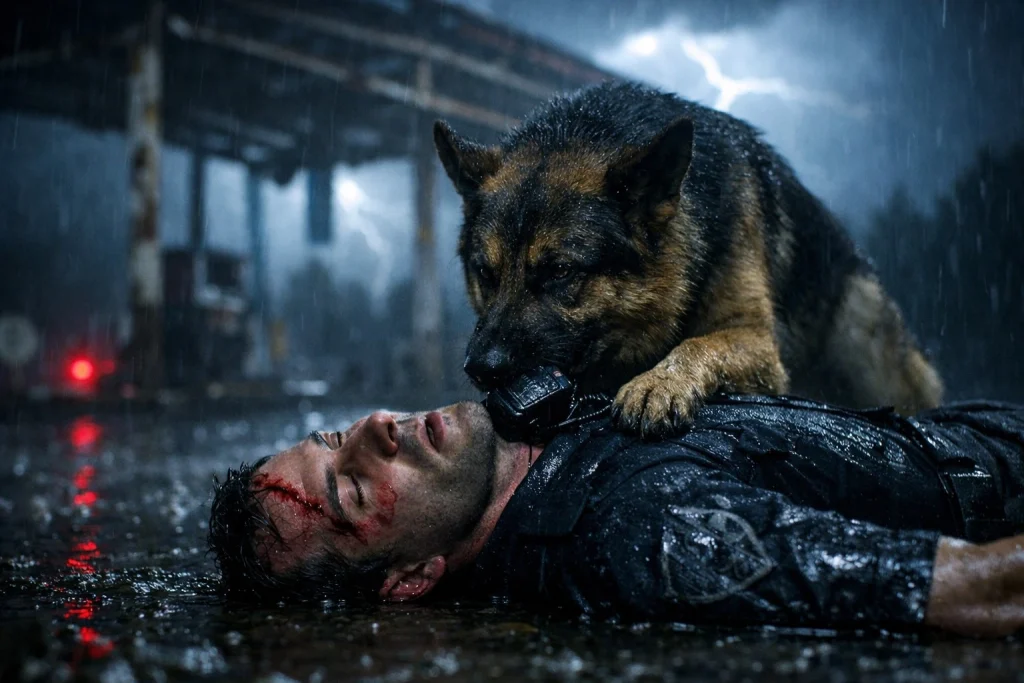
Rex growled. Not a warning — a command. He lowered his head, jaw opening, and closed his
teeth gently but deliberately around the plastic housing of the shoulder mic.
Lucas watched, delirious. What are you doing?
Rex didn’t pull. He turned his head sideways. Careful. Precise. His jaw compressed just enough to
press the side of the unit — the Push-to-Talk button.
KZZZHHHHT.
Static exploded across the open channel.
Rex held perfectly still, eyes locked on Lucas’s face, jaw clamped, button depressed. He didn’t
know Morse code. He didn’t know radio protocol. But he knew what made that sound, and he
knew the sound meant someone was listening.
He threw his head back and howled into the mic. Not a bark. A call. High and raw and ancient —
the sound a wolf makes when the pack is in danger.
Molly Rivers was twenty-six years old and owed $94,000 to a university that had promised her
the world. She worked doubles in the basement of the municipal building, a windowless room
they called “The Hive,” bathed in monitor glow and fluorescent buzz and the particular kind of
exhaustion that doesn’t sleep away.
She had good ears. That was the thing about Molly. She could tell the difference between a TV
shouting match and a real one. She could read silence the way other people read faces.
The sound that hit her headset made her hand freeze over the keyboard.
Bark. Bark. Howl.
“Unit 47, status?” Her voice was flat, professional, the mask she’d trained herself to wear.
Static. Then a low, guttural whine. Wet breathing against an open mic.
“Unit 47, Lucas, come in.”
The storm hissed. Nothing else.
Molly knew that whine. She’d heard it once in a bodycam review — low and urgent, from the big
Malinois that Shaw treated better than most people treated their kids. Her stomach turned to
stone.
“Sarge!” She spun her chair. “Sarge, I need eyes on Unit 47.”
Sergeant Miller didn’t look up from his clipboard. He was a man who had traded street instinct
for budget projections somewhere around year twelve. “Keep it down, Rivers. Pile-up on the
interstate.”
“I need a bus and backup to mile marker 8. The old Petro-Stop.”
“Shaw’s on a routine check. What’s the code?”
“No code. Open mic.”
Miller rolled his eyes so hard Molly could hear it. “His radio got wet. Don’t clog the channel.”
“It’s not just an open mic.” She stood up. The floor went quiet around her. “His dog is on the radio,
Sarge. The dog is holding down the push-to-talk. His dog is calling us.”
Miller let out a short, dismissive laugh. “What is this, a Lassie movie? Sit down, Rivers. Shaw
probably slipped in the mud.”
“I know the difference between a drop and a distress signal!” Molly slammed her hand on the
desk, her coffee mug jumping. “Shaw is a ten-year vet. He doesn’t dead-air for thirty seconds
unless he can’t talk. And that dog sounds terrified.”
Miller’s face hardened. “We have three priority ones on the board. Heart attack in the Heights.
Burglary at the Marina. Resources are thin. I’m not sending a rolling squad to an abandoned gas
station because a dog barked.”
The Heights. The Marina.
The words hung in the air like smoke.
Of course. The wealthy neighborhoods got the instant response. The broken gas station on the
edge of the industrial waste zone? That was where the disposable people went. That was where
the numbers on the board didn’t justify the cost.
Molly put her headset back on.
“Unit 47… if you can hear me… click twice for yes.”
She held her breath. The Hive leaned in, every dispatcher suddenly not typing, not talking.
Click.
Silence.
Then — agonizingly slow —
Click.
It was faint. It sounded like plastic crunching against teeth. Because it was.
Molly stared at Miller. Her eyes were on fire. “That was a confirm. Send the cavalry, Sarge. Right
now.”
Four miles away, Lucas was floating.
The pain in his chest had dulled to a deep, throbbing pressure, replaced by a creeping warmth
that he knew, somewhere in the rational corner of his fading mind, was the worst possible sign.
Hypothermia felt like comfort at the end. It whispered just close your eyes.
He stared up at the storm clouds. Lightning split the sky every few seconds, white and violent.
He thought of his father — grease-stained hands, assembly-line calluses, crying at the academy
graduation. “You’re gonna be the line between the wolves and the sheep, Lucas.”
But Dad had it wrong. There weren’t just wolves and sheep. There were the Shepherds, the
Wolves, and the people who owned the farm. And the owners didn’t lose sleep when a Shepherd
got eaten.
He turned his head. Rex was flat on his belly in the mud, body pressed along Lucas’s torso like a
weighted blanket. His ears were pinned back. His eyes had shifted — no longer watching Lucas.
Watching the dark beyond the pumps.
A low growl vibrated through Rex’s chest and transferred directly into Lucas’s ribcage.
The threat isn’t gone.
Lucas tried to move his hand to his ankle holster, but his legs had stopped answering. He couldn’t
feel his feet.
Think. The shooter had run when Rex deployed. That was the amateur move. But a professional
— a professional would understand that a living cop is a witness. A living cop means a manhunt.
A dead cop is just a headline.
Deliberate footsteps. Sloshing through the puddles. Slow. Patient.
A silhouette emerged from the rain.
Tall. Hooded. Something long and dark in one hand.
This wasn’t a junkie. Junkies twitch. They yell. They run. This figure walked like someone who
had done this before and didn’t feel anything about it.
It’s a hit.
“Rex…” Lucas wheezed, blood on his lips. “Run. Please. Run.”
Rex released the radio mic. It dropped into the puddle with a splash. He stood up over Lucas,
planting his paws wide. He bared his teeth — a wall of glistening white against the encroaching
shadow.
The figure stopped twenty yards out. Lightning flashed.
Lucas saw it: a balaclava. Gloved hands. And the gun — suppressed, expensive, not a street piece.
The kind of weapon someone ordered from a specific catalog and paid cash for.
“Good dog,” the man said. His voice was smooth, educated. The voice of a man who knew how to
order scotch in a quiet room. “Walk away, mutt. You don’t have to die for him.”
Rex answered with a sound that came from somewhere before language. Prehistoric. Absolute.
“I said run!” Lucas tried to scream. It came out as a whisper.
The man raised the gun. “Suit yourself.”
He took a step forward.
Then the sound came.
Not a siren. Not yet.
The roar of an engine — old, high-RPM, being pushed well past the point of reason.
The shooter’s head turned toward the road.
A pair of headlights crested the hill, blindingly bright, bouncing hard over the potholes of the
service road. No police cruiser. No clean black-and-white. It was an old pickup truck with
mismatched doors and a ladder rack welded crooked to the roof.
It didn’t slow down.
It drifted sideways on the wet asphalt, a ten-foot arc of mud and gravel, and plowed straight into
the canopy support post and the rusted hulk of an old gas pump. The shriek of shearing metal
split the night.
The truck jolted to a stop ten feet from Lucas.
The driver’s door swung open.
Old Man Weaver stepped out. Sixty years old. Grease-stained jumpsuit. A tire iron in one hand
and fury in both eyes.
Lucas knew him. He’d let Weaver off with a warning for expired registration last month —
couldn’t bring himself to stack a fine on a man who was clearly counting to the next payday.
Weaver looked at the shooter. He looked at Lucas. He didn’t flinch.
“Hey!” Weaver bellowed, holding the tire iron high. “You get away from him!”
The shooter lifted his gun, steady as a statue. “Back off, old man. Walk away.”
Weaver spat in the mud. “This is my neighborhood. You think you can come here and kill our
boys?”
From the passenger side of the truck, two more figures dropped out. Young men — barely twenty,
hoodies soaked through. Lucas knew their faces too. Kids he’d chased off corners but never
booked, because he knew a record at nineteen ended everything.
They weren’t armed with guns. They had rocks. Bricks. Whatever had been in the truck bed.
They stepped up beside Weaver without a word — a jagged, fragile line between the killer and
the man bleeding in the mud.
The shooter processed it. He could drop all three. He had the ammunition and the training. But
that would take time. It would take noise. And in the distance — growing louder, punching
through the rain — the wail of a siren finally arrived.
Transport 6. Two miles out. Four minutes.
The shooter’s jaw moved behind the balaclava. His eyes, cold and calculating, found Lucas’s one
last time.
“Lucky,” he muttered.
Then he turned and disappeared into the tree line, swallowed by the storm.
Rex didn’t chase.
He turned back to Lucas immediately, lowering his head, licking the rain and blood from his face,
whining in a continuous, broken stream. I’m here. I’m here. Stay with me.
Weaver dropped the tire iron and hit his knees in the oily water beside Lucas. His rough hands
found the chest wound and pressed down, hard and steady.
“Hang on, son,” Weaver said. His voice was shaking now that the adrenaline had somewhere to
go. “Help’s coming. We got you.” He looked at Lucas’s face and nodded once, slow. “The whole
damn neighborhood’s got you.”
Lucas tried to say something. Couldn’t. He just looked at the old mechanic’s face — a man the
city had designated low priority, a man who didn’t even register on the board — and felt
something in his chest that wasn’t the bullet wound.
I didn’t hesitate with you. And you didn’t hesitate with me.
The sirens multiplied. Blue lights cracked through the rain, strobing across the puddles, painting
everything in emergency color. Paramedics spilled out, pushing Weaver’s hands aside, calling
codes Lucas couldn’t track anymore.
Rex refused to move.
He had to be physically lifted — all ninety pounds of soaking, exhausted, blood-streaked
Malinois — and placed in the ambulance alongside the stretcher. He lay beside Lucas the entire
ride, chin on his handler’s hand, eyes open and watchful.
At County General, Lucas was rushed into surgery. The bullet had missed his heart by eleven
millimeters. The second round had shattered two vertebrae. He would never walk again.
The shooter was identified forty-eight hours later — prints from the balaclava left snagged on the
gas pump wreckage. His name was Raymond Colt. Former private contractor. Hired through a
shell company that traced, after seven weeks of federal subpoenas, back to the Bradford family’s
private legal trust.
The Bradford kid hadn’t gone to rehab in Malibu to get better.
He’d gone to make a phone call.
Three people were indicted, including the Bradford family attorney and a city councilman who
had been quietly pressuring the department to keep Lucas Shaw isolated and under-resourced
on the night shift.
Sergeant Miller was demoted. He submitted a resignation letter two weeks later.
Molly Rivers was promoted to senior dispatcher. She used her first paycheck bump to make a
dent in her student loans. She cried in her car afterward — not from relief, but because it was the
first time in years the math had actually worked out.
At the press conference — the one where the DA stood beside the federal prosecutor and named
every name — Lucas showed up in a wheelchair. Rex sat beside him on the floor, leash slack,
perfectly still.
A reporter leaned forward. “Officer Shaw, you were left without backup, in a dangerous area, with
no one responding for over twelve minutes. What do you want to say about the system that
night?”
Lucas was quiet for a moment.
Then he reached down and put his hand on Rex’s head.
“The system failed,” Lucas said. “But the people didn’t.” He looked at the back of the room, where
Weaver stood in a clean flannel shirt, the two young men flanking him like bodyguards. “The
neighborhood didn’t fail me. An old mechanic and two kids with rocks didn’t fail me.” He paused.
“And my dog didn’t fail me.”
He looked straight into the cameras.
“Fix the system. Trust the people.”
Rex pressed his head harder into Lucas’s hand.
The room was quiet for exactly three seconds.
Then it wasn’t.
Original fictional stories. AI-assisted creative content.