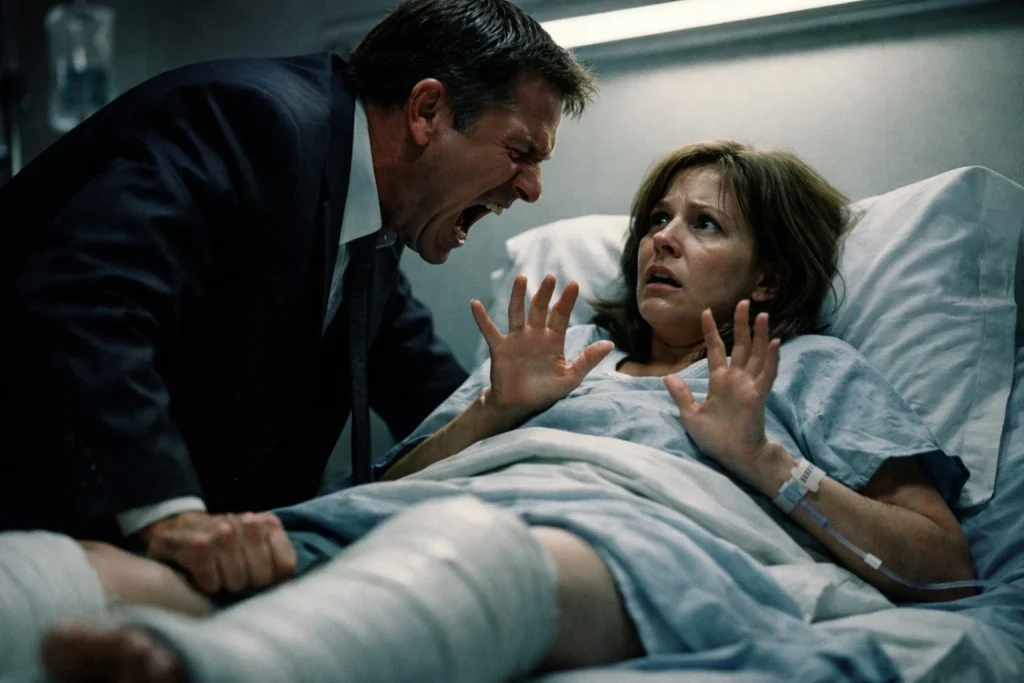

The monitor beeped in a steady, indifferent rhythm. Amy Carter stared at the white ceiling tiles above her bed and breathed—carefully, shallowly—because anything deeper sent a hot spike of pain through her ribs.
She had been here twenty-one days.
Twenty-one days since a car had run a red light and hit her in the crosswalk. Twenty-one days since the paramedics had cut her jeans away on the pavement, since the surgeon had explained both legs would need casts, since her daughter Emily had pressed her small face against Amy’s hospital gown and whispered, “You’re going to be okay, Mommy.”
Henry hadn’t come.
Not on day one, when Amy’s mother Kathleen had called him in tears. Not on day seven, when Amy asked the nurse to try his cell again. Not on day fourteen, when Emily had drawn a get-well card with a yellow sun and a stick figure in a wheelchair and held it up to the window during a video call, saying, “Tell Daddy to bring it to you.”
He hadn’t come.
And every time the door to her room opened—nurses, orderlies, her parents, the hospital chaplain—Amy’s chest would lift with a small, involuntary hope, and then sink again. She hated herself for it. She had forty-five years of evidence that Henry Carter did not show up. But the heart keeps its stupid little vigil anyway.
On the twenty-first morning, her father Eric had gone to get coffee. Her mother had stepped out to call Emily’s school. The room was quiet.
The door opened.
Henry stood in the frame. He wore his good gray jacket, the one he saved for meetings. His jaw was tight. His arms were folded across his chest. He didn’t look like a man visiting his injured wife. He looked like a man who had been summoned somewhere he didn’t want to be.
“Henry.” Amy’s voice came out softer than she intended.
He didn’t move to kiss her. Didn’t move to touch her. He walked to the foot of the bed and looked at her the way he looked at a broken appliance—calculating the repair cost, deciding if it was worth it.
“Do you have any idea,” he said, “how much of a burden you’ve become?”
The heart monitor kept beeping. Amy blinked.
“Henry. I was hit by a car.”
“I know what happened.” He rolled his eyes toward the window. “My mother’s birthday is this weekend. I need you home. I need this whole thing to stop.”
Amy looked at both legs, encased in white plaster from ankle to mid-thigh. She looked back at her husband.
“I can’t walk.”
“You can manage.”
“I literally cannot walk, Henry. I have two broken legs.”
“Then figure it out.” He stepped closer, voice dropping, as if reducing the volume made the words more reasonable. “Sell the jewelry. You’ve got enough sitting in that box to cover all of this without me spending another dime. I’m not bankrupting myself over a crosswalk.”
Amy’s throat tightened. “You’re my husband. You’re supposed to—”
“Support you?” The word came out like a laugh. “That’s rich. I’ve been supporting this family for eight years while you stayed home and played house.”
“I raised our daughter,” Amy said. Her voice was steadying, even as her hands trembled against the sheets. “I left a career for you. I raised Emily while you were between jobs for two of those years, and I never said a word.”
His face flushed. A specific red she knew. The one that came before the cold silences, before the slammed doors, before he found something of Emily’s to criticize that was really a criticism of Amy.
“You think you can talk back to me?” he said.
“I think I’m lying in a hospital bed with two broken legs, and you’re telling me I’m a burden.”
Henry’s hand shot out and grabbed her forearm.
His fingers found the bruised skin above her IV line and pressed. Amy gasped—a short, involuntary sound—as he pulled, dragging her arm toward the edge of the mattress, her body angling with it, ribs igniting.
“Henry—stop—”
“You’re going to embarrass me,” he hissed, his face close to hers now. “You’re going to go home, you’re going to smile, and you’re going to act like a wife.”
“Please—” Her casts scraped the sheets. “You’re hurting me—”
The door slammed open so hard it bounced off the wall.
Henry released her arm instantly. He spun around, and for one brief, naked second, his face showed something Amy had never seen there before.
Fear.
Her father stood in the doorway. Behind him was a security guard—a broad-shouldered man named Torres who Amy had seen doing rounds every morning. Behind Torres was Dana, her day-shift nurse, whose eyes had already taken in the scene and gone very still the way people go still when they’ve seen something they intend to remember.
“What’s happening in here?” Dana’s voice was controlled and precise.
“Nothing.” Henry straightened his jacket. “She’s exaggerating. She gets emotional.”
Amy’s arm lay on the mattress where he’d dropped it. Even from across the room, the marks were visible—four crescents pressed into the pale inside of her forearm, already darkening.
Her father didn’t look at Henry when he spoke. He looked at Amy. “Are you all right?”
The old answer was ready. Fine. It’s fine. Don’t make it worse. She had said it a hundred times. At dinner parties when Henry’s joke landed too sharp. To Emily’s teacher when she asked why Emily seemed so anxious. To her own mother on the phone at midnight.
Her father’s eyes stayed steady on hers. Patient. Asking the real question.
Amy looked at her arm. She looked at her husband, who was already constructing the narrative, already tilting his head in that long-suffering way that said: you see what I deal with?
She nodded.
“I need security assistance in 412,” Dana said into the call button. “And please contact the on-call supervisor.”
Henry let out a short bark of a laugh. “You’re calling security on me? She’s my wife.”
“You’re going to step out now,” Torres said. He positioned himself between Henry and the bed with the calm efficiency of someone who had done this before.
Henry looked at Amy. One last look—the kind that was meant to land like a warning. “You’ll regret this.”
“Sir.” Torres put a firm hand on Henry’s elbow. “Now.”
Henry shook it off, but he went. He went because he had no choice, because there were witnesses, because the story he told about himself required an audience that wasn’t watching him be removed from a hospital room.
When the door swung shut behind him, the silence was enormous.
Amy let her breath out—thin and shaky, like the first exhale after being held underwater.
“Let me look at your arm,” Dana said, already moving toward her.
Her mother arrived twenty minutes later. Kathleen walked in, saw Amy’s arm, saw Dana’s documentation kit, and pressed her lips into a line so tight her chin trembled.
“Emmy is fine,” she said, before Amy could ask. She kissed her daughter’s forehead hard. “She’s eating mac and cheese at our house and watching cartoons. She doesn’t know anything.”
“Mom—”
“No.” Kathleen sat on the edge of the chair and took Amy’s good hand in both of hers. “No more. We’re done.”
Officer Reyes arrived within the hour—a compact, unhurried woman who pulled up a chair, set a recorder on the bedside table, and asked Amy to tell her everything. Not the summary version. Everything.
Amy told her.
She told her about the forearm. She told her about the jewelry and the money. She told her the full sentence: “You’re useless right now, Amy.” She told her about Emily flinching at loud footsteps. She told her about the rules—what to wear, who to call, how to speak.
Officer Reyes wrote without interrupting.
“What you’re describing before today is a pattern,” she said when Amy finished. “The incident today is assault. Those are two separate things that work together in court. The hospital will provide documentation of the marks, the nurse’s statement, and the security guard’s account. That means this isn’t your word alone against his.” She paused. “I can file an emergency protective order for both you and your daughter. Do you want that?”
Emily had drawn a yellow sun on a piece of paper and asked her father to bring it to the hospital.
He hadn’t come.
“Yes,” Amy said. “I want that.”
Henry called eleven times that night. Amy lay in the dark and listened to the voicemails arrive one by one through Dana’s notification system.
“Amy. Pick up. This is insane.”
“I know you’re angry but think about Emily. Think about what you’re doing to this family.”
“You’re going to regret this. I promise you that.”
Officer Reyes had said: let him talk.
So Amy let him talk. And she saved every word.
The attorney came on day twenty-four.
Kelly West arrived carrying a legal pad and wearing the particular expression of someone who had heard a thousand versions of Amy’s story and still paid close attention to this one. She sat down without fanfare, asked Dana to leave them alone for an hour, and said, “Start at the beginning. Not the hospital. The beginning.”
So Amy went back eight years. Back to the job she’d left because Henry said she didn’t have to work anymore, isn’t that what you always wanted? Back to the first year, when she’d thought the rules were love. Back to Emily’s birth, and the way Henry had walked in and immediately started cataloguing what Amy had done wrong in the labor room, while she lay sweating and shaking and still attached to a monitor.
Kelly wrote without flinching. When Amy’s voice faltered, Kelly just waited and let the silence sit, which was somehow the most professional thing anyone had done for Amy in years.
“The financial control,” Kelly said. “Tell me about the accounts.”
“He manages everything. His name’s primary on the joint account. I have to ask for cash.”
“For eight years?”
“He said it was more efficient.”
Kelly made a note. “It wasn’t.” She looked up. “It’s documented isolation. There’s a word for what you’ve been living inside. We can prove it, and we will.” She set her pen down. “Here’s how this goes. Criminal track, we push the assault forward—the evidence is strong. Family court track, we file for divorce and petition for primary custody of Emily. We document the pattern of coercive control. You won’t walk away from this marriage with nothing, and Henry will not have unsupervised access to your daughter during proceedings.”
Amy looked at the plaster casts on her legs. She thought about her daughter in those casts, a small body forced still. She thought about Emily flinching at footsteps.
“Do it,” she said. “All of it.”
She left the hospital in a wheelchair on day thirty-one. Her father pushed her down the corridor while Dana walked alongside them holding a folder of discharge paperwork and a printed copy of the protective order.
“You can come back if you ever need anything,” Dana said at the exit. She squeezed Amy’s shoulder once—brief and firm—the way people do when they mean it without needing to make a speech out of it.
Amy’s parents had prepared the first-floor bedroom. They’d added a ramp over the two porch steps. The pantry had Emily’s cereal and the fruit snacks she liked and the particular brand of apple juice she would only drink from a box.
Emily was waiting in the front room. She stood up very carefully when she saw the wheelchair coming through the door, like she was restraining herself from running. Then she walked forward and put her arms around her mother’s neck with the precise, considered gentleness of a child who had learned very young to calibrate how much space other people had left.
Amy held her tightly and said nothing for a long time.
“Are we camping here?” Emily asked against her shoulder.
Amy laughed—a real one, short and unexpected, that moved through her ribs and hurt and felt good. “For a while,” she said. “And then we’re going somewhere just ours.”
“Can we have a dog?”
“Maybe.”
Emily leaned back and looked at her with tremendous seriousness. “I think a dog would help.”
“I think you might be right,” Amy said.
Physical therapy was relentless. Four times a week, a therapist named Marcus showed no mercy and minimal sympathy, which was precisely what Amy needed. He made her work. She worked. The casts came off. She stood, then balanced, then walked with a cane, then walked without one.
The paperwork matched the physical recovery—slow, repetitive, requiring constant effort.
Kelly filed the divorce petition. Henry’s lawyer responded by contesting the asset division and questioning Amy’s fitness as a primary parent, which Kelly had anticipated and documented against in advance. Henry sent messages through his sister, then through Emily’s school, then through a mutual friend from their neighborhood—each one politely passed to Kelly, each one added to the file.
“He’s building your case for you,” Kelly said on the phone. “Every contact attempt is a violation of the order. Keep saving them.”
At the criminal hearing, Henry sat at a table across a room that felt appropriately formal and cold. He wore the gray jacket again. His lawyer was sharp and quick, and the approach was clear: reduce it to an emotional misunderstanding between a stressed husband and a wife who’d lost perspective.
Kelly called Dana.
Dana described, without drama or embellishment, what she had seen when she entered the room: a man’s hand on a patient’s arm, the patient half-pulled toward the bed’s edge, marks already visible. She described the patient’s verbal distress. She described Henry’s words when he was removed: “You’ll regret this.”
Kelly called Torres.
Torres confirmed the same sequence. He added that in his experience, the behavior he observed was consistent with someone using physical force as a control mechanism, not reacting in panic.
Henry’s lawyer asked whether Torres had a psychology degree.
“No,” Torres said. “I’ve just worked hospital security for fourteen years.”
The courtroom was quiet.
Kelly played the voicemail. Henry’s voice, flat and certain: “You’re going to regret this. I promise you that.”
Henry’s lawyer called it an expression of frustration.
Kelly asked Henry directly: “When you said, ‘you’re going to regret this,’ what did you want your wife to understand?”
Henry opened his mouth. Closed it. Said: “I was upset.”
“What were you going to do,” Kelly said, “that she would regret?”
“Nothing. It was—it was just something you say.”
“Your wife was lying in a hospital bed with two broken legs when you said it. What were you counting on her being afraid of?”
No answer came.
The judge didn’t require much deliberation. The assault conviction was entered. The permanent protective order was extended. In family court, based on the documented coercive control pattern and the criminal conviction, Henry was granted supervised visitation only—two hours per week, with a court-appointed supervisor present—pending completion of a certified intervention program.
He did not look at Amy when the ruling was read. He looked at a fixed point somewhere above the judge’s head, jaw tight, holding himself very still. Performing, Amy thought. Even now. Even alone with the consequence.
She felt almost nothing watching him. That surprised her—she’d expected grief, or anger, or vindication. Instead there was a quietness. A finality, like a door she’d been leaning against for years had finally been locked from her side.
The apartment was on the second floor of a building two blocks from Emily’s school. It had tall windows that let the afternoon light in long and low, hardwood floors that creaked pleasantly in the kitchen, and a small balcony with just enough room for two chairs and a potted plant. The rent was within range of what Amy had started earning again—bookkeeping, remote clients, small businesses who needed someone organized and discreet.
The first night, she and Emily ate Thai takeout from containers on the living room floor because their table hadn’t arrived yet. Emily announced this was exactly like camping. She made Amy do an imaginary campfire. They held their hands out to it and said “ahhh, warm” and Emily laughed until she got hiccups.
After Emily fell asleep, Amy sat on the balcony in the dark and let herself think about the last year. The crosswalk. The ceiling tiles. The look on Henry’s face when the door opened and he saw people who could witness him.
She thought about Dana pressing the call button without hesitation. About Torres standing between them. About Officer Reyes who said let him talk, it helps you. About Kelly West with her legal pad who said patterns matter like it was the simplest and most radical thing in the world.
She thought about her father’s eyes in the hospital room—steady, asking her the real question—and how that one moment of being truly seen had made it possible to nod.
She pulled out her phone. The support group she’d joined had a private online forum. She’d been reading other people’s posts for weeks—recognizing herself in sentences, feeling less alone in the dark. She had never posted.
She opened a new message and wrote:
My name is Amy. I had an accident, and it was the thing that finally made it possible to leave. I want to tell you what happened, not because it was brave—because most of it I did while terrified—but because someone might read this and recognize their own fear. And I want them to know that being scared and doing it anyway still counts.
She read it back once. Then posted it.
She sat in the dark a little longer, listening to the street below and the creak of the building around her. Somewhere inside, her daughter slept in a room that belonged to them—just them. No footsteps to flinch at. No temperature of a room to read before speaking.
On the forum, a notification appeared: 3 people liked your post.
Then five. Then twelve.
Amy set the phone face-down on the chair beside her and looked up at the sky above the rooftops—dark and orange-edged with city light—and breathed in as deeply as her healed ribs would allow.
It didn’t feel like triumph. It felt like oxygen. Like something that had been cut off for a long time, quietly restored.
She exhaled slowly.
It was enough.
Original fictional stories. AI-assisted creative content.