
“GET OUT.”
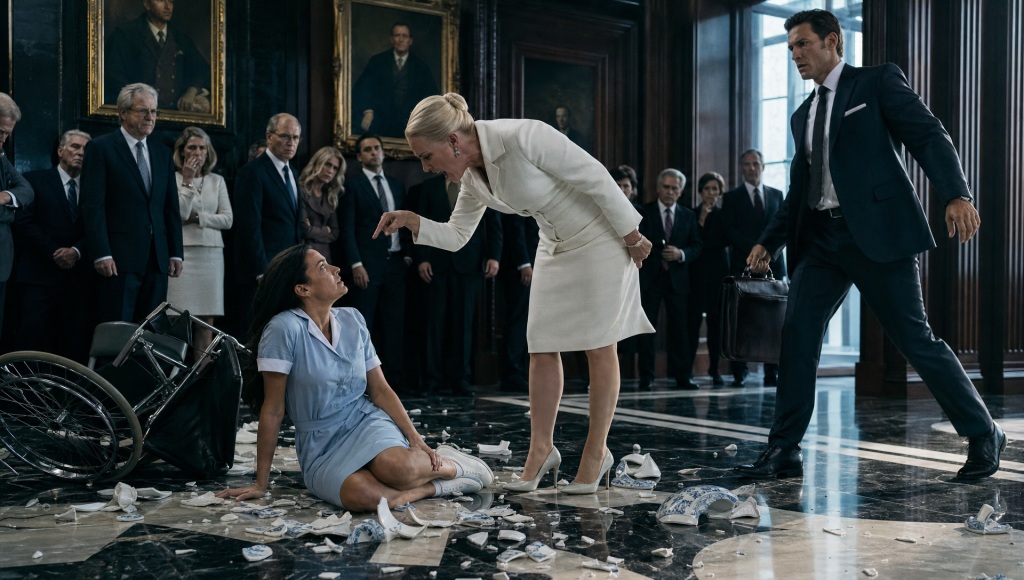
The words cracked through the foyer like a whip.
“People like you dirty my home.”
Everyone froze.
Clara Vale lay beside the brass wheel of an overturned wheelchair, one cheek pressed against the cold marble. Blood beaded along her knuckles where the metal frame had pinned her hand.
But she didn’t scream.
Vivienne Whitmore stepped closer in her ivory dress, diamonds bright at her ears, platinum hair pinned into a perfect knot. She looked less like a grieving widow than a woman accepting a trophy.
Then she placed one sharp heel directly over Clara’s bare hand.
And pressed down.
A soft sound escaped the crowd.
No one moved.
I was sixty-two years old and had practiced law inside that house for thirty years. I had written its trusts, witnessed its signatures, and buried enough family secrets in legal language to recognize when a room was lying.
I took one step forward.
“Stop,” I said.
Vivienne turned her head slowly.
“Edward,” she said. “This is a family matter.”
Before I could answer, the front doors burst open.
A man in a charcoal suit rushed in, shoes striking the marble like gunshots. He carried a leather document case and had the look of someone who had driven through hell to get there.
Vivienne lifted her heel and smiled.
“Finally,” she said. “Mr. Mercer, please escort this woman out.”
But Thomas Mercer didn’t look at Vivienne.
He went straight to Clara.
He knelt right there on the marble, in front of everyone, and pressed his handkerchief against her bleeding knuckles.
Vivienne’s smirk sharpened.
“What a touching display,” she said. “Perhaps through the kitchen.”
Thomas raised his eyes.
“She owns this house,” he said.
Not to Vivienne.
To the room.
The smirk vanished.
Clara sat on the floor, hair loose, blood on her hand. Slowly, she reached into the pocket of her uniform. The keys inside gave a small metallic chime.
Old brass keys.
The master set.
And when she lifted her eyes to Vivienne, the calm in them finally made sense.
She had not been afraid because she had not come there to beg.
She had come to take back what was stolen.
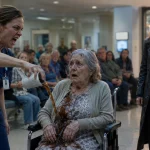
Then Mrs. Whitmore, still trapped in the overturned chair, rasped six words that turned the room colder than death.
“She is my daughter.”
For a few seconds, no one understood.
Or maybe they did and refused to let the truth enter the room.
Vivienne’s blood drained. Her mouth opened. Nolan stared at Clara like he had just watched a ghost climb out of the family crypt.
Mrs. Whitmore’s hand trembled toward her.
“My Evelyn,” she whispered.
Clara closed her eyes.
For the first time, pain crossed her face.
Not from her hand.
From that name.
Everyone in old Boston knew the story of Evelyn Whitmore.
The missing daughter. The scandal. The girl who vanished at nineteen after a violent fight with her father and was quietly erased from the family’s social history. Her portrait removed from the west corridor. Her name gone from Christmas letters. Over the years, people filled the silence with gossip. Drugs. A foreign lover. Suicide.
Mrs. Whitmore had never accepted any of it.
Every Christmas, she set one extra place at dinner.
Every year, Grant had it removed before dessert.
And now the missing daughter sat on the marble in a nurse’s uniform with blood running down her wrist.
Vivienne recovered fast.
“This is absurd,” she said. “That woman is a hired nurse named Clara Vale.”
Thomas rose slowly.
“My name is Thomas Mercer. I represent the holding company that purchased controlling interest in Whitmore Hall six weeks ago.”
Vivienne blinked.
“What holding company?”
“Vale Restoration Trust.”
Clara opened her eyes.
Vivienne looked from Thomas to Clara to me.
“Edward,” she snapped. “Say something.”
My throat had gone dry.
Because Whitmore Hall could not be sold without approval from the estate trustee.
I was the estate trustee.
And I had approved no such thing.
Thomas withdrew a thick folder.
“The deed transfer is lawful,” he said. “Executed under the dormant reversion clause in the 1962 family settlement. If the direct Whitmore line attempted to declare a living heir legally dead through fraud, the house reverted to the wronged heir.”
Vivienne’s voice sharpened.
“She is an imposter.”
Clara looked at her calmly.
“You stepped on my hand in a room full of witnesses. I don’t need to perform.”
“You think a bruise makes you family?”
“No,” Clara said.
She reached up and slowly removed her nurse’s cap. Beneath it, pinned to her collar, was a thin gold chain. On it hung a locket I had not seen in forty years.
Mrs. Whitmore made a broken sound.
The locket had belonged to her mother. Inside, if memory served, was a photograph of three children beside the orchard pond. Grant. Evelyn. And Henry, the youngest boy, who died of leukemia before he turned nine.
Vivienne stepped back.
“No,” she whispered.
Clara opened the locket.
Mrs. Whitmore began to cry.
Not polite tears. Not elegant grief.
A raw, animal sob.
“My baby,” she said.
The room shattered after that.
Guests whispered. Someone dropped a glass. Nolan backed toward the staircase. Vivienne stood perfectly still, calculating. Denial would not hold. Ridicule would not hold. So she reached for the next weapon.
“Even if she is Evelyn,” Vivienne said, “she abandoned this family. She has no right to come dressed as staff and terrorize an elderly woman.”
Clara looked toward her mother.
“I came dressed as staff because it was the only way your people would let me near her.”
Vivienne’s eyes sharpened.
“My people?”
“The agency,” Clara said. “The physician. The security guard outside her bedroom. The attorney who told her I was dead.”
Every eye turned toward me.
“Not Mr. Hale,” Clara said quietly. “The other one.”
Martin Kessler. Vivienne’s personal counsel. Too smooth. Too careful never to say anything illegal where it could be remembered.
Vivienne turned toward the guests.
“Everyone, leave. This is over.”
No one moved.
Not one person.
That was the first time I saw real fear enter her eyes.
Because power depends on obedience.
And the room had stopped obeying.
Thomas placed documents on the marble console table.
“Mrs. Evelyn Whitmore Vale was declared legally dead twenty-nine years ago,” he said. “That declaration was used to consolidate inheritance rights. It was also used, three months ago, to support an emergency petition declaring Margaret Whitmore incompetent and transferring estate authority to Vivienne Whitmore.”
Three months ago.
Right after Grant’s death.
Vivienne had not simply planned to place the old woman in a facility.
She had planned to erase the last person who could identify Evelyn.
I turned toward Mrs. Whitmore.
Her eyes were clearer than I had seen them in months.
Drugged, I realized.
Not demented.
Drugged.
“The pills made her confused,” Clara said. “The injections made her weak. The isolation made everyone believe it.”
Vivienne’s face hardened.
“That is slander.”
“No,” Clara said. “That is Tuesday.”
Thomas opened another page.
“We have pharmacy records. Nurse logs. Security footage. Bank transfers. And a sworn statement from the doctor who signed the incapacity report.”
Vivienne laughed, but the sound cracked.
“You have nothing.”
Clara slowly stood.
She swayed once. Thomas caught her elbow.
Blood dripped from her hand onto the marble.
One red dot. Then another. Then another.
She faced Vivienne fully.
“I have the floorboards.”
Vivienne stopped breathing.
It was so slight most people missed it.
But Clara didn’t.
“When I was sixteen,” Clara said, “my father showed me where he hid the original family settlement. Not the safe copy. The original. Under the nursery floorboards. He said every Whitmore heir should know where the truth sleeps.”
Vivienne’s jaw tightened.
Clara’s voice dropped.
“I found what Grant hid there after he told the world I was dead.”
Nolan turned white.
Vivienne whispered, “Shut up.”
Clara took one step closer.
“No.”
The blue nursery stood at the end of the east corridor, where the air always felt colder. Clara crossed to the far wall, knelt despite her hand, and pressed her fingers to the baseboard. Thomas pulled away a narrow strip of molding. One floorboard sat slightly raised.
The board came up with a tired groan.
Inside lay a metal document box, black with age.
Clara did not touch it immediately.
For all her calm downstairs, her hand trembled.
“My father put my birthday cards here,” she said softly. “After Grant convinced him I was too unstable to receive mail.”
I felt sick.
Grant had been my friend.
That is the sentence men tell themselves before admitting they protected a monster.
Thomas opened the box.
Inside were documents sealed in plastic sleeves. Birth certificates. Letters. Photographs. Medical records. And one cassette tape.
“My mother recorded everything,” Clara said. “Father’s moods. Grant’s threats. The night they sent me away.”
“Sent you away?” I asked.
She kept her eyes on the tape.
“Grant didn’t tell the family I disappeared,” she said. “He made me disappear.”
She swallowed.
“When I was nineteen, I found out Grant had been stealing from the charitable foundation. Millions. Shell companies, false invoices. I confronted him here because Mother was downstairs and Father was too ill for another scandal.”
“He laughed at me,” she said. “Told me no one would believe the difficult daughter over the golden son. Then Kessler walked in with two men I didn’t know.”
“What did they do?”
“They said I had suffered a psychiatric break. They took me to a private clinic in Vermont under a false intake order. Grant signed as next of kin. Kessler notarized it.”
My mouth went dry.
“I was there for eleven months.”
Eleven months.
While Boston whispered about lovers and drugs, Evelyn Whitmore had been in a private clinic under her brother’s orders.
“When I got out, I had nothing,” she said. “No money. No identification they hadn’t controlled. Every time I tried to come home, Grant had lawyers waiting.”
“So you changed your name,” I said.
“I survived,” she corrected.
Then she trained as a nurse.
The woman they had imprisoned under false medical records had spent decades learning the exact language of care, dosage, and institutional cruelty.
She became what they had weaponized against her.
Thomas removed another file from the box.
“This is the original foundation audit. It proves Grant’s embezzlement. More importantly, it proves Kessler knew Evelyn was alive when he filed the legal-death petition.”
If Kessler knew, then every transfer made under that declaration was fraud. Every trust consolidation. Every incapacity petition. Every step that brought Vivienne within reach of the estate.
Clara reached for a small envelope at the bottom of the box.
Her face changed when she saw it.
Inside was a photograph. Not old. Recent.
Grant stood beside Vivienne in the garden. Behind them, near the hedge, stood Kessler. Beside him stood a doctor.
Dr. Simon Bell. The geriatric specialist who had diagnosed Mrs. Whitmore with irreversible cognitive decline.
Clara turned the photo over.
On the back, in Grant’s handwriting, were four words.
If she remembers, accelerate.
No one spoke.
Not treatment. Not care.
A plan.
Clara stared at it.
“Grant didn’t die by accident,” she said.
“What?” Thomas said.
“Three months ago, he called me. First time in twenty-nine years. He was drunk. Crying. Said Vivienne and Kessler had gone too far. Said Mother was asking for me in her sleep.”
She looked toward the long gravel drive.
“He told me he had hidden something in the nursery. Something that would bring everything down. Then he said he was going to meet Vivienne at the lake house and confess.”
A siren sounded in the distance.
Clara’s voice dropped to a whisper.
“He died before midnight.”
The front door stood open by the time we reached the stairs.
Cold air poured into the foyer.
Vivienne was gone.
So was Nolan.
So was Martin Kessler.
Thomas, Clara, and I drove to the lake house after sunset. The police told us not to. We went anyway. The place sat ninety minutes north, hidden behind pines on a private road slick with rain.
My phone rang twice on the way.
The second call left a voicemail.
Kessler’s voice filled the car.
“Edward. You’ve gotten yourself confused. That woman is dangerous. Grant knew it. If you help her, you’ll destroy your own reputation. Turn around.”
A pause.
“You have grandchildren, don’t you?”
Thomas cursed under his breath.
Clara leaned forward.
“Play it again.”
She listened without blinking.
“He’s scared,” she said.
I looked back at her.
“You hear fear in that?”
“I hear a man who expected to threaten me,” she said. “Not you.”
The lake house was dark except for one light in the kitchen.
The back door was unlocked. That frightened me more than a locked one would have.
Clara went straight to the fireplace.
“How do you know?” I asked.
“Grant was lazy,” she said. “He hid things where he drank.”
She lifted a painting from above the mantel and found a small safe behind it.
“Do we need a code?” Thomas asked.
Clara entered six numbers.
The safe clicked open.
“My birthday,” she said. “Grant was sentimental when it helped him feel innocent.”
Inside were ledgers. Hard drives. A handgun. And a stack of passports.
Not one. Not two.
Seven.
Different names. Different faces.
Vivienne’s face on every one.
Thomas laid them across the desk.
Vivienne Clarke. Vivienne Moreau. Vivienne Bellamy. Vivienne Rusk.
I picked up the last.
Vivienne Kessler.
“She married him?” Thomas said.
Clara’s expression did not change.
“No,” she said. “She owned him.”
The ledgers told the rest.
For years, Grant, Kessler, Bell, and Vivienne had operated a private pipeline for controlling wealthy elderly clients whose families were fractured or easily manipulated. False diagnoses. Emergency guardianships. Asset transfers. Foundation siphoning.
And when someone resisted — they were declared unstable. Incompetent. Dead on paper.
Evelyn had not been the beginning.
She had been the test.
At the bottom of the safe was a red folder.
M.W. Final Transition.
Inside was a signed transfer order to Rosehaven Memory Institute, scheduled for that evening. Once admitted, Mrs. Whitmore would be isolated under medical authority. Within thirty days, her estate voting rights would transfer fully to Vivienne.
At the back was a second document.
A death certificate.
Unsigned.
Cause of death: complications of advanced dementia.
Date: tomorrow.
Thomas stepped back.
“Oh my God.”
Clara stared at the paper.
“She was going to kill her.”
Then the front door opened.
Footsteps entered the house. Slow. Unhurried.
A woman’s voice drifted through the hall.
“You always were dramatic, Evelyn.”
Vivienne stepped into the study wearing a raincoat over her white dress.
Beside her stood Nolan, pale and shaking.
Behind them stood Martin Kessler with a pistol in his hand.
Vivienne smiled at Clara’s bandaged fingers.
“I should have pressed harder.”
No one moved.
Kessler’s hand trembled, but not enough to comfort me.
Vivienne looked utterly serene.
She had been exposed, stripped of the house, the name, the performance.
And still she looked as if everyone else had misunderstood the script.
“Put the files down,” she said.
Thomas stepped in front of Clara.
Kessler raised the gun.
“Don’t be stupid,” he snapped.
Vivienne sighed.
“Martin, please. Panic is vulgar.”
He flinched at the reprimand.
Clara had been right. She didn’t love him. She controlled him.
Nolan began to cry.
“I didn’t know about the death certificate,” he whispered. “Viv, you said it was just paperwork.”
Vivienne turned her head slowly.
“Nolan,” she said, “if you speak again, I will let Martin shoot you first.”
He went silent.
I looked at the open safe. Then at the ledgers. Then at Clara.
Her eyes were fixed not on the gun, but on the desk lamp beside Grant’s old leather chair.
A tiny red light blinked beneath its shade.
Recording.
Grant had installed cameras at the lake house after a burglary. I had forgotten.
Clara saw me notice.
So did Vivienne.
Her face changed.
Then she lunged for the lamp.
Thomas moved first.
Kessler shouted.
The gun went off.
The sound destroyed the room.
Thomas fell against the desk, blood spreading across his shoulder.
Clara grabbed a ledger and swung it into Kessler’s wrist. The gun clattered across the floor. I kicked it under the cabinet with a sixty-two-year-old hip and more rage than balance.
Vivienne reached for the red folder.
Clara reached for Vivienne.
They collided beside the fireplace. No elegance. No performance.
Just two women with three decades of stolen life between them.
Vivienne clawed at Clara’s injured hand.
Clara did not let go.
“You were nothing,” Vivienne hissed. “A ghost. A family embarrassment. I built myself out of what you threw away.”
Clara’s face twisted.
“I didn’t throw it away.”
Vivienne smiled with blood on her lip.
“No. Grant did.”
That was when Clara struck her.
Not hard. Not theatrically.
Once.
Open palm. Across the face.
Vivienne staggered back into the mantel.
The painting fell.
The recording lamp kept blinking.
Outside, sirens rose through the trees.
Kessler looked toward the window and understood before anyone else did.
“You called them,” he whispered.
Clara breathed hard.
“No,” she said. “Grant did.”
She pointed to the old landline on the desk. Its receiver was slightly lifted. A call had been active the entire time.
Grant’s panic button. The one he installed after a break-in and never used.
Clara had triggered it when she opened the safe.
Police burst through the front door seconds later.
Kessler dropped to his knees.
Nolan raised both hands, sobbing.
Vivienne stood by the fireplace, rainwater dripping from her white dress onto the floor.
For the first time, she looked truly cornered.
But just before the officers reached her, she turned to Clara and whispered something I almost missed.
“Ask your mother what she signed.”
Mrs. Whitmore woke fully two days later.
Not all at once. Not like stories pretend.
Her mind returned in fragments. A name. The smell of Evelyn’s hair when she was small. The wallpaper in the blue nursery. The sound of Grant crying outside her bedroom after their father died.
On the third morning, she opened her eyes and said, “I knew you weren’t dead.”
Clara broke.
There is no elegant way to describe a woman losing twenty-nine years all at once.
She folded over her mother’s hand and sobbed with a sound so deep it seemed pulled from the foundation of the house itself. Mrs. Whitmore cried too, frail fingers moving through Clara’s hair, whispering apologies that would never be large enough.
I stood by the window and looked away.
Some reunions are too sacred for witnesses.
Later, when the room settled, Clara asked the question.
“Mother,” she said gently. “What did Vivienne mean? What did you sign?”
Mrs. Whitmore closed her eyes.
“Grant came to me before he died,” she whispered. “He told me Evelyn was alive.”
Clara went still.
“He cried,” Margaret said. “He said he had done unforgivable things. He said he wanted to fix it, but Vivienne knew too much. Martin knew too much.”
She swallowed.
“He brought papers. Said if anything happened to him, I needed to sign them. Said it would protect the house until Evelyn came home.”
The pills, we later learned, had already started by that night.
The papers had not protected the house.
They had not protected Evelyn.
They created a contingency trust naming Vivienne as emergency executor if Grant died and Margaret was declared medically incapacitated — with a clause authorizing transfer of family assets into a preservation fund controlled by Kessler’s firm.
The old woman had signed the blade they planned to use against her.
Drugged. Afraid. Desperate to save the daughter she had mourned alive.
Vivienne’s trial began nine months later.
Thomas Mercer had recovered from the gunshot. Dr. Bell turned state’s witness to avoid dying in prison. Nolan testified in exchange for limited immunity, though Clara never forgave him and did not pretend otherwise.
Martin Kessler aged twenty years between arrest and sentencing.
Vivienne did not.
She entered court in gray, not white, but somehow made even prison fabric look curated. She sat straight-backed beside her attorneys while prosecutors laid out decades of fraud, coercion, unlawful confinement, medical abuse, attempted murder, and conspiracy.
The media called it the Whitmore Ghost Case.
They called Clara the Nurse Who Owned the Mansion.
They called Vivienne the White Widow of Boston.
Names are how strangers make horror easier to swallow.
But I knew the truth was not a headline.
It was Mrs. Whitmore waking at 3:00 a.m. begging forgiveness from a daughter she had failed to save.
It was Clara standing in the blue nursery with her hand still scarred from Vivienne’s heel.
It was Thomas flinching whenever a door slammed.
It was me reading documents I should have questioned years earlier.
The verdict came on a rainy Thursday.
Guilty on all major counts.
Vivienne received forty-seven years. Kessler received thirty-two. Dr. Bell received eighteen. Nolan left the state and was not invited to return.
After sentencing, Vivienne asked to speak.
The judge allowed it.
She stood slowly, turned toward Clara, and smiled the same small smile she had worn in the foyer the day this all began.
“You think this makes you a Whitmore again,” she said. “But all I did was show the world what your family already was.”
Clara did not answer.
That was her victory.
Some people want your rage because it proves they still own a room inside you.
Clara gave Vivienne nothing.
Whitmore Hall reopened the following spring.
Not as a private mansion.
Clara turned it into the Vale Center for Elder Justice — a legal and medical advocacy foundation for families fighting guardianship abuse. The ballroom became a hearing room. The east wing became temporary housing. The blue nursery became an archive, with the original floorboards preserved beneath glass.
Mrs. Whitmore spent her final year there.
Not hidden. Not sedated. Not managed.
She sat in the garden on clear afternoons, wrapped in wool blankets, watching Clara argue with contractors, attorneys, doctors, and anyone else foolish enough to underestimate her.
One evening, I found them together beneath the old magnolia tree. The same tree Evelyn had climbed as a girl.
Mrs. Whitmore was asleep in her chair. Clara sat beside her, a book open in her lap, the late sun catching the scar across her hand.
“You could sell this place,” I said.
She smiled faintly.
“Everyone keeps telling me that.”
“It’s worth a fortune.”
“So was my silence.”
I had no answer to that.
For a while, we listened to the wind move through the branches.
Then Clara reached into her pocket and took out the brass keys.
The master set.
She placed them in my palm.
I frowned.
“What’s this?”
“A copy,” she said. “In case someone ever tries to lock the truth away again.”
Across the garden, Mrs. Whitmore stirred and opened her eyes. For a second she looked lost, caught between old nightmares and present light.
Then she saw Clara.
Her face softened.
“My Evelyn,” she whispered.
Clara went to her immediately.
No hesitation. No anger. No performance.
She knelt beside the wheelchair and took her mother’s hand.
This time, no one stood over her.
No one pressed her down.
No one dared tell her she did not belong.
And as the sun lowered behind Whitmore Hall, touching every window with gold, the house finally looked less like a verdict and more like what it should have been all along.
A home.
Original fictional stories. AI-assisted creative content.