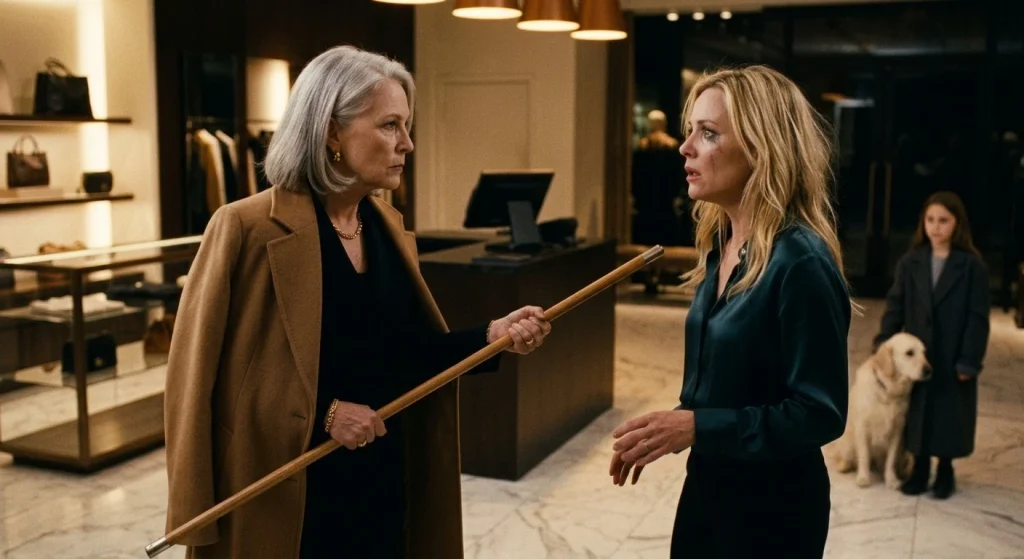

The wind off the street hit Eleanor like a slap the moment the boutique door swung open.
She looked up from behind the glass counter, ready to greet a client wrapped in fur or cashmere. Instead, she saw a girl — maybe ten years old — in a thin jacket two sizes too small. Her sneakers were soaked through, leaving wet footprints across her white carpet. Beside her shuffled an old golden retriever, one hind leg dragging, fur matted with snow.
Eleanor’s smile died.
“We’re closed,” she said, even though the OPEN sign glowed red behind her.
The girl didn’t leave. She walked straight to the counter, eyes down, and set a handful of crumpled bills on the polished glass. They were damp. Some were torn. She smoothed each one carefully, like they were something precious.
She pointed to the wool blanket on the end display — the cheapest item in the store, forty-two dollars.
“Just that one,” she whispered. “He’s really cold.”
The dog looked up at Eleanor with cloudy eyes and let out a low, exhausted whimper.
She looked at the bills. She looked at the wet footprints spreading across her carpet. She looked at the dog, shivering on her floor.
And she smiled.
Not with warmth.
“You think I run a shelter?” Eleanor said. Her voice was light, almost amused, the way a person sounds when they’ve already decided something cruel and are enjoying the approach.
“Please,” the girl said. “I have enough. I counted it.”
Eleanor walked around the counter. She took the wool blanket off the display — folded it smooth and neat — and carried it to the fireplace at the far wall.
“No.”
She dropped it in.
The flames took it fast, wool curling black at the edges before the whole thing went up. The girl made a sound that wasn’t quite a word.
“Get out,” Eleanor said. She reached behind the counter and came back with the wooden broom. “Both of you. Right now.”
“Please—” the girl started.
She shoved her toward the door. Not a nudge. A hard shove, the broom handle catching her across the ribs. She stumbled, grabbed the counter to keep from falling. The dog skittered sideways, nails clicking on the marble floor, whining high and sharp.
“I said OUT.”
She raised the broom again.
The crack was so loud and sudden that Eleanor actually flinched.
A hand had caught the broom handle mid-swing. One hand, five fingers, immovable.
Eleanor turned.
The woman standing in the archway of the VIP fitting room was tall. Older — maybe sixty — but with the kind of stillness that only comes from never having needed to prove anything to anyone. Her coat was still half-on, one arm in the sleeve, like she’d heard the girl’s voice from behind the curtain and come straight out.
Eleanor recognized her immediately.
Mrs. Diane Carmichael. Commercial real estate. Three buildings on this block alone. Forty percent of Eleanor’s client roster sent referrals through her charity circles. Half the boutique’s annual revenue, by Eleanor’s own accountant’s estimate.
“Mrs. Carmichael,” Eleanor said, and her voice came out strange. Thin. “I’m so sorry — this isn’t—”
“Let go of the broom,” Mrs. Carmichael said.
Eleanor let go of the broom.
Mrs. Carmichael set it against the wall carefully, without looking away from Eleanor. The dog had pressed himself against the girl’s legs. The girl wasn’t crying anymore. She was just watching, very still, the way children watch things they don’t fully understand but know are important.
“What is your name?” Mrs. Carmichael asked the girl.
“Lily,” she said.
“How much did you have?”
She looked at the bills still spread on the counter. “Forty-three dollars. I had forty-three.”
Mrs. Carmichael nodded once.
“This is my building,” she said to Eleanor. Her tone hadn’t changed. It was almost conversational. “I own it. You lease the commercial space from my property company.”
Eleanor’s mouth moved. Nothing came out.
“I watched you burn a child’s money,” Mrs. Carmichael said. “I watched you raise a broom at a little girl and a sick dog.”
“She was trespassing, she tracked mud—”
“Stop talking.”
Eleanor stopped.
Mrs. Carmichael pulled out her phone. She dialed without looking at the screen, like the number was muscle memory.
“Andrew,” she said. “Pull up the Whitmore Avenue commercial lease. The boutique on the ground floor.” A pause. “Terminate it. Effective tonight.” Another pause. “Yes, tonight. And call legal — I want the operating accounts associated with that entity frozen pending review. She can fight it in court if she wants.” She paused one more time, listening. “Thank you.”
She hung up.
The silence in the boutique was total.
Eleanor heard the fire crackling. She heard the dog’s slow breath. She heard the blood in her own ears.
“You can’t—” she started.
Her phone buzzed on the counter. Then again. Then a long, sustained vibration that didn’t stop.
She picked it up. Her bank app. Her business account. A red notification she’d never seen before — Account access restricted. Contact your account manager.
The boutique’s point-of-sale screen flickered and went dark.
“My—” Eleanor looked up. “Everything—”
“Yes,” Mrs. Carmichael said simply.
Eleanor’s knees hit the floor. She didn’t plan for it. They just went. She grabbed the edge of the counter and her hands were shaking and she heard herself say something that wasn’t words, just sound, the sound a person makes when they realize something is gone and isn’t coming back.
“Please,” she said. Her voice didn’t sound like hers anymore. “I built this. I built all of it. Please, I’m sorry, I wasn’t thinking—”
“You were thinking exactly,” Mrs. Carmichael said. “That’s the problem.”
She turned away from Eleanor.
She walked to the coat display near the window — the cashmere section, the items locked behind glass — and she opened the case with the key from the counter. She pulled out a full-length cashmere coat in cream, fitted for a man but wide at the shoulders. She knelt down and wrapped it around the dog, tucking it under his belly, tying the sleeves loosely so it would hold.
The dog leaned into her hand.
“Good boy,” she said quietly.
She stood and pulled a second coat — a long charcoal one, lined in silk — and draped it over Lily’s shoulders. She looked up at her, confused.
“It’s yours,” she said.
“I can’t—”
“It’s yours,” she said again.
Lily pulled it tighter around herself, and for the first time since he’d come in, he stopped shaking.
Mrs. Carmichael walked to the door and held it open. Her driver was already at the curb — the long black car idling, exhaust rising white in the cold air. The rear door was open.
“Come on,” she said to Lily. “Both of you.”
Lily looked once at Eleanor, still crumpled on the floor behind the counter.
Then she clicked her tongue softly and walked out the door with her dog.
Mrs. Carmichael followed without looking back.
The fire in the decorative hearth burned down to embers. The boutique’s lights stayed on — nobody had turned them off — illuminating the white carpet, the wet footprints, and Eleanor on her knees beside the dark register, holding her phone with both hands, calling numbers that no longer answered.
Outside, the car pulled away from the curb into the snow.
Lily pressed her face against the window and watched the city pass. The dog was curled across both their laps, already asleep, breathing slow and even beneath the cream cashmere coat.
“Where do you live?” Mrs. Carmichael asked.
She told her.
She told the driver.
They rode the rest of the way in silence, and it was the warmest silence Lily had ever been inside.
Original fictional stories. AI-assisted creative content.