
Marcus checked his cufflinks in the sacristy mirror and smiled at the reflection.
He looked like a man who had gotten away with everything. Because he had.
The cathedral held four hundred guests — senators, venture capitalists, old-money families who had once bowed to Evelyn’s father and now bowed to Marcus instead. He had spent two years cultivating that deference, and today it would be sealed in vows.
His bride, Sienna, twenty-six and radiant, waited at the altar in a dress that cost more than most people made in a year. Her father had no idea the money came from a dead woman’s trust.
Neither did she.
Father Connelly began the ceremony with practiced solemnity. The organ swelled. Marcus walked the aisle feeling the eyes of four hundred people tracking his every step, the way he had always wanted them to.
He reached the altar. He turned to face Sienna. He exhaled.
Father Connelly opened his book. “If anyone here has cause to object to this union—”
The oak doors at the back of the cathedral exploded open.
Not a dramatic swing. A full, two-handed shove, the kind that sent both doors hammering into the stone walls so hard the candle flames bent sideways.
Every head in the cathedral turned.
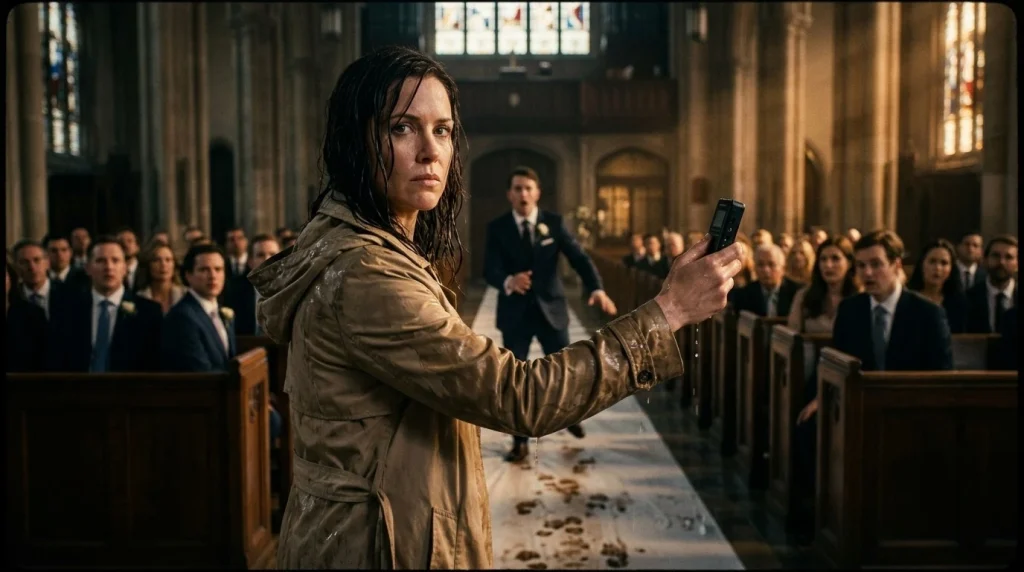
A woman stood in the doorway. Alone. Drenched. A cheap beige trench coat soaked through to the lining, dripping onto the silk aisle runner in dark, spreading puddles. Her hair was plastered flat. Her shoes squelched with each step.
She walked forward.
Not fast. Not slow. The measured pace of someone who had rehearsed this moment ten thousand times and was no longer afraid of it.
Marcus’s first reaction was embarrassment. His second was rage.
He snatched the wireless microphone from the podium.
“Stop.” His voice boomed through the cathedral’s sound system. “Security.”
Six men in dark suits materialized from the flanks of the pews. Marcus’s personal detail — ex-military, trained, expensive.
The woman kept walking.
“Do you have any idea—” Marcus kept his voice light, performatively amused, playing to the room. “—what this looks like? Sweetheart, the soup kitchen is three blocks north. Let me call you a cab.”
Low, nervous laughter from the front pews. The kind people exhale when they want the discomfort to end.
The woman reached the halfway point of the aisle and stopped.
She raised her hands — slowly, deliberately, the way you raise them when you want everyone to see — and pushed back her hood.
The sound that came out of four hundred people at once was not a gasp. It was something older than language. A collective reflex. The breath of a room that had just been hit.
Father Connelly’s Bible struck the marble floor with a crack that echoed off the vaulted ceiling.
Sienna made a small, strangled noise and stepped back from the altar.
Marcus did not move. Could not move. His brain was running the same loop on repeat: impossible, impossible, impossible.
Because standing in the aisle, hair dripping, eyes fixed on his face with the calm of someone who had survived something unsurvivable —
Was Evelyn.
His wife.
His dead wife.
The six security guards had been three steps from grabbing her when they froze.
They recognized her. Of course they did. Four of them had worked for her father for fifteen years before Marcus had inherited — had stolen — the company. They had attended her birthday parties. They had stood at her father’s funeral. They had grieved her.
The largest of them, a man named Darius who had once carried Evelyn’s luggage through three international airports without complaint, slowly lowered his hands to his sides.
Then he turned and faced Marcus.
The other three followed.
Marcus watched his own security team execute a silent, seamless pivot and understood, in a single horrible second, that he was no longer the principal they were protecting.
“Darius—” His voice came out smaller than he intended.
Darius said nothing. He crossed his arms.
Evelyn reached into her soaked coat.
The room went absolutely still.
She pulled out a digital recorder. Matte black, scuffed, the kind you could buy at any electronics store. She held it up so the front rows could see it clearly. Then she pressed play.
The audio filled the cathedral through the house speakers she hadn’t touched — because her hand was nowhere near the sound board. Someone in the tech booth had patched it in. She had planned this down to the wire.
A man’s voice. Rough. Slightly drunk or trying to sound like he was. “He paid me a hundred and forty thousand cash. Said to take out the bilge pump and reseal it wrong. She’d be twenty miles offshore before the hull started taking water. He said it had to look like an accident.”
A pause on the recording.
Then a second voice — Marcus’s voice, unmistakable, the cadence she had heard for six years across a thousand dinner tables: “And nobody saw the transfer?”
First voice: “Nobody. Account’s in my cousin’s name. Untraceable.”
Marcus: “Good man.”
The sirens started before the recording finished.
Not far away. Not approaching. Already outside — the kind of presence that meant they had been there for ten minutes, waiting for the cue.
The cathedral’s tall stained-glass windows lit up in alternating red and blue.
Sienna made a sound that was half sob, half fury, gathered her dress in both hands, and walked off the altar and down the side aisle without looking at Marcus once. Her mother followed. Her father put his hand on the pew and sat down heavily, staring at the floor.
Marcus was still holding the microphone.
He looked at it. He set it on the altar rail. He looked at Evelyn.
“You don’t understand—” he started.
“I understand,” Evelyn said. Her voice was steady and very quiet and the microphones caught every word. “I spent five hours in forty-degree water before a fishing charter found me. I spent the next four years and eleven months rebuilding enough to walk back in here and end this.” She paused. “I understand perfectly.”
The cathedral doors opened again. This time: two detectives, four uniformed officers, and a woman in a gray blazer who Marcus recognized as the lead investigator from the financial crimes unit of the FBI — a woman he had specifically paid a lobbyist to keep reassigned away from his company eighteen months ago.
She had apparently been reassigned back.
“Marcus Hale,” the woman in the blazer said, holding up her credentials, “you’re under arrest for conspiracy to commit murder, wire fraud, and securities fraud. You have the right to remain silent.”
Darius stepped aside to let them through.
They cuffed him at the altar.
In front of four hundred guests, beneath a vaulted ceiling, under the same stained glass that was supposed to bless his second marriage. The handcuffs were standard-issue steel and they clicked twice and the sound was very small in that large space.
Marcus said nothing when they walked him down the aisle. He looked straight ahead. He was still, in some vestigial way, trying to look composed.
The guests watched in absolute silence. Not one person stood up. Not one person spoke on his behalf. Four hundred people who had eaten his food and drunk his wine and shaken his hand sat perfectly still and let him walk past.
The oak doors closed behind him.
Father Connelly retrieved his Bible from the floor. He smoothed the bent pages with both hands. He looked at Evelyn for a long moment.
“Are you all right, child?” he asked.
“Getting there,” she said.
She turned and looked at the room — at the hundreds of faces, at the flowers that had been arranged for someone else’s wedding, at the silk runner that now bore a trail of muddy footprints leading straight to the altar.
Her altar. Her cathedral. Her inheritance, beginning its long return.
One of the guests in the third row — a woman in her seventies who had known Evelyn’s father for forty years — began to clap.
It wasn’t enthusiastic. It was deliberate. The kind of applause that means: I see you. I believe you. I’m sorry it took this long.
One by one, others joined.
Evelyn didn’t smile. Her jaw was tight and her eyes were bright and she held herself very still the way people do when they are holding something enormous together by sheer will.
But she stood at the altar of the cathedral that had been built with her family’s money, and she let the sound wash over her, and she did not look away.
Two weeks later, a federal judge signed the order restoring Evelyn’s controlling interest in Hale-Voss Technologies — the company her father had built, that she had inherited, that Marcus had operated under a fraudulent death declaration for five years.
The board reinstated her as CEO by a vote of nine to zero.
The boat captain, granted immunity for his cooperation, testified for six hours.
Marcus Hale pled not guilty. His attorneys requested bail. It was denied on flight risk grounds.
Sienna returned the engagement ring. It was appraised at $340,000. She donated the proceeds to a maritime safety nonprofit and did not issue a statement.
Evelyn issued one statement, three sentences long, from the steps of the courthouse:
“My father built this company because he believed that what you build should outlast you. I intend to honor that. We have work to do.”
She went inside and got to work.
Original fictional stories. AI-assisted creative content.