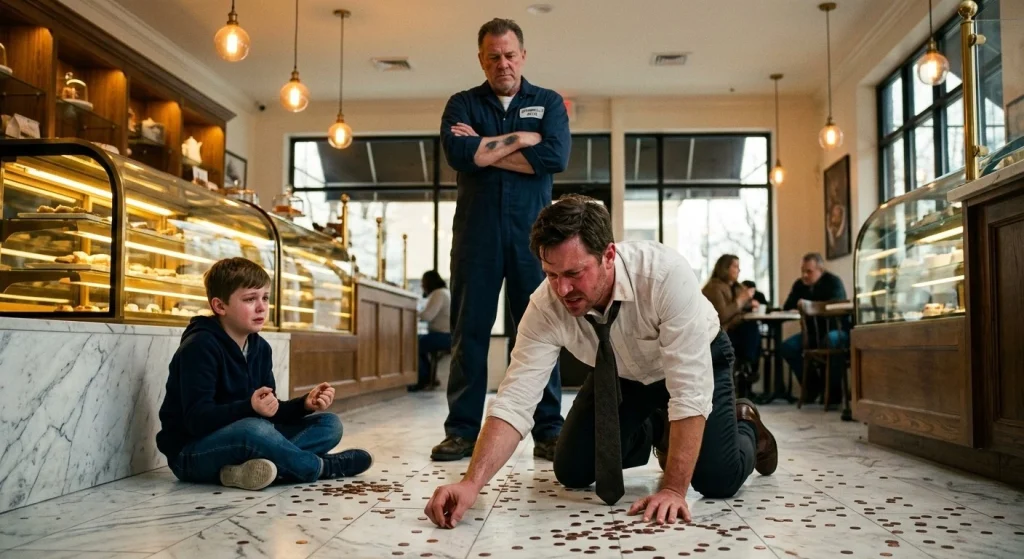

The boutique smelled like butter and money.
Arthur Vance had built that. Every detail — the white marble counters, the hand-lettered menu board, the staff in pressed linen aprons — was curated to keep a certain kind of person out. And to keep a certain kind of person very, very comfortable inside.
It was a freezing Tuesday afternoon when the glass doors opened and everything changed.
The boy couldn’t have been older than nine. His jacket was three sizes too big, the sleeves frayed at the wrist, and there was a smear of mud across his left cheek that nobody had bothered to wipe off. He walked slowly, the way small children do when they’re trying very hard not to look scared, and he was carrying a glass jar against his chest like it was precious.
It was full of pennies.
Every head in the boutique turned. Two women at a corner table glanced up from their lattes and looked back down. A man in a wool overcoat pretended to study the pastry case. The girl behind the counter — nineteen years old, new, still learning when to speak — watched the boy approach and said nothing.
Arthur saw him from across the room.
He came around the counter slowly, straightening his cuffs. His expression didn’t change. That was the thing about Arthur — his contempt was always very calm.
“Can I help you?” he said. His voice made it clear he could not.
The boy pointed. Behind the glass, on the second shelf, there was a single strawberry cupcake in a white paper cup. Pink frosting. A sugar-dusted strawberry on top.
“That one,” the boy whispered. “Please. It’s for my sister.”
“Your sister.”
“She’s outside. In her wheelchair.” He hesitated. “She’s cold. I wanted to get her something nice.”
Arthur looked at the jar. Then at the boy’s shoes — one was missing a lace entirely. Then back at the jar.
“How much is in there?”
“Four dollars and sixty-two cents. I counted it three times.”
The cupcake was eight dollars.
Arthur knew the boy knew this. He could see it in the slight drop of the child’s shoulders, the way his grip tightened on the glass. He’d known when he walked in. He’d come anyway, because nine-year-olds still believe that if you try hard enough and are polite enough and bring every penny you have, the world will meet you halfway.
Arthur Vance reached out and took the jar.
“Sir—”
He turned it over. The lid was on, but loosely, and when the jar hit the marble floor the sound was enormous — a crack of shattering glass followed by the bright metallic cascade of four hundred pennies scattering in every direction, spinning and rolling under tables, under chairs, against the baseboard trim, under the feet of every frozen customer in the room.
Silence.
Then the boy made a sound that wasn’t quite a word. He dropped to his knees on the marble and started grabbing at the coins with both hands, his fingers shaking, picking up one and then another, stuffing them into his jacket pocket, his face crumpling.
“Stop.” Arthur pointed at the door. “Take your mess and get out. This is not a charity.”
“Please—” The boy’s voice broke. “Please, I just need — she’s really cold — please—”
“Out.” Arthur’s voice rose. A woman at the corner table stood up and put on her coat, not looking at anyone. “OUT. Right now, before I call the police.”
The boy kept picking up pennies. He was crying now, silently, his whole body shaking, and the sound of the coins clinking together was the only sound in the room.
Nobody moved.
That’s when the door to the VIP lounge opened.
The man who stepped out was not what anyone expected. He was in his early sixties, broad in the shoulders, and he was wearing a mechanic’s uniform — dark blue, oil-stained at the knees, with a name tag that said Ray. There was a smudge of grease on his left forearm that he hadn’t bothered to clean off. His hair was gray. His watch was nothing special.
He stopped at the edge of the marble floor and looked at the pennies. Then at the boy. Then at Arthur.
Arthur opened his mouth.
“Don’t,” the man said quietly.
Something in his voice stopped the room.
He walked to the front entrance, turned both deadbolts, and came back to the center of the floor. He stood in front of Arthur and looked at him for a long moment without speaking.
“Do you know who I am?” Arthur said, though his voice had changed.
“I know exactly who you are,” the man said. “Arthur Vance. Store manager. Employee ID 4471. I hired you personally, Mr. Vance, eighteen months ago.”
The blood left Arthur’s face.
“I’m sorry,” Arthur said. “Mr. Sterling, I didn’t realize — I had no idea you were conducting an inspection, I would have—”
“You would have what?” Sterling said. “Been kinder? Only in front of me?” He looked down at the boy, who had frozen on his knees, coins in both fists, tears drying on his face. “How many pennies are still on the floor?”
The boy looked around. “I don’t know. A lot.”
Sterling pulled his tie loose — then stopped. He looked at Arthur’s tie instead. Italian silk, custom-knotted, powder blue.
He grabbed it.
Arthur stumbled forward. “Sir — Mr. Sterling — please—”
Sterling walked him to the center of the floor by his tie and put pressure on his shoulder until Arthur’s knees hit the marble.
“Pick them up,” Sterling said.
“I — what?”
“Every single one. I’ll wait.”
The room held its breath. The girl behind the counter pressed her hand to her mouth. The man in the wool overcoat sat very still.
Arthur Vance, manager of the most prestigious pastry boutique in the downtown luxury plaza, got down on his hands and knees on the white marble floor and started picking up pennies.
The boy watched him. He didn’t say anything. He just watched, with the coins still in his fists, until Arthur crawled past him reaching for a penny under a chair leg.
Sterling crouched down next to the boy.
“What’s your name, son?”
“Marcus.”
“And your sister?”
“Lily. She’s eight. She has a kitten. His name is Biscuit.” Marcus looked up at him. “Are you really the owner?”
“Of this building. Every shop in it.” Sterling straightened up. “Including this one.”
Marcus looked at the pastry case. “She just wanted the strawberry one.”
“I know.” Sterling walked to the counter and spoke to the girl behind it — whose name tag said Claire — in a low voice. Claire nodded and started opening the case.
Sterling unlocked the front door himself. He stepped outside into the January cold, and there she was — a little girl in a rust-spotted wheelchair, bundled in a coat that didn’t quite close all the way, a gray kitten tucked under her arm. She looked up at Sterling with the wariness of a child who has learned that adults who approach with purpose usually mean trouble.
“Hi,” Sterling said. “Your brother’s inside. He asked me to come get you.”
Lily looked past him at the warm light of the boutique, at the glass cases full of color and sweetness, and her grip on the kitten tightened.
“I don’t have any money,” she said.
“I know,” Sterling said. “That’s okay. I do.”
He wheeled her inside.
Marcus ran to her the moment she came through the door, throwing his arms around her shoulders from behind. The kitten made a small sound and put one paw on his arm.
“I got the pennies back,” Marcus told her. “Most of them.”
“All of them,” Sterling said from behind him, dropping a handful onto the counter. “Claire counted.”
Claire had. She pushed the jar — cracked but intact — across the counter. Four dollars and sixty-two cents, rubber-banded together in small stacks, with a yellow sticky note on top that said $4.62 — all here.
Then she set a box on the counter.
Not one strawberry cupcake. Six. Plus two hot chocolates in white cups, two butter croissants, and a paper bag of madeleines with the store’s ribbon seal.
“For the road,” Claire said, and her voice was not quite steady.
Lily looked at all of it. She looked at her brother. She looked at the kitten, who was attempting to bat the ribbon off the bag.
“Biscuit,” she said seriously, “stop.”
The kitten stopped.
Sterling watched them and said nothing for a moment. Then he turned.
Arthur was still on the floor. He’d found all the pennies — there were 400 and some, it turned out — and he was holding them in cupped hands because he’d run out of pockets and had nowhere to put them. His tie was crooked. His knees were dirty. Three customers were still at their tables, watching him.
“You’re terminated,” Sterling said. “Effective right now. Security will meet you in the parking structure in twenty minutes.” He paused. “And I’ll be making some calls this afternoon. There are fourteen other luxury retail properties in this district that I either own or have significant interest in. I’ll be letting their management know about today.”
Arthur’s hands opened. The pennies hit the floor again, one by one, then all at once, rolling away in every direction.
Nobody picked them up.
Sterling sat down at the table nearest to Lily’s wheelchair, pulled off his mechanic’s jacket, and draped it over the back of the chair.
“So,” he said. “What does Biscuit think of croissants?”
Lily considered this very seriously. She tore off a small piece and held it out. Biscuit sniffed it. Then ate it with an air of extreme dignity.
“He likes them,” she said.
“Good taste,” Sterling said.
Marcus sat down across from him, both hands wrapped around his hot chocolate. He looked at Sterling for a moment, then looked down at the table, then back up.
“Thank you,” he said. “For — all of it.”
Sterling picked up his own cup. “You walked in here and tried to buy your sister a cupcake in January with four dollars and sixty-two cents,” he said. “You were the bravest person in the room.” He looked at the door, where Arthur had just slipped out with his coat and his dignity in ruins. “The rest of us just finally caught up.”
Outside, it was still freezing. The plaza lights were coming on in the early dark.
Inside, Biscuit had fallen asleep on Lily’s lap, and Marcus was on his third madeleine, and the girl behind the counter was crying just a little, though she would have denied it if you asked.
Arthur Vance sent three emails that night to former colleagues asking for references.
None of them wrote back.
Original fictional stories. AI-assisted creative content.