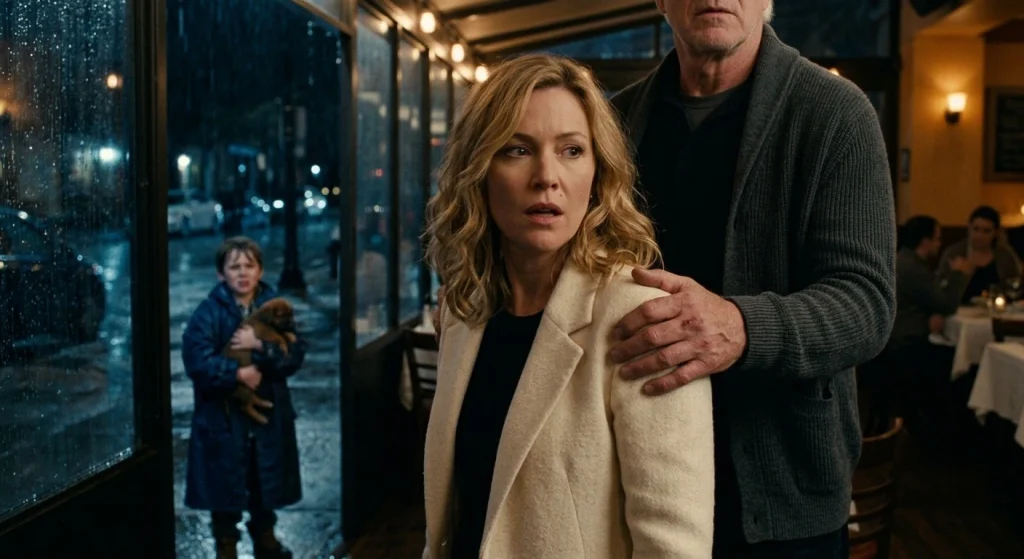

The patio at Aldren’s was the kind of place that cost money just to walk past.
Three walls of floor-to-ceiling glass sealed it off from the street like a terrarium for the wealthy. Chandeliers no one needed. Silverware no one counted. A guest list that said more about your last name than your character.
Victoria Hargrove had booked the entire east patio for twelve.
She sat at the head of the table in a cream Chanel blazer, her gold bracelet catching the light every time she lifted her wine glass — which was often. Around her: her usual crowd. Margot, who collected divorces the way other women collected handbags. Phillip, who hadn’t held a real job in eleven years but still managed to have opinions about everyone else’s finances. Diane. Christopher. The rest.
“The wagyu is obscene,” Margot said, cutting into her steak. “In the best possible way.”
“It should be. I told them nothing under A5.” Victoria didn’t look up from her phone. “If I’m hosting, I’m hosting.”
Outside, the rain came down in cold, slanted sheets.
The street beyond the glass had gone dark and wet. The glow from the patio lights hit the puddles and scattered. Anyone standing out there would have been invisible to the diners inside — just another patch of winter shadow.
Except Victoria noticed him.
She always noticed things she could use.
He was small. Maybe seven, maybe eight. Hard to tell when someone was that thin. He wore a jacket that was three sizes too big and soaked through at the shoulders. His sneakers had gone gray with water. He stood at the glass with both hands pressed flat against it, not begging, not knocking — just looking.
In the crook of his left arm, tucked against his chest like something precious, was a dog. A tiny thing. Wet fur matted in every direction. Shaking.
The boy was shaking too.
“Oh my god,” Diane said quietly, spotting him. “Is that a child?”
“Don’t make eye contact,” Phillip said. “They’ll just —”
“He’s soaking,” Margot said.
Victoria set down her wine glass.
Something crossed her face. Not pity. The others would later describe it differently — some said she smirked, some said she smiled — but everyone agreed her eyes went flat and deliberate the way they always did right before she did something she’d decided to enjoy.
She stood.
She walked to the serving cart near the window, lifted the large silver platter — the one loaded with the remaining prime cuts, the backup portions the kitchen had sent out twenty minutes ago and no one had touched — and carried it to the patio doors.
The boy saw her coming. His face opened up. He straightened.
He thought she was bringing it to him.
Victoria looked directly at him through the glass. She held his gaze. Then she pushed open the door with her shoulder, stepped just past the threshold into the covered overhang, and upended the entire platter into the gutter.
The steaks hit the puddles with a wet, flat sound.
The gravy spread across the dirty water in a dark ribbon.
The boy didn’t move for a second. Then his face crumpled. His arms tightened around the puppy. He made a sound — not loud, just a small, broken exhale — and looked down at the ruined food floating in the gutter.
Victoria laughed.
It was a real laugh. Bright and full and genuinely entertained.
She turned back to her table. “Problem solved,” she said, reaching for her wine.
Her friends said nothing.
Margot had put her fork down.
Phillip was staring at the tablecloth.
Diane had turned her chair so she didn’t have to look at the window.
None of them said a word.
That was the thing about Victoria’s crowd. They never said a word.
The restaurant’s interior beyond the patio was quieter tonight — a Wednesday, off-season for the downtown lunch crowd. A few couples. A businessman working through a bowl of French onion soup at a corner table near the partition.
He was old. Maybe seventy, maybe more. Wore a plain charcoal cardigan, no tie, no watch anyone would notice. His hair had gone fully white. His hands, wrapped around the soup bowl for warmth, were large and scarred across the knuckles in the way hands get scarred from decades of actual physical work.
He had been sitting there for forty minutes.
He’d ordered soup and bread and a glass of water.
He’d watched the boy at the glass.
He’d watched Victoria pick up the platter.
He watched her dump it.
He set down his spoon.
He sat still for a moment, the way a person sits still when they’ve made a decision and are simply calculating how to execute it cleanly.
Then he stood.
He was taller than he looked sitting down. He moved through the dining room slowly, without urgency, toward the patio partition. A young server near the pass saw him and went very still. Then the server said something quietly into his earpiece.
Two men in dark suits appeared from a door near the host stand.
Then two more.
They didn’t rush. They simply positioned themselves — one at the patio door that led back to the main restaurant, one near the exterior entrance, two flanking the partition — with the calm, practiced arrangement of people who had done this kind of thing before and knew exactly how little force was required when the positioning was correct.
Victoria didn’t notice any of this.
She was telling a story about a ski resort in Aspen and the incompetence of the rental staff.
She felt the hand on her shoulder before she heard him.
Heavy. Firm. Not rough — just immovable.
She turned.
The old man in the cardigan was standing behind her.
“Excuse me,” she said. “Do you mind? We’re in the middle of —”
“My name is Edmund Harlan,” he said.
He said it the way a person states the weather. No inflection. No performance.
Something flickered across Phillip’s face. Then Margot’s.
“I’m sorry,” Diane said slowly. “Did you say Edmund —”
“Harlan,” Victoria said. And for the first time that evening, her voice lost its edge. She stared at him. “You’re Edmund Harlan.”
“I am.” He pulled a chair from an empty neighboring table, set it down across from her, and sat. “I also own this building. And the four blocks around it. And, as of three weeks ago, the mortgage on your family’s estate in Westchester.” He paused. “Among other things.”
Victoria’s wine glass was still in her hand. She set it down very carefully.
“I don’t know what you think you —”
“I’ve been watching you for about forty minutes,” Edmund said. “I was going to finish my soup and leave. People disappoint me regularly. I’ve made peace with it.” His eyes moved to the glass, to the street beyond. “But that boy is still standing in the rain.”
Everyone at the table looked.
He was. Still there. Still holding the puppy. Not looking in anymore — just standing, head down, rain running off the back of his jacket.
“That’s not my problem,” Victoria said. “People walk by children on the street every day. I don’t see you —”
“I grew up on the street,” Edmund said. Simply. No drama in it. “Not a metaphor. Not an anecdote I tell at fundraisers. I slept in a parking structure on 9th Avenue for fourteen months when I was nine years old.” He looked at her. “I know exactly what that boy is feeling right now.”
Victoria opened her mouth.
Edmund raised one hand, slightly, and she closed it.
“I’m not here to argue with you,” he said. “I’m here to do two things.” He reached into the inside pocket of his cardigan and removed a folded set of papers. He set them on the table in front of her, flat, unhurried. “The first is to give you those.”
Victoria looked at them without touching them.
Margot leaned slightly. She read the header. Then she leaned back.
“What is that?” Phillip asked.
No one answered him.
“Those,” Edmund said, “are your family’s foreclosure filings. And the bankruptcy petition your attorneys filed eleven days ago in the Southern District.” He kept his voice even. “I assumed you’d want to have them, since I understand you’ve been telling your friends your family’s portfolio is performing exceptionally.”
The color left Victoria’s face in a single, clean withdrawal.
“Those are private —”
“They’re public record as of last Friday,” Edmund said. “Anyone can access them. I simply printed a copy for your convenience.”
Margot pushed her chair back slightly from the table.
Phillip had gone very still.
Diane was looking at Victoria with an expression that was not sympathy.
“You can’t just —” Victoria’s voice cracked. She steadied it. “This is harassment. I’ll have my lawyers —”
“Your lawyers,” Edmund said, “filed those papers. They work for me now. Your family sold the firm’s debt to one of my holding companies in September.” He tilted his head. “You might want to get new lawyers.”
Victoria stood up. Her chair scraped back. “I am leaving.”
Edmund nodded. “That’s the second thing.”
He looked toward the patio doors.
The two men in dark suits moved.
Not toward Victoria — just to the doors. One held the exterior patio door open. The other spoke quietly into his earpiece.
Through the glass, movement: two more men in suits emerged from a dark SUV parked at the curb. With them — badges visible now under the restaurant lights — were two police officers.
Victoria saw them.
She understood.
“What is this,” she said. Not a question. The voice of someone already knowing the answer and testing whether saying it differently would change anything.
“Tax evasion carries its own timeline,” Edmund said. “I didn’t file the report. The IRS did — about six months ago. I simply made a call this afternoon to confirm they were still looking for a moment to execute.” He stood from the chair. “Apparently tonight worked for everyone.”
“You can’t do this —”
“You dumped four hundred dollars of food into the gutter,” Edmund said, “while a hungry child watched you.” His voice was still even. “I can do quite a lot of things. This is a small one.”
The officers came through the door.
Victoria turned once to her table — to Margot, to Phillip, to Diane — as if expecting someone to stand, to say something, to make a call.
No one moved.
Margot picked up her fork and began eating again.
“Victoria Hargrove,” one of the officers said.
“I know,” Victoria said quietly.
She was escorted out through the main restaurant, not the patio — through the full dining room, past every table, under the lights, between the white tablecloths and the staring faces of couples mid-dinner who stopped their conversations to watch a woman in a cream Chanel blazer walk out in handcuffs with her hair starting to come loose from its pins.
The restaurant was very quiet.
Then someone near the back started eating again, and the sound of silverware returned.
Edmund stood at the exterior patio doors.
The boy was still there.
Edmund pushed the door open.
The cold came in immediately — real, wet, winter cold that made the warmth of the patio feel suddenly small.
The boy looked up. His eyes were red. His grip on the puppy tightened on reflex.
Edmund crouched down. He was a large man and he made himself smaller deliberately, the way someone does when they know from experience that size is frightening when you’ve had nothing.
“What’s his name?” Edmund said. He nodded at the puppy.
The boy blinked. He hadn’t expected the question. “I don’t know yet,” he said. His voice was hoarse. “I just found him. He was under a car.”
“Okay,” Edmund said. “You should name him tonight. Dogs need names early.”
The boy looked at him.
“Are you hungry?” Edmund said.
A pause. The boy’s jaw worked. He gave a very small nod.
Edmund stood. He turned back to the doorway and looked at a server who had appeared at the threshold. “Best table,” he said. “And whatever the kitchen has that’s warm. Both of them.”
He looked back at the boy.
“Can you carry him inside, or do you want me to?”
The boy looked down at the puppy, then up at the warm light spilling out from the patio, the white tablecloths, the glasses still glowing amber.
“I can carry him,” the boy said.
“Good.” Edmund stepped back and held the door.
The boy walked in.
He left wet footprints on the marble. No one said anything.
Edmund followed and let the door close behind them, sealing out the rain.
At the table — the best one, center of the patio, glass on three sides — the server brought out bread first. Hot, in a cloth. The boy set the puppy on the empty chair beside him, and the puppy turned three times and lay down, and stopped shaking.
The boy watched this happen.
Then, for the first time, his shoulders dropped.
Edmund ordered the soup. The real dinner would take a few minutes, the server said.
“What do they have that a dog can eat?” Edmund asked.
The server thought. “We have plain chicken breast. I can have the kitchen slice it small.”
“Please.”
Edmund sat across from the boy. He didn’t make conversation. He just sat there the way adults sit with children when they understand that silence is sometimes the most generous thing you can offer — no questions yet, no paperwork, no processing. Just the table and the warmth and the bread cooling slightly in its cloth.
The boy reached for the bread.
He ate.
After a while, without looking up, he said: “Why did she do that? With the food?”
Edmund thought about this.
“Some people,” he said, “only feel large when they make others feel small.” He watched the boy eat. “It never actually works. But they keep trying.”
The boy considered this. He tore another piece of bread. He fed a small corner of it to the puppy.
“Is she in trouble?” the boy asked.
“Yes,” Edmund said.
“A lot of trouble?”
“Enough.”
The boy nodded slowly. He seemed satisfied with this — not gleeful, just settled. The way a child accepts a true answer when adults are honest enough to give one.
The soup came. Then the chicken for the puppy. Then, eventually, the full meal — real food, hot, on real plates, with cloth napkins the boy didn’t know what to do with and finally just left folded.
Edmund didn’t correct him.
Outside, the rain kept coming down.
Inside, it was warm, and the puppy had fallen asleep, and the boy was on his second bowl of soup and beginning to look less like someone bracing for a blow and more like someone simply sitting.
At some point, Edmund said: “Have you decided on the name?”
The boy looked at the sleeping puppy. He thought about it seriously, the way children think about things that matter.
“Rex,” he said finally.
Edmund nodded. “Good name.”
“It means king,” the boy said.
“I know,” Edmund said.
The boy looked up at him for a moment with something careful and assessing in his expression — the kind of look children give adults who turn out to be different from what they expected.
“What’s your name?” the boy said.
“Edmund.”
“I’m Danny.”
“Hello, Danny.”
They shook hands across the table.
Outside, a police car rolled silently past the glass, lights off, no hurry now.
Danny watched it go.
Then he went back to his soup.
Edmund signaled the server for the check, and then, after a moment, waved him off.
Tonight, the bill could wait.
Margot left the patio first. She didn’t say anything to Phillip or Diane. She simply picked up her bag and her coat and walked out through the main restaurant, past the table where Danny was eating, without looking at it.
Phillip stayed another twenty minutes, then left too. He paused near the host stand on his way out, seemed about to say something to the maître d’, then didn’t.
Diane was the last. She stopped near Edmund’s corner table — the original one, the soup bowl still sitting there, half-finished — and stood for a moment looking at it.
Then she walked to Danny’s table.
Danny looked up.
“I’m sorry,” Diane said. “That I didn’t do anything.”
Danny looked at her for a moment. He was eight years old and had probably heard a lot of adult apologies and understood already, with the particular intelligence of children who’ve had to pay attention, how much they were worth.
“Okay,” he said.
Diane nodded. She left.
Edmund, who had heard this, said nothing.
He watched Danny finish the last of his soup. He watched Rex shift in the chair and settle again with a small noise.
He thought about a parking structure on 9th Avenue. The smell of exhaust and cold concrete. The way a car engine sounds when it’s the only warmth in forty feet.
He thought: sixty years.
Sixty years between that parking structure and this table. Between that boy and this one.
He thought: not enough changes. And then sometimes something does.
He picked up his water glass.
“Danny,” he said.
The boy looked up.
“When you’re done eating, we’re going to make some calls. Find somewhere warm for you and Rex tonight. Tomorrow we’ll sort out the rest.” He set the glass down. “But tonight you eat. Understood?”
Danny looked at him. The careful, assessing look again.
Then: “Okay.”
He went back to eating.
Edmund sat back in his chair.
Outside, the rain finally began to slow. The street gutter ran dark for a while longer, carrying away the last of what had been wasted, and then it cleared, and the water ran clean, and the city went on.
Six weeks later, Victoria Hargrove entered a federal courtroom in lower Manhattan.
The bankruptcy was public by then. The tax case was moving fast — the kind of fast that happens when the documentation is thorough and the prosecutor is motivated. The Westchester estate had been seized. The apartment had been listed. The friends had redistributed, as friends of that kind always do, toward whoever remained solvent.
Margot sent a fruit basket to someone’s holiday party and didn’t mention Victoria’s name.
Phillip gave an interview to a financial podcast about the importance of diversification.
Diane deleted her Instagram.
Victoria sat at the defense table in a gray suit that wasn’t Chanel, next to a public defender, and looked at the courtroom with the expression of someone who had spent her whole life being looked at and was now, for the first time, not enjoying it.
The charges were read.
The proceeding began.
Victoria said nothing.
There was nothing left to say.
Edmund Harlan’s office was on the 34th floor of a building he also owned, on a street he’d been walking since before the current city government was born.
On his desk was a framed photograph — not of himself, not of any deal or acquisition or ceremony. A photograph of a boy and a medium-sized dog, the dog no longer small, sitting in a patch of afternoon sun on what appeared to be a building’s front stoop.
Edmund had arranged, through a foundation he ran quietly and didn’t name things after himself, for Danny to be placed with a foster family in Brooklyn. Good people. A retired teacher and her husband. They had space and patience and a backyard, which Rex had opinions about.
Edmund visited on a Tuesday in February.
Danny answered the door.
He’d grown half an inch. He looked warm.
“Rex dug a hole under the fence,” Danny reported immediately. “We fixed it with rocks.”
“Smart,” Edmund said.
“It was my idea.”
“I believe you.”
They had lunch. The foster mother made soup — a different soup, chicken, with wide noodles — and they sat around a small kitchen table and ate it, and Rex put his head on Edmund’s shoe and stayed there for the entire meal.
After lunch, Danny showed Edmund the name he’d written on a piece of paper and taped to his bedroom door.
DANNY’S ROOM.
Not a question. Not a request. Just a fact, stated clearly, in blue marker, by a boy who had decided he was allowed to take up space.
Edmund looked at it for a long moment.
“Good,” he said.
Danny nodded. He’d known Edmund would say that.
Some things, once decided, don’t need arguing.
The patio at Aldren’s was booked solid on Saturday nights.
Edmund almost never ate there. He had an office with a window and usually ate a sandwich at his desk and read the reports his team left in the morning. Simple habits, held since the days when simple was all he had.
But occasionally, on a night when the city was doing that specific winter thing — the rain half-turning to something heavier, the glow of lights on wet stone — he would walk past the restaurant and stop for a moment at the glass.
Not to look at the patio.
To look at the street.
At the empty stretch of sidewalk outside.
At what wasn’t there anymore.
Then he’d turn up his collar and keep walking.
He had calls to make. There was always another call to make. Another piece of paper to sign. Another arrangement to set in motion that would be invisible and quiet and would matter to exactly one person in a way that no one else would ever measure or count or know about.
That was fine.
He hadn’t done it to be counted.
He did it because sixty years ago, on a cold night outside a building with warm lights, no one had opened the door.
He’d always meant to fix that.
He was fixing it.
One door at a time.
Original fictional stories. AI-assisted creative content.