
Claire had always loved the basement. It was the one room in the house that felt entirely hers — dark, cool, stacked with old sketchbooks and half-finished canvases. Arthur never came down here. He said the damp bothered his sinuses.
Tonight she was reorganizing. Moving the old mahogany bookshelf had been on her list for two months, and she finally had the energy.
She gripped the frame and dragged it forward. A small object hit the concrete floor with a sharp click.
She picked it up. A USB drive, unmarked, wrapped in electrical tape. The tape that had held it — flush against the underside of the bottom shelf — was still sticky.
She stared at it for a long moment.
Then she carried it to her laptop.
The drive opened quietly. Dozens of audio files, organized by date. The oldest was from six weeks ago. The newest was labeled Claire_Final_Statement.wav.
Her name. In the file title. On a drive she had never seen before.
She clicked play.
Her own voice filled the room.
“I’m so sorry. I know I’ve been a burden for a long time. I don’t want anyone to feel guilty about this. It’s my decision and mine alone…”
The voice continued. Calm. Heartbroken. Specific. It named Arthur. Named their house. Named the trust fund she’d inherited from her grandmother — two point three million dollars, held in her name alone. It said she’d been struggling for years. It said she couldn’t go on.
It was a suicide note. In her voice. Recorded clean, with no background noise, no artifacts. A professional forgery.
Claire sat perfectly still.
She had never said any of those words.
She didn’t move for almost a minute. Her mind kept rejecting what her ears were processing.
Then a shadow crossed her screen.
She turned slowly.
Arthur stood at the bottom of the basement stairs. He was holding a glass of red wine in one hand. In the other, a thick medical syringe, the kind used for large-volume injections. His face wore its familiar, warm expression — the one she’d fallen in love with nine years ago.
That expression lasted exactly two more seconds.
Then he saw the laptop screen. Saw the file name. Saw her face.
The warmth evaporated.
“Claire.” His voice dropped to something she had never heard before. Flat. “Put that away.”
“You made this,” she said. The words came out before she’d decided to say them.
“You’re misreading what that is.”
“I’m hearing myself read a suicide note, Arthur.”
He took one step toward her. “You’ve been under enormous stress. I’ve been worried about you. We should talk about this upstairs.”
“While you carry a syringe.”
He looked down at his hand as if he’d forgotten it was there. Then back at her. “This is not what you think.”
“Then put it down.”
He didn’t.
She knew in that moment — with the absolute clarity that only pure fear can produce — exactly what the night was supposed to look like. The wine, probably laced. The injection as backup. Her body arranged somewhere plausible. The audio files discovered later, on her own laptop, passcode-free because he knew it. The trust fund transferring to him as her surviving spouse within ninety days of probate.
He had planned every detail.
He had cloned her voice.
He had taped the drive under the shelf himself, so it would look like she’d hidden it.
Arthur took another step toward her. “Claire, I need you to calm down.”
She grabbed the fireplace poker from the corner stand beside the shelf.
He blinked. “What are you—”
She swung it low and hard, the way her father had taught her to swing a bat when she was eight years old.
The impact was catastrophic. Arthur went down with a sound she would hear in her sleep for years afterward — a crack, then a scream, then the heavy thud of his body on the concrete floor. The syringe skittered across the room and came to rest against the far wall.
He was alive. He was not getting up.
Claire stepped over him, ran up the stairs, and locked the basement door with the deadbolt Arthur himself had installed three years ago, claiming it was for security.
Then she called 911.
“Nine-one-one, what’s your emergency?”
“My name is Claire Mercer. My husband just attempted to drug me in our basement. He’s incapacitated. I have a USB drive with forged audio evidence of a staged suicide. I need police and an ambulance.”
A pause. “Ma’am, are you in a safe location?”
“I’m standing at my front door with a fireplace poker. Please hurry.”
The first unit arrived in eleven minutes. Two detectives followed forty minutes after that.
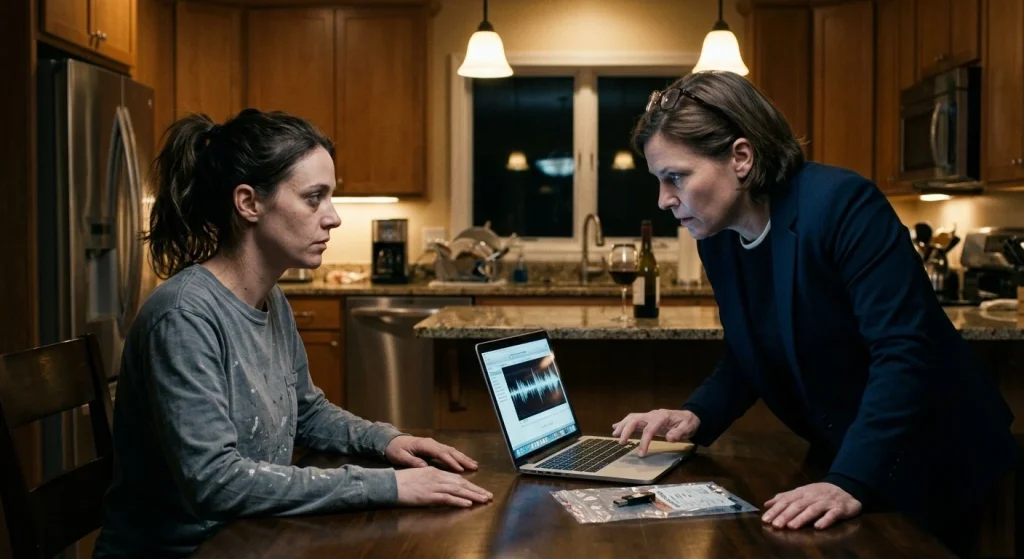
Claire sat at her kitchen table wrapped in a blanket, the laptop open in front of her, the USB drive in an evidence bag. She had not cried yet. She wasn’t sure she was capable of it right now.
Detective Harlow, a short woman with reading glasses pushed up on her forehead, leaned over the screen. She listened to thirty seconds of the file. Then she straightened up.
“AI-generated voice clone,” she said to her partner. Not a question.
“Forensics will confirm,” he said.
“They’ll confirm.” She looked at Claire. “You said there are other files on this drive?”
“Dozens. Dated across the last six weeks.”
“He was building a timeline,” the detective said quietly. She looked almost impressed, in the way that professionals sometimes are when they encounter meticulous evil. “He wanted it to look like a documented deterioration.”
“He works in software,” Claire said. “He knows how to build systems.”
“He built one too well.” Harlow closed the laptop. “Everything on this drive is federal. Wire fraud, forgery, conspiracy. The attempted drugging tonight is attempted murder. He’s not coming home.”
Claire stared at the kitchen table. The wine glass Arthur had poured — for her, presumably — was still sitting on the counter. She hadn’t touched it.
“Can I ask you something?” she said.
“Go ahead.”
“How long does it take to clone someone’s voice well enough to pass forensic review?”
Harlow exchanged a glance with her partner. “With current commercial tools? For someone who knows what they’re doing?” She paused. “A few hours. Maybe less.”
Claire thought about the evenings Arthur had spent in his home office with the door closed. She had assumed he was working. She had made him tea and slid it under the door.
She had handed him the raw material.
Arthur Mercer was arraigned four days later. His attorney entered a not-guilty plea, which lasted until the FBI’s digital forensics team traced the AI voice synthesis software to a subscription purchased on Arthur’s work credit card fourteen weeks prior.
At sentencing, the judge noted that the sophistication of the forgery — and the fact that Arthur had also forged three separate “journal entries” on Claire’s personal cloud account — demonstrated a level of premeditation that warranted the maximum enhancement.
Arthur received twenty-two years.
Claire sold the house. She moved to a rented studio apartment with high ceilings and good north light, the kind she’d always wanted. She changed her laptop password. She started locking her sketchbooks.
Six months later, her attorney finalized the divorce. The trust fund — two point three million dollars, established by her grandmother, held in her name alone — remained exactly where it had always been.
Intact.
Untouched.
Hers.
She opened a new sketchbook. On the first page she drew a small USB drive, just the outline of it, then closed the book and went to make coffee.
She didn’t need to finish the drawing. She already knew how the story ended.
Original fictional stories. AI-assisted creative content.