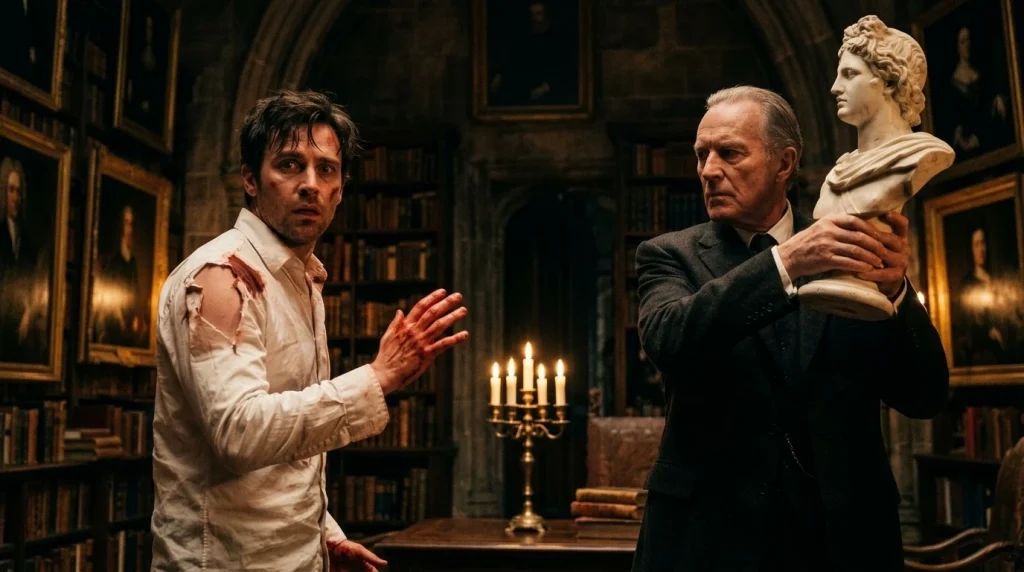

Julian had been working for three hours when he first heard the scraping sound of his own scalpel stop making sense.
He was in the library of Ashford Estate—stone walls, cathedral ceilings, the kind of room that swallowed light. The owner, Arthur Graves, sat twenty feet behind him in a velvet armchair, a teacup balanced on one knee, eyes milky white and fixed on nothing.
“You’re very precise,” Arthur said quietly. “Most restorers rush.”
“That’s how they ruin things,” Julian answered without turning around.
He returned to the portrait. A Victorian matriarch, supposedly painted in 1887. Dark, cracked varnish coated the surface like old skin. Julian’s job was to strip it back, slowly, let the original colors breathe again.
The scalpel carved another thin curl of old varnish away.
Julian leaned closer.
His hand stopped.
The face beneath wasn’t Victorian. It wasn’t historical. It wasn’t old at all.
He knew those cheekbones. That jawline. The faint scar above the left brow from a bicycle fall when she was nine.
“No,” he whispered.
His sister Emma had been missing for three years. The police had stopped looking after fourteen months. Julian had never stopped.
He pressed one finger to the painted cheek.
It came away red. Wet. Oil paint that hadn’t dried.
His stomach lurched. He stepped back from the canvas—and looked left. Then right.
Every portrait in this library. Twelve frames. Twelve faces locked behind layers of false varnish.
“You’re very quiet suddenly,” Arthur said from behind him.
Julian didn’t answer. He moved to the nearest adjacent painting—a supposed 18th-century merchant—and pressed his thumbnail to the corner. The surface gave. Tacky. Fresh.
He moved to the next. And the next.
Fresh. Fresh. Fresh.
Every face in this room was real. Every portrait was a grave marker.
“How many?” Julian said. His voice barely worked.
Silence from the armchair.
Julian turned around slowly.
The armchair was empty.
The teacup sat on the side table, still steaming. He hadn’t heard Arthur stand. Hadn’t heard footsteps. The room was forty feet wide with a stone floor and he hadn’t heard a single sound.
“Arthur.”
Nothing.
Julian’s eyes moved to the shadows at the far end of the room—between the shelves, where the candlelight didn’t reach.
Arthur was standing there.
Not shuffling. Not feeling along the shelves with cautious hands. Standing completely still, both eyes open wide, pupils sharp and dark and perfectly focused directly on Julian from across the room.
The milky film was gone.
“You weren’t supposed to work that fast,” Arthur said. His voice was different now. Quieter. Colder.
“You can see.” Julian’s voice came out flat.
“I could always see.” Arthur stepped forward, one slow, unhurried step. “The blindness was for guests. People are so much more relaxed around a helpless old man.”
Julian’s gaze dropped. Arthur’s right hand was raised. In it—a marble bust, Renaissance-style, heavy and pale, held overhead like a hammer.
“She came to restore a landscape,” Arthur said. “Your sister. She had excellent references.”
Julian threw himself left.
The marble came down with a sound like a gunshot. The wooden easel exploded into splinters beneath it. Canvas and frame collapsed. The portrait of Emma hit the floor face-up, wet paint smearing across the stone.
Julian ran.
He didn’t know the room. He ran by instinct, angling toward the far wall, toward the faint gray rectangle of a window in the dark.
“Stop running,” Arthur called behind him, almost conversational. “There’s nowhere—”
Julian hit the stained-glass window at full speed, shoulder-first. It exploded outward in a cascade of colored fragments and cold air. He tumbled through, caught the stone ledge with one hand, tore his palm open, and dropped six feet onto wet grass.
He rolled. Got up. Ran into the fog.
He ran until the estate lights were swallowed by the dark. Then he ran further.
The police came back with him three hours later—four squad cars, two detectives, a forensic unit.
They found the chamber behind the portrait wall.
It took a crime scene investigator forty minutes to count the canvases stacked inside. Thirty-one in total. All of them fresh. All of them faces.
Emma’s portrait was among the first twelve confirmed. She had been there the longest.
Arthur was apprehended at the front gate, still carrying the marble bust. He had walked calmly toward the road in the fog, apparently confident Julian hadn’t survived the fall.
He said nothing when the cuffs went on. He looked at Julian across the gravel drive with those sharp, clear eyes—and for one moment, Julian looked straight back.
“You picked the wrong restorer,” Julian said.
Arthur said nothing.
The detective beside Julian touched his shoulder. “We’ll need your statement.”
“I know.” Julian didn’t look away from Arthur until the squad car door closed. “I’ve been waiting three years to give it.”
At trial, the prosecutor laid out seventeen months of evidence. Thirty-one confirmed victims. Eleven families who had spent years not knowing.
Arthur Graves received seven consecutive life sentences without the possibility of parole. The estate was seized. The portraits were removed and documented—each one a record of someone who had walked through that front door and trusted an old blind man in a velvet chair.
Emma’s portrait was the last piece of evidence entered. Julian sat in the gallery and watched them carry it past.
He didn’t look away.
Outside the courthouse, a detective who had originally closed Emma’s case found him on the steps.
“I owe you an apology,” she said.
“You owe her family one,” Julian said. “Mine, and all of theirs.”
She nodded. “You’re right.”
He walked to his car. He didn’t know what came next—grief, probably, and the long work of a proper burial, and the even longer work of putting himself back together after three years of not knowing had ended in one night with a scalpel and a wet canvas.
But Arthur Graves was in a cell. The chamber was empty. The portraits had names now.
Julian started the car and drove toward the morning.
Original fictional stories. AI-assisted creative content.