
Sarah had been white-knuckling the wheel for three hours.
Interstate 95 at 2 AM was nothing but black road and headlights bouncing off tree lines. She had her phone on the dash, speaker on, Greg’s voice keeping her tethered to something warm and familiar.
“You’re almost home,” he said, his voice thick with sleep. “Just stay on 95 and wake me up when you hit the exit.”
“I will. Go back to sleep, babe.”
She heard him shift in bed. The rustling of sheets. The small, domestic sound of it made the dark highway feel less threatening.
Then the signal dropped.
Dead silence. Not static — nothing. The call just vanished.
Sarah exhaled and reached for the radio dial. That was when the infotainment screen lit up blue.
Bluetooth Device Connected: Greg’s iPhone.
She stared at it.
Bluetooth. Thirty feet. Maximum.
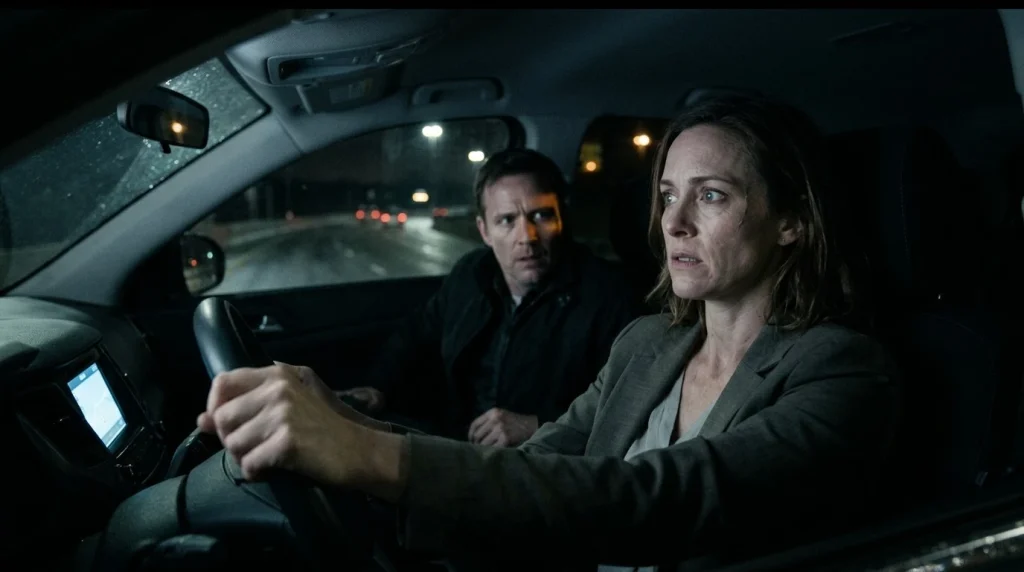
Her hand froze on the dial. The SUV drifted slightly right before she corrected it. Her eyes moved to the rearview mirror — just a flicker, just a reflex — and the air left her lungs entirely.
In the dark of the backseat, something was moving.
A shape. Rising slowly from the floor behind the passenger seat. She caught the pale blur of a face in the passing glow of a distant highway lamp, and for one impossible moment she told herself it wasn’t him.
It was Greg.
Same jaw. Same hairline. Same Greg she’d kissed goodbye four days ago when she left for the conference.
He was looking at her the way a stranger looks at a problem they’ve already solved.
“Hey, Sarah,” he said. Flat. Casual. Like he was asking if she’d eaten.
She didn’t scream. Her body didn’t let her. Everything went cold and mechanical — survival brain overriding everything else.
Greg rose from the floor in one smooth motion, the thick plastic zip-tie already looped between both hands, and lunged.
The loop caught her throat before she could duck.
The plastic was rigid, clinical, nothing like rope — it bit in immediately. She gagged, both hands flying up, the SUV lurching hard into the left lane as her foot came off the gas. Greg grunted behind her, bracing against the headrest, pulling tighter.
She didn’t think. She just slammed the brake.
Both of them went forward. Her seatbelt caught. Greg didn’t have one. He hit the center console face-first with a sound like a bat hitting a melon, then bounced into the dash, and the pressure on her throat disappeared.
Sarah didn’t look back.
She yanked the door handle while the car was still shuddering to a stop, tumbled out onto the asphalt, hit the gravel shoulder hard enough to tear open her palms, and rolled down the embankment.
Weeds. Mud. The smell of drainage ditch.
She crawled into the tree line on her hands and knees and pressed herself flat behind a fallen log, gasping.
Behind her, the SUV sat crooked across the lane, hazards clicking on automatically. She could hear Greg moving inside. A door opened.
“Sarah.” His voice in the dark. Controlled still, but with something underneath it now — the first thread of panic. “Sarah, come on. Let me explain.”
She stayed silent. Pine needles against her cheek. Heart so loud she was sure he could hear it.
A pair of headlights appeared far up the road. Big. High. A long-haul truck dropping speed as it approached the stopped car.
Greg saw it. A long pause. Then she heard his footsteps on the asphalt, moving back toward the SUV, and the sharp hiss of him yanking the door open.
The truck slowed to a stop. Air brakes. A cab door.
“You alright?” A man’s voice, deep and unhurried.
From the brush, Sarah screamed.
She screamed until her throat gave out, screamed his name, screamed call 911, screamed until she saw the trucker freeze and grab his phone from his pocket, and she didn’t stop until she could see the blue-red pulse of police lights coming over the far hill.
The first officer found her sitting on the tailgate of the tow truck, a reflective blanket around her shoulders, the zip-tie still loose around her wrist from where she’d pulled it off her throat as evidence.
Two units had Greg pinned on the shoulder, hands cuffed behind him, blood from the dash impact dried dark across his forehead. He was saying something about a misunderstanding.
The detective who sat down beside Sarah was a woman, fifties, no-nonsense ponytail. She had a notepad open but hadn’t written anything yet.
“He say anything to you in the car?” she asked.
“No,” Sarah said. “He just went for my throat.”
The detective nodded, clicked her pen. “We ran the plates on the way out here. You know he took out a life insurance policy on you six days ago?”
Sarah didn’t move. “How much?”
“Two point four million.”
The blanket crinkled as she exhaled. “There’s a woman,” Sarah said. “I don’t know her name. Check his phone.”
“We will.”
They did. The phone was unlocked, still open to a text thread — two hundred and forty messages, the last one sent at 1:47 AM, fourteen minutes before his Bluetooth connected to the car. The last message read: Almost done. Drive to the address I sent you. Don’t text back.
The detective read it twice, then looked at Greg across the highway, where he was still explaining himself to officers who had stopped listening.
“Thirteen years married,” Sarah said. It wasn’t a question.
“I’m sorry.”
“Don’t be.” She pulled the blanket tighter. “I am.”
The trial lasted nine days.
The prosecution laid it out in order: the insurance policy dated six days prior, the burner credit card used to purchase the zip-ties — a ten-pack, cash, at a gas station forty miles from their house — the text thread with the mistress, the Airbnb she had been waiting at in Savannah, the search history on Greg’s laptop that included how long does it take to find a body in a river and what does a staged carjacking look like to police.
Greg’s attorney argued impulse, argued instability, argued that Sarah had driven him to a breaking point.
The jury took less than four hours.
Greg got twenty-two years on the attempted murder charge alone. The insurance fraud added another eight, consecutive.
The mistress was charged separately. She pled out. Testified against him in exchange for reduced sentencing and spent eleven months in a minimum-security facility before release. She did not attend any of his hearings.
Sarah sold the house.
She bought a small place two hours north, near the coast — a blue-gray cottage with a view of the water and a gravel driveway that crunched loud enough that she could always hear when someone was coming.
On the day the divorce was finalized, her attorney called her with the paperwork confirmation. Sarah was standing on her porch with a coffee, watching the fog come in off the ocean.
“It’s done,” her attorney said. “Everything’s filed. You’re clear.”
“Thank you, Linda.”
“What are you going to do now?”
Sarah watched a pelican drop low over the water and disappear into the gray.
“Nothing,” she said. “Absolutely nothing.”
She meant it as the best possible answer.
Original fictional stories. AI-assisted creative content.