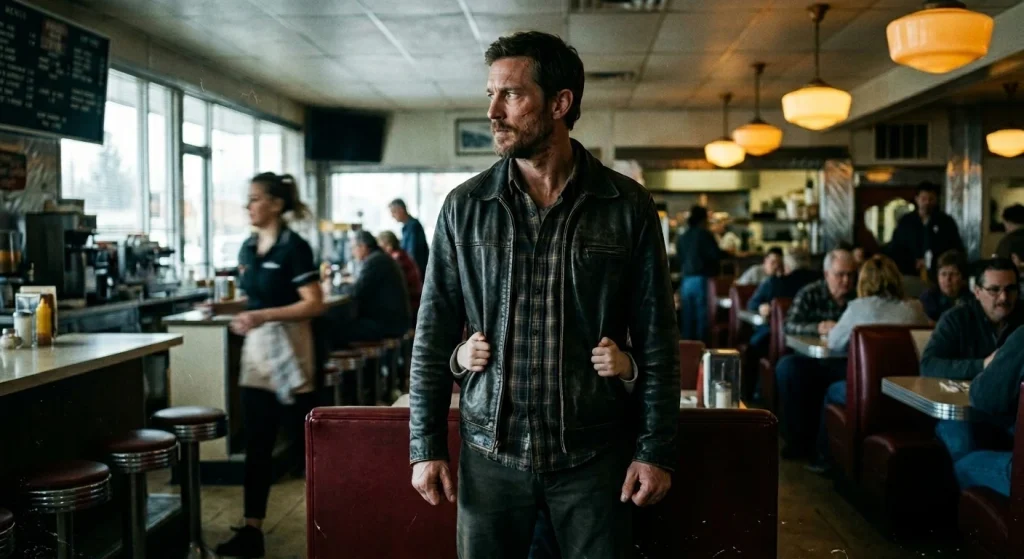

The diner smelled like burnt coffee and old grease — the kind of place where people minded their business because they didn’t want anyone minding theirs.
Marcus had been sitting alone for twenty minutes. Booth in the back. Coffee he hadn’t touched. A view of the door out of habit, not preference.
Then the chair scraped.
Loud enough that three tables went quiet.
A boy — maybe nine years old, red hoodie soaked through from rain — was pushing through the lunch crowd with his arms out and his face completely broken. Tears and snot. Breath coming in pieces. The kind of crying that’s already been going on a long time.
He wasn’t looking at anyone.
He was looking for someone.
His eyes landed on Marcus and stayed there.
He ran.
Both small fists grabbed the sleeve of Marcus’s jacket and held on like it was the edge of something.
“They found me where you said they would,” the boy whispered. “You said if they ever came — I come here.”
Marcus went still.
He hadn’t moved yet. Hadn’t stood. But the stillness itself was a kind of action — the whole booth seemed to contract around it.
“Who told you to say that?” he said quietly.
“My brother.” The boy’s chest shook. “He said you’d know my face.”
Marcus stood.
Not because he was sure. Because through the diner’s front glass, past the amber light and the condensation on the windows, two men in dark hoodies were crossing the parking lot. Not running. Walking. The way men walk when they already know where someone is.
He put himself between the boy and the door.
The nearest waitress — fifties, name tag reading Deb, a woman who had seen enough in this diner not to react to much — took one look at Marcus’s face and went still behind the counter.
The two men came through the glass door without breaking stride.
They scanned the room once. Found what they were looking for.
The taller one had a jaw like a cinder block and the flat eyes of someone who’d stopped negotiating years ago. He looked at the boy first. Then at Marcus. Then let the corner of his mouth go up just slightly.
“Step aside,” he said. “We’re not here for you.”
Marcus’s voice came out low and even. “Then you came to the wrong place.”
The second man — shorter, wider, a scar of his own across his left hand — moved a half-step to the right, positioning. Automatic. Professional.
The boy pressed tighter behind Marcus’s back.
The trucker two tables over set his mug down very carefully, the way a man does when he’s quietly deciding something.
“You don’t know what he is,” the taller one said. “You don’t know who he belongs to.”
“I don’t need to,” Marcus said. “He’s standing behind me.”
“Move.”
“No.”
A beat passed. The diner was so quiet that the hiss of the griddle from the kitchen sounded like static on a broken radio.
The shorter man reached inside his jacket.
That was when Deb the waitress said, very clearly, from behind the counter: “I already called it in. You’ve got maybe four minutes.”
Nobody moved.
The shorter man’s hand stayed where it was — not pulling out, not retreating.
The taller one looked at Deb. Then back at Marcus.
“This isn’t finished,” he said.
“It is today,” Marcus said.
Another pause. Long enough that the old couple by the window had time to quietly slide out of their booth and move toward the kitchen hallway without anyone stopping them.
Then the two men walked back out the way they’d come. Still not hurrying. But they left.
The glass door swung shut.
Nobody in the diner said anything for a full five seconds.
Then the trucker picked his mug back up.
Marcus turned around.
The boy’s hood had twisted in the grabbing and holding, and the collar had folded outward. On the inside — stitched in black thread, amateur, careful — was a name.
Eli.
Marcus stopped breathing.
“What’s your name?” he said. His voice had changed. Quieter. Something underneath it now.
“Danny,” the boy said. “Danny Ware.”
Marcus crouched down so he was at eye level. His hands were steady. His face was not.
“Who stitched that name in your collar?”
“My brother.” Danny pulled the fabric around to see it himself, like he’d forgotten it was there. “He said it was for protection. He said if anyone ever saw it, they’d know whose I was.”
Marcus’s jaw worked once.
Eli Ware.
He knew that name. He’d known it for twelve years. He’d been carrying it for twelve years like something buried in his chest that never quite healed over.
Eli Ware had been nine years old the night Marcus had failed to pull him out of a burning car on Route 9. A job gone wrong. A fire he hadn’t started but hadn’t stopped. The scar across Marcus’s face — the one that made children flinch and strangers look away — was from that fire. From reaching in anyway. From not being fast enough.
Eli had survived.
Marcus hadn’t known that.
He’d spent twelve years believing otherwise.
“Your brother,” Marcus said carefully. “Eli. How old is he?”
“Twenty-one,” Danny said. “He’s in the hospital right now. That’s why I came alone. He said — if anything happens to me while he’s in there, I find the diner on Route 9. He said a man with a scarred face would be there.”
“How did he know I’d be here?”
Danny looked at him with the directness only small children have. “He said you eat here every Tuesday.”
Marcus sat back on his heels.
He did eat here every Tuesday. Had for years. Not because of the coffee. Because it was the last place he’d seen Eli Ware alive — or thought he had — and he couldn’t fully explain why he kept coming back except that some grief needs a place to live.
“He’s been watching out for you,” Danny said. “He never blamed you. He told me that.”
Marcus put one hand over his mouth.
Deb was watching from the counter with the practiced discretion of a woman who understood she was witnessing something that wasn’t hers.
“He said,” Danny continued, “that you were the only person who ever came back to pull him out. He said the other guys ran. You didn’t.”
Marcus stood up. He blinked once. Slowly.
“What hospital?” he said.
“St. Catherine’s. Downtown.”
“Those men outside — they’ll go around. They know where your brother is?”
Danny nodded.
“Then we’re not waiting.” Marcus looked at Deb. “Is there a back?”
“Through the kitchen,” she said. She was already moving to lift the counter pass-through. “Left at the fryer, door at the end.”
Marcus looked down at Danny. “Stay on my left. Don’t let go. You understand?”
Danny reached up and took his hand.
Not because he was told to.
Because he’d already made his decision about Marcus the moment he walked through the diner door — the same decision his brother had made twelve years ago in the wreck on Route 9, bleeding and terrified and reaching toward the scarred hands that hadn’t let him fall.
They went through the kitchen fast.
Past the fryer, past the startled line cook, out the back door and into the cold bright afternoon.
Marcus had his phone out before the door closed behind them.
He dialed.
Two rings.
“This is Reyes.” A woman’s voice. Crisp.
“It’s Marcus. I need a unit at St. Catherine’s Hospital, now. Two suspects, dark hoodies, possibly armed. And someone’s going to need to run protection on a patient named Eli Ware.”
A pause. “Marcus. You sure?”
“I’m sure.” He glanced down at Danny, who was keeping pace beside him, small hand locked in his. “I’m bringing his brother in.”
They reached his truck at the back of the lot.
He opened the passenger door and Danny climbed in without hesitating.
Marcus got in, started the engine, and pulled out of the lot.
Halfway to the highway, Danny said: “Are you going to be okay?”
Marcus glanced at him sideways.
“He’s alive,” Marcus said. “I’m better than okay.”
They got to St. Catherine’s in eleven minutes.
Detective Reyes had two units already in the lobby by the time they pushed through the sliding doors.
The two men from the diner had been picked up in the parking structure two blocks over — engine running, watching the hospital entrance. A third car had been waiting around the back.
Three cars. Just like Danny had said.
Eli Ware was in room 214.
He’d been admitted four days ago — appendix, emergency surgery, nothing life-threatening. But someone had figured out he was there, and someone had decided that Eli knowing what he knew about the people who’d arranged the crash on Route 9 twelve years ago was a loose end worth closing.
Marcus stood in the hallway outside room 214 for a long moment.
Danny looked up at him. “You want me to go in first?”
“No,” Marcus said. “We go together.”
He knocked once.
“Come in,” said a voice.
It was a young man’s voice. Steady. A little hoarse from the anesthesia.
Marcus pushed the door open.
Eli Ware was sitting up in the hospital bed, bandaged at the side, dark circles under his eyes — and when he saw Marcus’s face, he went completely still for one moment.
Then he exhaled like he’d been holding his breath for twelve years.
“I wondered,” Eli said, “if you’d ever come back to that diner.”
“Every Tuesday,” Marcus said.
Eli nodded slowly. “I know. I sent Danny to find you.”
“I know you did.” Marcus pulled the chair up to the side of the bed and sat down. Danny climbed up onto the foot of the bed like it was the most natural thing in the world and sat cross-legged.
“You need to hear something,” Eli said.
“I know,” Marcus said.
“The fire wasn’t your fault.”
The room was quiet.
Outside in the hallway, Detective Reyes was on her radio, running names through the system, pulling together twelve years of a case that had never fully closed.
Inside the room, Marcus looked at Eli Ware — alive at twenty-one, scarred in his own small ways, watching Marcus with no accusation in his eyes at all — and said the only thing that was true:
“You should’ve had those twelve years back.”
“So should you,” Eli said.
Danny reached over and put his hand on Marcus’s arm. Kid logic. The simplest kind of comfort and the most effective.
Marcus covered Danny’s hand with his own.
Outside the window, the afternoon was bright and indifferent, the way afternoons are.
Inside, something that had been broken for twelve years clicked quietly, irrevocably into place.
Three weeks later, the men from the diner — along with two others they rolled on during questioning — were charged in connection with the Route 9 incident, insurance fraud, and conspiracy to commit witness tampering. The case Reyes had been building since before she’d ever heard Marcus’s name had its anchor at last.
Marcus testified.
Eli testified.
Neither of them looked away from the defense table when they did.
The verdict took the jury four hours.
Danny was in the gallery for it, sitting between Marcus and Eli, a hand in each of theirs, watching twelve years of a wrong thing finally go on the record as wrong.
When the foreman read the word guilty, Eli let out a breath.
Marcus said nothing.
He didn’t need to.
Some things don’t require words when a boy in a red hoodie grabs your sleeve in a diner and trusts you with everything — and you turn out to deserve it.
Original fictional stories. AI-assisted creative content.