
David hadn’t planned to open the old boxes that Saturday. He just needed space in the garage for the new lawnmower. But when his elbow caught the edge of the shelf, the whole thing went sideways.
The rusted paint can hit the concrete with a hollow bang. Dry flakes scattered everywhere.
And something slid out from beneath the debris.
David crouched down. It was a phone — old, scuffed, sealed inside a waterproof plastic bag like someone had meant to preserve it. Like someone had meant to come back for it.
“What the hell,” he muttered.
He brought it inside and plugged it into the kitchen charger. The screen flickered on after a few minutes. No SIM slot. No default apps. Just one thing: a messenger icon with a padlock symbol he didn’t recognize.
He tried his daughter’s birthday first. Wrong.
Then his son’s. Wrong.
He sat there a moment, staring at the keypad. Something was pulling at the edge of his gut, the way a thread pulls loose from a sweater.
He typed in his wife’s maiden name and her college graduation year — a combo she’d used since he’d known her.
The screen opened.
The contact list had exactly one name: The Archivist.
David opened the chat. He read the last exchange. Then he read it again.
“He signed the life insurance papers today. Two million.”
The reply came from The Archivist: “The brake lines in his SUV are cut. It will look like a standard accident in the mountains. Leave tomorrow morning.”
David’s hand was shaking before he reached the end of the sentence.
They were supposed to drive up to the mountain cabin tomorrow. Both of them. In his SUV.
He scrolled up, and the world kept getting smaller. Message after message — dates, logistics, code words he didn’t understand but whose shape he recognized. This had been planned. This had been organized. Not a fight that went too far. Not a moment of blind rage. A project.
He was the project.
The garage door screamed open.
David spun around. Through the kitchen window, he saw headlights cutting across the driveway. He shoved the phone into his jacket pocket and stood up from the table, heart slamming against his ribs.
The door from the garage opened.
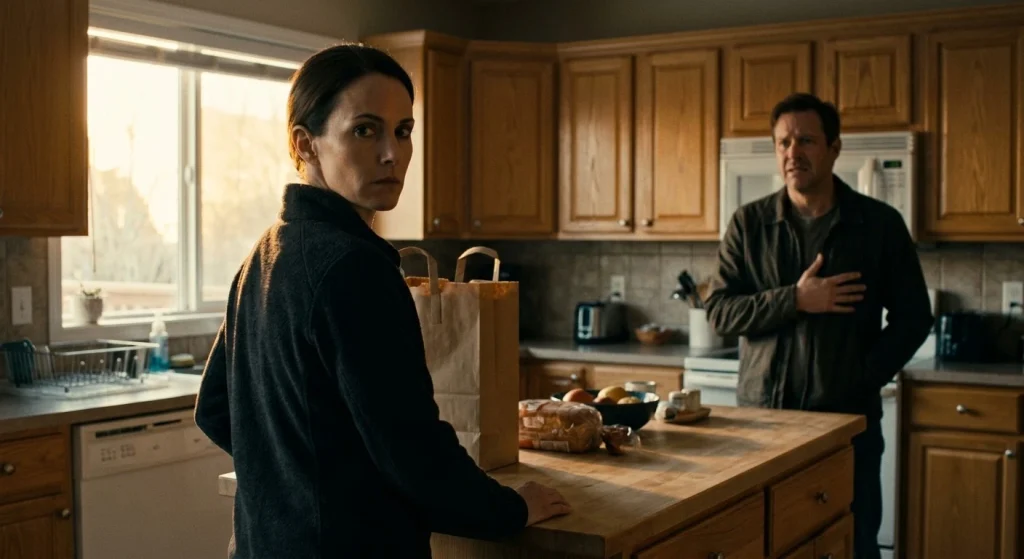
His wife stepped into the kitchen, holding two Whole Foods bags and wearing the same fleece she always wore on weekends. She looked warm. Familiar. Like someone he knew.
Then her eyes dropped to his jacket pocket — to the faint rectangular outline pressing through the fabric.
The smile left her face like a light turning off.
“Hey,” she said softly. “What are you doing in the kitchen?”
“Nothing,” David said. “Just got thirsty.”
She set the bags down on the counter. Very slowly. The way you move when you’re not actually thinking about the bags.
“You look pale,” she said.
“I’m fine.”
“David.” Her voice had gone quiet in a way he’d never heard before. Not soft. Quiet like an empty room. “What’s in your pocket?”
“Nothing,” he said again.
She reached into her purse.
David didn’t wait to see what she pulled out. He grabbed the paint can off the counter — he’d brought it in without thinking — and threw it.
It caught her hand. Whatever she was holding clattered across the tile.
He ran.
He was through the garage and into his SUV in four seconds flat. The ignition caught. He didn’t look back. He could hear her behind him — the slap of footsteps on concrete — and then a crack as something hit the driver’s side window and spiderwebbed the glass.
David threw the car into reverse and floored it.
The SUV shot down the driveway. He swung into the street, shifted into drive, and accelerated. His hands were white on the wheel. His breath came in short, useless bursts.
Get to a public place. Get to a public place. Get to the—
At the end of Birchwood, the light was red.
He pressed the brake.
The pedal went straight to the floor.
“No—” He pumped it. Nothing. He pumped it again. The car drifted forward. He yanked the emergency brake, felt the rear wheels lock, and used the friction to steer wide around a sedan pulling out from the side street.
An old man on the sidewalk yelled something. David didn’t hear it.
He made it four more blocks on the emergency brake, coasting and correcting, controlling the speed by grinding and releasing, until the red and blue of the police precinct sign came into view on the left.
He pulled the wheel hard, jumped the curb, and came to a stop in the fire lane.
He sat there for a moment with both hands still on the wheel.
Then he got out, walked through the glass doors, and put the phone on the front desk.
“I need to speak to someone,” he said. “Now.”
The detective who took the case was a compact woman named Reyes who had the manner of someone who had heard most things twice. She listened without interrupting. She took the phone. She called in a tech.
“The brake lines on your SUV,” she said, an hour later. “Confirmed. Two of them. Clean cuts.”
David nodded. He already knew.
“We’re going to need to ask you some questions about your wife’s known associates,” Reyes said. “Anyone she might have been in contact with outside of—”
“Check the chat history first,” David said. “The whole thing. I only read the last few messages.”
Reyes looked at him. “Why?”
“Because I don’t think it was a stranger.” He paused. “I think I recognized the handle.”
He was right.
The tech decrypted the full thread in under two hours. The Archivist’s identity was buried in a metadata slip — a device signature that matched a phone registered six years ago in Chicago.
To David’s older brother, Mark.
Detective Reyes set the printed summary on the table in front of David without saying anything. David read it. He read the part where Mark, drowning in gambling debts he’d hidden for three years, had first reached out to David’s wife with the idea. He read the part where she’d agreed within forty-eight hours. He read the part where they’d discussed timelines, contingencies, and how to spend the money.
He read all of it.
Then he put the paper down and looked at the wall.
“He was at my son’s birthday last month,” David said. “He brought a cake.”
“Mr. Harlan,” Reyes said carefully.
“Chocolate,” David said. “My son’s favorite. He remembered.”
Reyes gave him a moment.
“We’ll need a formal statement,” she said finally.
“I know.” David pulled his chair in and picked up the pen. “Let’s start.”
They arrested his wife at 9:47 that night, at the home of a friend she’d called from the grocery store parking lot. She didn’t run. A neighbor later told a reporter she’d come out of the front door with her coat already on, like she’d been expecting it.
Mark was picked up two days later at a budget motel outside Cincinnati, still carrying a burner phone of his own. His gambling debts, once surfaced, totaled just under $340,000.
The DA charged both with conspiracy to commit first-degree murder.
At the arraignment, David sat in the back of the courtroom. He watched his wife scan the gallery twice before she found him. She held his gaze for a long moment.
He didn’t look away.
She did.
Three months later, David stood in the driveway of a smaller house — a rental, clean and plain — watching the movers carry in the last of the boxes he’d kept.
His son was on the front steps, eating an apple, reading something on his phone.
“Dad,” his son called. “You want me to set up the Wi-Fi?”
“Yeah,” David said. “Go ahead.”
He stood there a moment longer, alone in the driveway, in the pale November light.
Then he went inside.
Original fictional stories. AI-assisted creative content.