
Daniel and Claire moved into the house on a Thursday.
By Friday night, they wished they hadn’t.
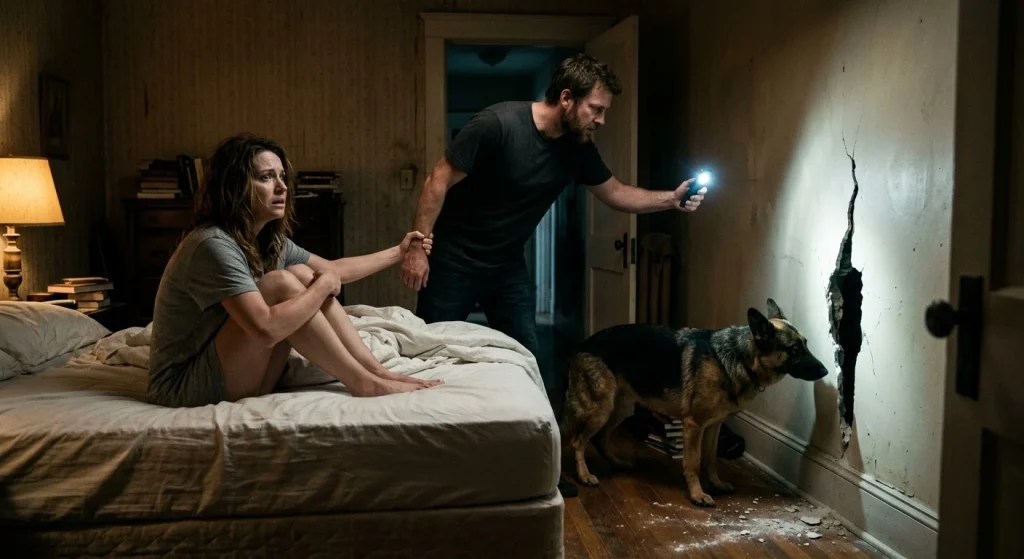
It started at 2 a.m. Rada — their three-year-old German Shepherd — stood at the far bedroom wall and wouldn’t stop staring. Not growling. Not whining. Just staring, ears flat, like she was watching something only she could see.
“Rada. Come here.” Daniel patted the bed. She didn’t move.
Claire sat up. “She’s never done this.”
“She’s adjusting. New place, new smells.”
“She’s not sniffing. She’s watching.”
Daniel groaned and rolled over. “She’ll stop.”
She didn’t stop.
By 3 a.m., the staring turned into barking — deep, hoarse, rattling the nightstand glass. By 3:30, Rada was clawing at the plaster, white dust falling like snow, her nails making a sound like fingernails on a blackboard.
“Rada!” Daniel shot upright. “Stop it! Let us sleep!”
The dog ignored him completely. Her teeth were bared now, her whole body trembling.
Claire pressed her back against the headboard. “Daniel. Something’s wrong with her.”
“She’s losing her mind is what’s wrong.”
“Dogs don’t just do this.”
“Claire, she’s a dog. She probably smells a mouse.”
But even as he said it, something in the room changed. The air felt heavier. Thicker. Like pressure building before a storm rolls in.
Rada let out a sound Claire had never heard from her before — not a bark, not a howl. Something between the two. Something desperate.
Then the crack appeared.
It started small — a hairline fracture running from the baseboard up toward the ceiling. Then it widened. Then a chunk of plaster the size of a dinner plate dropped to the floor and shattered.
Rada leaped back, still barking.
Daniel was already on his feet. “What the—”
The wall hadn’t just cracked. It had opened. A narrow vertical gap — dark inside, cold air breathing out of it like a held-exhale finally released.
“Don’t,” Claire said.
Daniel grabbed his phone and turned on the flashlight. He aimed it through the gap.
“Daniel. Don’t.”
He leaned in.
Then he went completely still.
“What?” Claire’s voice cracked. “Daniel, what is it?”
He didn’t answer right away. He just stood there, light aimed into the dark, not moving.
“Daniel.”
He turned slowly. His face had changed in a way that scared her more than Rada’s barking had.
“Call someone,” he said.
“What? Who? What is in there?”
“Call the police. Call them now.”
Claire grabbed her phone with shaking hands. “You have to tell me what you saw.”
He looked at the wall. Then back at her. “There’s a space in there. A room. Small — like a closet, but sealed. No door, no vent.”
“Okay—”
“And there’s something in it.”
“What kind of something?”
“A box. A wooden box. And — ” He stopped.
“And what?”
“Bones, Claire. Small ones. Beside the box.”
The 911 operator picked up on the second ring.
The officers arrived within eight minutes. Two squad cars, then a third. A sergeant named Keller — tall, broad, unflappable — walked the perimeter of the bedroom while a younger officer photographed the gap in the wall.
“You didn’t touch anything inside?” Keller asked.
“Nothing,” Daniel said. “I just looked.”
“The dog find it?”
“She was at that wall for two hours before it cracked.”
Keller glanced at Rada, who sat in the corner of the room now, quiet, watching the officers with calm eyes like the crisis had passed and she was simply monitoring cleanup.
The forensics team came an hour later. They widened the gap carefully — the wall, it turned out, wasn’t structural. It was a false panel, framed in and plastered over, deliberately built to hide the space behind it.
The room inside was roughly four feet by six. Sealed. No light, no airflow.
The box was cedar, about the size of a shoebox, with a small brass latch. The bones beside it were confirmed within minutes by the lead forensics tech to be animal — a small dog, from the look of the skull.
“There’s writing on the inside of the wall,” one of the officers called from inside the space.
Keller leaned in. On the plaster, in faded pencil, barely legible:
For whoever finds this. Her name was Bess. She found it first. — R.H., 1962
The box held documents.
Old ones — brittle, folded in thirds, smelling like cedar and time. The officers bagged them carefully, but the forensics tech held one up so Daniel and Claire could see: a deed. A property deed from 1951, signed over to a woman named Margaret Helen Voss.
Below it — a second document. A handwritten affidavit, witnessed and notarized.
And below that — a photograph. Black and white. A man in a suit standing in front of the house — their house — with a woman who wasn’t his wife. The back of the photo was labeled in the same handwriting as the wall: Evidence kept. For when it matters.
Keller read the affidavit slowly. Then he set it down.
“You bought this house from the Hargrove estate?”
“Yes,” Claire said. “They said the family had owned it since the fifties.”
“The Hargroves,” Keller said quietly, “had a fraud case that was dropped in 1963 for lack of evidence.” He looked at the affidavit. “Looks like R.H. found the evidence. And then sealed it up instead of using it.”
“Why would someone seal up evidence?” Daniel asked.
“Could’ve been scared. Could’ve been paid off. Could’ve died before they got the chance.” Keller shook his head. “Sixty-two years in a wall.”
It took the county historical society three months to trace it fully.
Robert Hargrove — R.H. — had been the previous owner’s groundskeeper. In 1961, he’d discovered that his employer, Thomas Hargrove Sr., had forged the property deed to seize the house from Margaret Voss, a widow, after her husband died. The affidavit named witnesses. The photo proved the relationship — and the motive.
Robert had hidden the evidence in the wall. His dog, Bess, had apparently found the space first and been sealed inside accidentally — or not accidentally.
Robert Hargrove died in 1964. The case had never been reopened.
But Margaret Voss had a granddaughter.
Her name was Donna, and she was seventy-one, living in a retirement community forty miles away. She’d spent her entire adult life believing her grandmother had simply “lost” the house to debt.
A county investigator drove out to tell her in person.
Claire read the follow-up article three weeks later on her phone while sitting at the kitchen table, Rada’s head on her knee.
Voss Heir to Receive Settlement After Six-Decade Property Fraud Exposed. The estate — including the current market value of the house — was being contested in probate court. Daniel and Claire had been interviewed, their purchase flagged, the Hargrove estate named in the suit.
Their realtor called that afternoon, panicked.
“You need a lawyer,” he said.
“We have one,” Daniel said.
“This could drag on for—”
“We already talked to Donna.”
Silence. “You talked to — you contacted the heir?”
“She came to us.” Daniel leaned against the counter. “She wanted to see the house. See where her grandmother had lived.”
Claire looked up from the table.
“She’s not contesting our purchase,” Daniel said. “She said we could stay. Said the house was ours — that we’d earned it.”
“She said that?”
“She said — ” He paused. “She said the house had been waiting for the right people. People who’d actually listen when it tried to tell them something.”
Donna Voss received a settlement of $340,000 from the Hargrove estate — a figure the probate judge called “long overdue.”
She used part of it to have a small granite marker placed in the backyard of the house, with Claire and Daniel’s permission.
It read: Bess. Good girl. She found it first.
Rada visited the marker every morning.
She never barked at the wall again.
Original fictional stories. AI-assisted creative content.