
The scooter horn tore through the night like a scream.
A tiny girl in a torn red dress burst out of the crowd barefoot, straight into the wet market street, her arms pumping, her face already twisted in panic.
A woman in a grey coat saw her one second before impact.
She lunged.
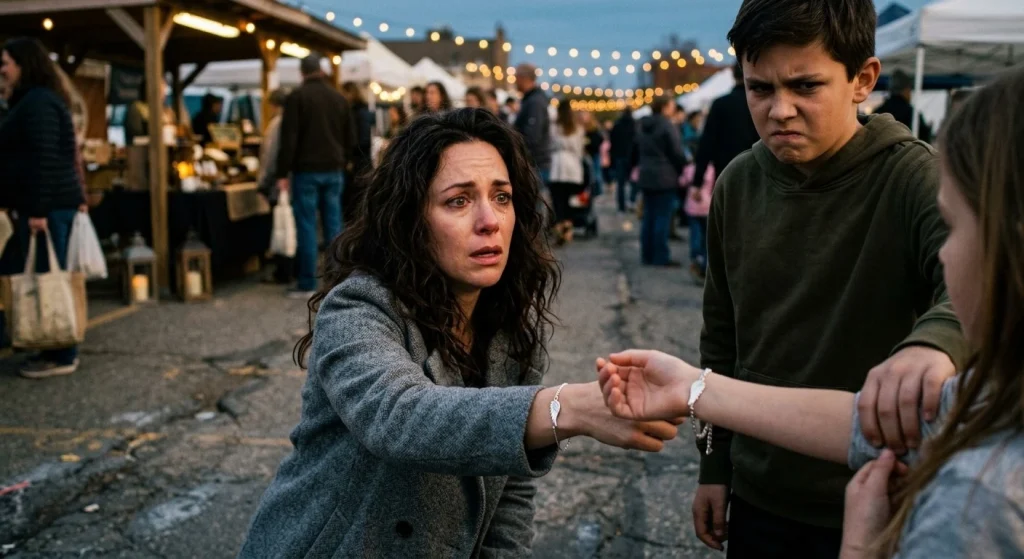
Her hand closed around the child’s thin arm and yanked her back so hard they both stumbled against a food stall. Paper cups rolled across the wet stone. Steam and grilled smoke wrapped around them. For one terrifying second, the whole market seemed to stop breathing.
The little girl looked up, eyes huge, lips shaking.
Then a boy came running.
He threw himself between them, one arm flung protectively across the girl’s chest, his dirty backpack sliding off one shoulder.
“Don’t touch her!”
The woman was still breathing hard from the shock. Her own heartbeat was loud in her ears. She looked from the boy’s frightened face to the girl’s trembling wrist.
And froze.
A broken angel bracelet.
Cheap silver, worn thin, one wing missing.
Her throat closed.
“That bracelet…”
The little girl shrank behind the boy, but lifted her wrist just a little, almost like she didn’t know whether to hide it or show it.
“It was my mom’s.”
The woman slowly pulled back the sleeve of her own grey coat.
On her wrist was the other half.
The missing silver wing.
It hung from a delicate chain, old and scratched in the exact same way.
The boy’s face drained of color.
The girl stared at both bracelets, confusion fighting with fear.
The woman’s knees gave a little. She crouched into the wet street without caring that her coat touched the dirty pavement.
Her voice came out broken.
“I gave this to my baby sister.”
The market blurred around them. Lantern light, footsteps, voices, all of it seemed far away now.
The boy grabbed the girl’s hand tighter and took one small step back.
He looked like he wanted to run.
But he was too scared to choose the wrong direction.
Then he whispered, his voice thin with terror, “Then why did she say to run from you?”
The woman stared at him.
The little girl’s eyes filled again.
She leaned forward just enough for the lantern light to catch her tears and whispered, “Because you were the one in the photo.”
The woman stopped moving.
Not slowly.
Completely.
Like her body remembered something before her mind was ready to.
The boy’s hand shook as he reached into the dirty backpack and pulled out an old folded photo. The corners were torn. One side was stained. He held it like it was dangerous.
When the woman saw it, the blood left her face.
It was her.
Younger. Crying. Half-turned away from the camera.
And beside her stood a man with one hand gripping her sister’s arm.
The boy looked between the woman and the photo, waiting for the lie he expected.
Instead, the woman whispered, “No…”
The little girl pressed against her brother’s side.
“Mama kept that under our blanket.”
The woman took the photo with trembling fingers.
She knew that night.
She had spent years trying not to.
Her father had dragged her away from the train station while her little sister screamed for her. The man in the picture had promised to “handle it.” She had believed, for one hour, that her sister would be sent somewhere safe.
One hour had turned into sixteen years.
Tears spilled down her face so fast she couldn’t hide them.
“She thought I left her.”
The boy’s mouth tightened.
“She said you watched.”
The sentence landed like a blade.
The woman nodded once, because the truth was worse than any excuse.
“I did.”
The children flinched.
She swallowed hard, forcing herself not to lie now, not when the truth had already taken so much.
“I was nineteen. I was terrified. I thought I could go back for her in the morning.” Her voice shook. “By morning, she was gone.”
The girl’s lips trembled.
“She waited for you.”
That almost crushed her.
The woman covered her mouth, then lowered her hand because these children deserved to see what guilt really looked like.
“Is she alive?” she asked.
The boy stared at the ground.
For a moment, she thought he wouldn’t answer.
Then he opened the front pocket of the backpack and pulled out one more thing.
A hospital wristband.
Old.
Bent.
Their mother’s name still barely visible.
The girl started crying before the woman even took it.
“She said if we ever found you…”
The little girl couldn’t finish. Her voice broke apart.
The boy did it for her.
“She said not to forgive you too fast.”
The woman let out a sound so raw it made both children freeze.
Then she nodded through tears.
“She was right.”
A long silence sat between them, heavy and wet and human.
The market slowly began moving again around the three of them, but none of them felt part of it.
Then the little girl did something small.
She lifted her wrist again.
The broken angel charm rattled softly.
“If you’re really her sister…” She looked at the woman with desperate, wounded hope. “…why did she still keep your bracelet?”
The woman stared at the missing wing on the child’s arm and the other half on her own.
Then she answered the only way a broken family ever can.
“Because she hated me,” she whispered. Her lips trembled. “But she still wanted you to find me.”
Nobody moved for a long moment.
Then a vendor’s cart rattled past, and the ordinary noise of the market snapped something loose in the woman’s chest.
“What’s your name?” she asked the boy.
He hesitated. “Theo.”
“And you?” She looked at the girl.
“Mia,” the girl whispered.
“I’m Anna.” Her voice cracked on her own name, like she wasn’t sure she deserved to say it. “I’m your aunt.”
Theo’s jaw tightened. “We know who you are.”
“Then you know I’m not going to hurt you.”
“Mama said that too,” Theo shot back. “About someone else.”
Anna flinched.
“Who?”
Theo’s eyes darted toward the crowd, scanning faces like he expected one of them to be wrong.
“The man in the photo,” he said quietly. “He still comes around.”
Anna’s stomach dropped. “Comes around where?”
“The hospital,” Mia said. “He brings flowers. He tells the nurses he’s family.”
“He’s not,” Theo snapped. “But nobody believes us. We’re just kids.”
Anna stood up slowly, her knees aching from the wet stone.
“Take me to her,” she said. “Now.”
The hospital smelled like antiseptic and old coffee.
A guard at the front desk barely looked up as the three of them walked in, Theo leading, Mia gripping Anna’s hand like she might disappear if she let go.
“Fourth floor,” Theo muttered. “End of the hall.”
The elevator ride was silent except for the hum of fluorescent lights.
Anna’s reflection in the steel doors looked like a stranger. Older. Guiltier.
When the doors opened, a nurse was standing at the station, flipping through a chart.
“Visiting hours ended an hour ago,” she said without looking up.
“I’m her sister,” Anna said.
That made the nurse look up.
“She doesn’t have a sister on file.”
“She has one now,” Anna said, and something in her voice made the nurse step aside.
The room was dim, lit only by the glow of a monitor.
Sera looked smaller than Anna remembered. Thinner. Her hair had gone grey at the temples, though she couldn’t have been older than thirty-two.
Anna’s breath caught.
“Sera…”
No response. Just the steady beep of the monitor.
“She’s sedated,” the nurse said from the doorway. “Infection. She’s stable, but weak.”
Theo moved to the other side of the bed and took his mother’s hand like it was a ritual he’d done a hundred times.
“She’s going to wake up,” he said, more to himself than anyone.
Mia climbed onto the small chair beside the bed and rested her head near her mother’s arm.
Anna stood frozen at the foot of the bed, afraid to get closer, afraid of what she’d feel if she did.
“How long has she been here?” she asked.
“Three weeks,” Theo said. “He pays for the room.”
Anna’s head snapped up. “He?”
“Dorian,” Theo said, like the name tasted like poison. “He says it’s out of the goodness of his heart.”
“It’s not,” Mia whispered.
Anna’s hands curled into fists at her sides.
“Why does he still have access to her?”
Theo looked at her like the answer was obvious.
“Because on paper, he’s still married to her.”
The words hit like a second impact, harder than the first.
“What?”
“They got married when I was a baby,” Theo said. “She never told anyone why. She just did it.”
Anna’s mind raced back sixteen years — the train station, her father’s grip on her arm, the man’s calm promise that he would “handle it.”
Handling it hadn’t meant sending Sera somewhere safe.
It had meant something far worse.
“He owned her,” Anna said quietly, understanding landing like ice water.
Theo nodded. “For a long time.”
“And now?”
“Now she’s trying to divorce him,” Mia said. “That’s why he’s angry. That’s why he keeps coming.”
Anna looked down at her sister’s pale, sleeping face and felt sixteen years of guilt reorganize itself into something sharper.
Rage.
“Where are the divorce papers?” she asked.
Theo hesitated, then reached into his backpack one more time.
A folder. Worn at the edges. Papers inside, half-filled out, unsigned.
“She was working on them before she got sick,” he said. “The lawyer needs a witness. Someone with no connection to Dorian.”
Anna took the folder with steady hands, though her heart was pounding.
“I can be that witness.”
They didn’t hear the door open.
“Well,” a voice said from the hallway. “Isn’t this a reunion.”
Anna turned.
The man from the photo stood in the doorway, older now, grey at the temples, dressed like someone who had learned exactly how to look respectable.
Dorian.
Mia grabbed Theo’s sleeve.
Theo stepped in front of his sister without thinking.
“Get out,” he said.
Dorian smiled like the words were cute.
“That’s no way to greet your stepfather.”
“You’re not my father,” Theo said. “You’re a debt she can’t pay off.”
Dorian’s smile thinned at the edges. His eyes moved to Anna.
“And you,” he said. “I wondered when you’d finally show up. Sixteen years is a long time to hide from a promise.”
Anna’s voice was steady, though her hands shook at her sides.
“What promise?”
“I told your father I’d handle her,” Dorian said. “I did. I’ve handled her for sixteen years.”
“You trafficked her,” Anna said, the word finally leaving her mouth after all this time. “You sold her like property.”
Dorian’s expression didn’t crack. That was the worst part.
“I gave her a roof. Food. A husband’s name so no one would ask questions.” He shrugged. “Ungrateful, if you ask me.”
“Nobody asked you,” Theo said.
Dorian’s eyes flicked to the folder in Anna’s hands.
His jaw tightened, just slightly.
“Put that down,” he said, voice suddenly quieter, more dangerous.
“No,” Anna said.
“That paperwork isn’t valid without a witness who isn’t a blood relative with an axe to grind.”
“I’m exactly the witness she needs,” Anna said. “Someone who knows what you did. Someone who’s done being afraid of you.”
Dorian took one step into the room.
Theo moved, blocking the space between him and the bed.
“Get. Out.”
For a moment, nobody breathed.
Then the nurse from earlier appeared in the doorway behind Dorian, arms crossed.
“Sir, you need to leave. Family only, and legal counsel has flagged your name on this patient’s file as a person of interest.”
Dorian’s mask slipped, just for a second — enough for Anna to see the fear underneath the control.
“This isn’t over,” he said, backing toward the hall.
“It’s about to be,” Anna said.
The next morning, Anna sat across from a lawyer named Priya Okonkwo in an office that smelled like old paper and strong coffee.
“Sixteen years of financial control,” Priya said, scanning the folder Anna had brought. “Falsified marriage documents. A pattern of coercion documented in your sister’s own handwriting.” She looked up. “This isn’t just a divorce case anymore. This is a criminal referral.”
“What does that mean for the kids?” Anna asked.
“It means if we move fast, and if you’re willing to testify to what you saw last night, we can get an emergency protective order within seventy-two hours.” Priya tapped the folder. “And once the prosecutor sees this pattern — the falsified documents, the financial trail, the hospital visits used as leverage — Dorian isn’t walking away from this with a slap on the wrist.”
Anna nodded slowly. “I’ll testify to everything. I should have testified sixteen years ago.”
“You can’t fix sixteen years ago,” Priya said, not unkindly. “You can only make sure the next sixteen look different.”
Three days later, Anna sat beside Sera’s bed when her sister’s eyes finally opened.
For a moment, Sera stared at the ceiling, confused, blinking against the light.
Then her eyes found Anna’s face.
Her breath caught.
“Anna?”
“I’m here,” Anna whispered, gripping her sister’s hand. “I’m so sorry. I’m here now.”
Sera’s eyes filled, but her voice, when it came, was fierce, not fragile.
“You’re late.”
“I know.”
“Sixteen years late.”
“I know,” Anna said again, tears sliding freely now. “I’ll spend the rest of my life making up for it, if you let me.”
Sera looked past her, to Theo and Mia standing at the foot of the bed, watching with wide, uncertain eyes.
“Did they find you,” Sera asked, “or did you find them?”
“They found me,” Anna said. “Mia’s bracelet found me.”
Sera’s hand moved weakly to her own bare wrist, remembering.
“I gave it to her,” she whispered. “So a piece of you would always be close, even after everything.”
“Even after you told her to run from me?”
Sera’s eyes closed briefly, guilt and love tangled together.
“I needed her to be careful,” she said. “Not cruel. There’s a difference.”
“I understand,” Anna said. “I don’t blame you.”
“Good,” Sera said, weak but suddenly sharp. “Because I still might blame you a little longer.”
A small, broken laugh escaped Anna’s throat — the first one in sixteen years that didn’t feel like betrayal.
The court date came five weeks later.
Dorian sat at the defense table in a suit that no longer looked like armor, just fabric stretched over a man finally out of places to hide.
The prosecutor laid it out plainly: falsified marriage records used to maintain legal control over a trafficking victim, financial documents showing over a decade of extorted “debt payments,” and hospital records showing a pattern of coercive visits used to intimidate a woman attempting to leave.
Anna testified about the train station. About her father’s hand on her arm. About the promise that had turned into sixteen years of silence.
Sera testified from a wheelchair, her voice steady despite everything, describing years she had never been allowed to speak about out loud.
Theo testified too, twelve years old and unflinching, describing exactly what “family” had looked like in that house.
When the judge read the sentence — twelve years, plus a permanent order voiding the marriage and severing all legal claims to Sera’s estate, her children, and any future contact — Dorian’s face finally cracked.
Not into remorse.
Into disbelief that the world had stopped protecting him.
Anna watched him being led out of the courtroom in handcuffs and felt something in her chest unclench for the first time in sixteen years.
Justice wasn’t loud. It wasn’t dramatic.
It was a door closing, permanently, on a man who had spent a lifetime making sure doors never closed on him.
Six months later, the four of them stood in the same wet market where it had all started, lanterns glowing overhead, steam curling up from the food stalls.
Sera was thinner than before, but steady on her feet, her hand resting lightly on Theo’s shoulder as they walked.
Mia skipped ahead, her wrist bare now — the broken bracelet finally repaired by a jeweler Anna had found, both wings whole again, resting safely in a box at home instead of hanging from a frightened child’s arm.
“You didn’t have to fix it,” Sera said, watching her daughter twirl between the stalls.
“I did,” Anna said. “Some things need to be whole again, even if it takes sixteen years.”
Sera looked at her sister for a long moment, something softening behind her eyes.
“I used to think I’d hate you forever,” she said quietly.
“And now?”
“Now I think forever was never really the plan.” Sera’s hand found Anna’s. “Mom would have wanted us to stop counting the years we lost and start counting the ones we have left.”
Anna squeezed her sister’s hand, watching Theo laugh at something Mia said, watching the lanterns sway gently overhead, watching a market that had once nearly taken a child’s life instead hold their whole family safely inside it.
“Then let’s start counting,” Anna said.
And for the first time in sixteen years, the promise didn’t break.
Original fictional stories. AI-assisted creative content.