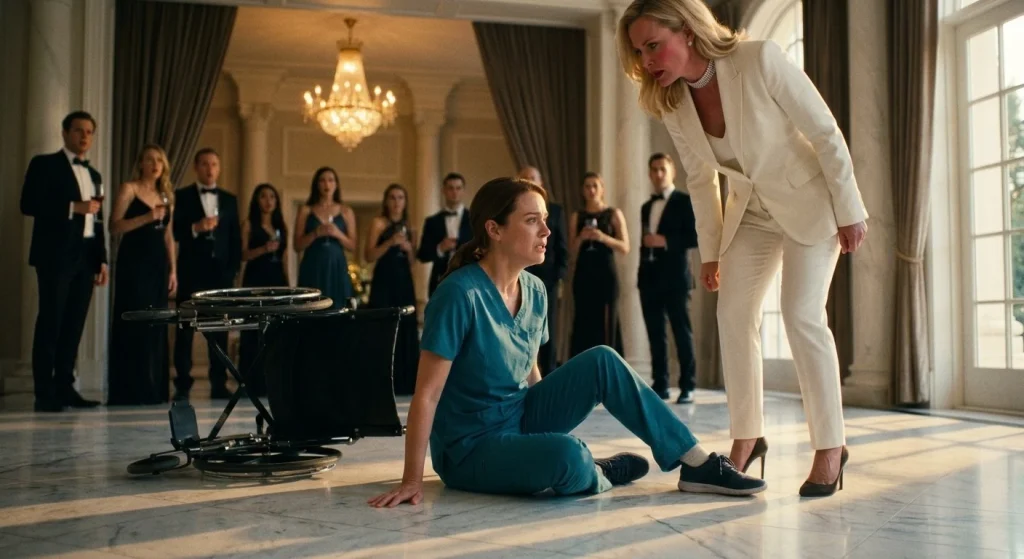

The wheelchair hit the marble on its side.
Metal screamed against stone.
Naomi Carter went down with it, her shoulder slamming the floor, her purse skidding open across the polished tile.
For a second, nobody moved.
Then the gasps came — quick, sharp, performative.
Nobody helped.
Above her stood Vivian Ashford-Cole, white suit, diamond choker trembling at her throat, chest heaving with fury she hadn’t earned the right to feel.
“Get out,” Vivian said.
Naomi pressed her palm flat against the cold floor and pushed.
Her arm shook.
Her fingers slipped on the polish.
Vivian stepped closer. Her heel stopped an inch from Naomi’s hand.
“People like you dirty my home.”
A few of the party guests looked away, wine glasses frozen mid-air, pretending the marble had suddenly become interesting.
Naomi lifted her eyes.
They were wet.
She did not beg.
She held Vivian’s stare with a quiet, steady pain that made the whole lobby feel smaller than it was.
Then footsteps — fast, urgent — echoed off the vaulted ceiling.
A man in a charcoal suit rushed through the front doors, saw the overturned wheelchair, and went pale.
He dropped to his knees beside Naomi before anyone could stop him.
“Miss Carter. Forgive us. Forgive me.”
Vivian blinked. “Miss?”
The man — Daniel Reyes, Naomi’s attorney — lifted the wheelchair upright with both hands and eased her back into it like the house itself owed her an apology.
The guests took a collective step back.
Naomi wiped one tear from her cheek with the back of her hand, steady, unhurried.
Daniel straightened, faced the room, and said the four words that would end the party.
“She owns this house.”
Vivian’s face went empty.
For one long second she looked at the woman in the wheelchair like the chair had disappeared and a throne had risen in its place.
“No,” she whispered. “She’s staff.”
Naomi’s fingers tightened on the armrest. She was still catching her breath from the fall.
“My mother was staff.”
The room went silent enough to hear the chandelier hum.
Naomi looked around the marble lobby, her eyes bright with something older than anger.
“She cleaned this floor for twenty-six years.”
Her voice stayed soft. Every word landed like a wound anyway.
“She came in through the side door. She ate standing up in the pantry. She apologized when people like you stepped over her.”
Vivian’s throat moved. “I didn’t know who you were.”
Naomi looked at her, unblinking.
“You knew I was human.”
That sentence cracked something in the room. A woman near the bar set her glass down without drinking from it.
Daniel crouched again and placed a leather folder gently in Naomi’s lap. She opened it with hands that hadn’t fully stopped shaking.
Transfer papers.
The estate. The east wing. The gardens. The staff quarters where her mother used to sleep on a cot behind the kitchen.
All signed.
All hers, three weeks now, filed and recorded and sealed by the county clerk’s office.
“My mother died believing this house would never belong to anyone who looked like us,” Naomi said. A tear slid down her jaw and she let it fall. “So I bought it back.”
Vivian took one step backward. Her heel landed exactly where the wheelchair had crashed.
For the first time, she looked afraid of the floor beneath her feet.
Naomi rolled forward, slow, deliberate.
Not helpless.
Not ashamed.
“You said people like me dirty your home.”
She stopped a few feet from Vivian and looked up at her with a strength that had nothing left to prove.
“This was never your home.”
Her voice cracked, just once.
“It was my mother’s grave.”
Vivian’s hand rose to cover her mouth.
Naomi’s eyes hardened through the tears still standing in them.
“And today I came to open the door she was never allowed to use.”
Nobody in that lobby said a word for almost ten seconds.
Then a phone camera, held by a caterer near the staircase, clicked off record — she’d been filming the whole thing without meaning to, hands shaking too hard to stop.
“Oh my God,” the caterer whispered. “I got all of it.”
Vivian’s head snapped toward her. “Delete that.”
“No,” Daniel said, stepping between them. “You don’t get to give orders in this house anymore.”
Vivian’s husband, Marcus Ashford-Cole, pushed through the crowd from the terrace, tie loosened, a drink still in his hand. He froze at the scene — his wife backed against the wall, a woman in a wheelchair holding a folder of legal papers, his family’s attorney standing guard beside her.
“Vivian. What did you do.”
“She fell,” Vivian said quickly. “It’s not — I didn’t push her.”
“You didn’t have to push her,” said an older woman near the fireplace. Naomi recognized the voice before she placed the face — Eleanor Ashford, Marcus’s grandmother, ninety-one years old and sharper than most people half her age. “You screamed at her while she was on the ground. I heard you.”
“Eleanor, please,” Vivian started.
“Don’t ‘Eleanor’ me.” The old woman crossed the lobby slowly, cane tapping the marble, and stopped in front of Naomi’s wheelchair. She looked down, studied her face for a long moment, then said something that made the whole room go still again.
“You’re Delores’s girl.”
Naomi’s breath caught. “You knew my mother?”
“I watched her raise you from a photograph she kept in her apron pocket,” Eleanor said. “She showed it to me every Christmas for two decades. I told her once she should be sitting at my table instead of serving it.” Eleanor’s eyes glistened. “She said she wasn’t allowed to want that. I never forgot that sentence.”
Naomi pressed her lips together, fighting to keep her composure.
“She never told me that.”
“She was proud,” Eleanor said. “She didn’t want you carrying her hurt. But I carried it. I’ve carried it for years.”
Vivian’s voice cut through, thin and panicked. “Can we not do this right now? In front of guests?”
Eleanor turned on her with a coldness that silenced the entire lobby. “You married into this family eight months ago. You do not get to decide what happens in it.”
Marcus set his drink down on the nearest table, hard enough that the ice rattled.
“Somebody explain to me right now how my wife is throwing a wheelchair-bound woman onto the floor of a house that isn’t even ours anymore.”
“It’s a mistake,” Vivian said. “A misunderstanding. She walked in wearing a caregiver’s uniform, Marcus, what was I supposed to think?”
Naomi looked down at herself. Teal scrub top, name badge still clipped to her collar — CARTER, PHYSICAL THERAPY DEPT, RIVERSIDE REHAB. She’d come straight from her shift. She hadn’t changed because she hadn’t expected to need to prove anything to walk into a house she legally owned.
“You were supposed to think I was a person,” Naomi said quietly. “That’s all. Just a person.”
Daniel opened the folder again and turned it so Marcus could see. “The Ashford estate went to auction fourteen months ago after your father’s debts came due. Ms. Carter’s holding company submitted the winning bid. The sale closed in March. It’s recorded at the county courthouse. Your family has been living here for the past three months as tenants under an agreement your father signed and never told any of you about.”
Marcus’s jaw tightened. “Tenants.”
“Tenants,” Daniel confirmed. “Which means Ms. Carter has been more than generous letting the transition happen quietly, without press, without lawyers crawling through your family’s finances in public. She wanted this handled with dignity.”
“And instead,” Eleanor said, staring hard at Vivian, “you handled it by throwing dignity onto the floor.”
Vivian’s mouth opened and closed. For the first time since the party started, she had nothing to say.
The caterer who’d filmed the fall stepped forward, holding her phone out toward Naomi like an offering. “Ma’am — I’m so sorry, I should’ve stepped in. I froze. I’m sorry.”
“You didn’t freeze,” Naomi said gently. “You got the truth on camera. That took more courage than stepping in would have.”
“What do you want me to do with it?”
Naomi looked at the video paused on the screen — Vivian’s heel an inch from her hand, the words people like you dirty my home hanging in the frozen frame.
She thought of her mother’s hands, cracked from bleach and years of scrubbing baseboards in a house that would one day, somehow, against every odd stacked against a Black single mother working two jobs, belong to her daughter.
“Send it to Mr. Reyes,” Naomi said. “Nothing happens with it unless it needs to.”
“It needs to,” Eleanor said flatly. “The whole town’s HOA board is under this roof right now eating my grandson’s shrimp cocktail. Let them see exactly who they’ve been letting throw galas in a house she doesn’t own.”
Word moves fast in a room full of people who love a story more than they love loyalty.
By the time Naomi rolled toward the study to sign the last of the transition paperwork with Daniel, half the guests had already pulled out their phones. Not to help. To text. To share. To ask each other in hushed, thrilled voices, did you see what just happened.
Vivian found her in the hallway outside the study, arms crossed so tight her knuckles had gone white.
“You did this on purpose,” Vivian hissed. “You wore that uniform. You planned this.”
Naomi turned her chair slowly to face her. “I came straight from work to sign papers with my attorney in a house I legally own. I didn’t plan anything except getting here on time.”
“You wanted to humiliate me.”
“No,” Naomi said. “You did that yourself. I just didn’t get up off the floor fast enough to stop you from finishing.”
Vivian’s eyes filled, but there was no softness in them, only the particular fear of someone watching a life built on borrowed ground start to crack. “Marcus is going to leave me over this.”
“That’s between you and Marcus.”
“You don’t understand what it’s like,” Vivian said, voice rising. “Marrying into money that isn’t yours, walking into rooms where everyone’s already decided you’re not enough, having to fight for every inch of respect—”
Naomi’s expression didn’t change. “You just described my mother’s entire life. Word for word. Except she never once threw a person to the ground to feel bigger.”
Vivian had no answer for that.
Marcus appeared at the end of the hallway, phone in hand, face unreadable. “Vivian. The caterer sent Grandma Eleanor the video. Eleanor sent it to the family group chat. My mother has already called twice.”
“Marcus—”
“There’s a prenup clause,” he said quietly. “Section nine. Conduct that brings public disgrace to the Ashford name voids the asset protections. My father put it in years ago after my uncle’s divorce scandal. I forgot it even existed until my mother reminded me ten minutes ago.”
Vivian went white. “You wouldn’t.”
“I watched you put your heel an inch from a disabled woman’s hand and call her filth,” Marcus said. “I don’t know who I married.”
By nine that night, the party had emptied out in the particular hush of people who’d witnessed something they’d be retelling for years. Naomi sat in the study with Daniel, the last signature drying on the final page, Eleanor pouring three cups of tea nobody had asked for because, she said, some nights call for tea whether you want it or not.
“Your mother would be proud of you,” Eleanor said, setting a cup in Naomi’s hands. “Furious at the wheelchair part. Proud of everything after.”
Naomi laughed, wet and surprised, the first easy sound she’d made all night. “She’d tell me I shouldn’t have let it get filmed. She hated attention.”
“She also scrubbed floors in silence for twenty-six years so somebody in this family could sit in this study as its owner,” Eleanor said. “I think she’d forgive the attention, just this once.”
Daniel closed his folder. “There’s a press inquiry already. Local news picked up the video from a guest’s public post. They want a statement.”
Naomi looked down at her hands, at the teacup, at the marble floor visible through the study door where an hour ago she’d been lying on her side with her purse spilled open.
“Give them one line,” she said. “Say the house has new ownership, and it finally has a name in it that belongs there.”
Three weeks later, the story had made its way through every local outlet and half the national ones — MANSION HEIRESS THROWN FROM WHEELCHAIR TURNS OUT TO OWN THE ESTATE, the headlines read, over and over, with slightly different wording each time. Vivian and Marcus’s divorce filing became public two days after the party. The prenup clause held. She left with a fraction of what she’d married into and none of the house.
Naomi didn’t watch the coverage. She was busy.
The east wing, where her mother used to sleep on a narrow cot behind the kitchen pantry, became the first classroom of the Delores Carter Foundation — full scholarships for the children of domestic and home-care workers, funded by the very estate her mother had once cleaned on her knees.
On opening day, Naomi rolled through the same marble lobby, past the exact spot where the wheelchair had gone down weeks earlier. There was a small brass plaque set into the floor now, easy to miss unless you were looking for it.
For Delores. You were never staff. You were always home.
Eleanor stood beside her at the ribbon-cutting, cane in one hand, scissors in the other, refusing to let anyone else do the honors.
“Ready?” Eleanor asked.
Naomi looked around the lobby — chandelier catching the afternoon light, a dozen kids from the neighborhood lined up near the door in new backpacks, Daniel setting up a small podium, no diamonds, no white suits, no heels an inch from anyone’s hand.
“Ready,” Naomi said.
The ribbon came down.
Somewhere behind her, she could almost hear her mother’s voice, the one that used to hum quietly while she worked, finally, after twenty-six years, echoing through a house that belonged to her daughter and to nobody who would ever again call her people dirt.
The door her mother was never allowed to use stood wide open.
Naomi rolled through it first.
END.
Original fictional stories. AI-assisted creative content.