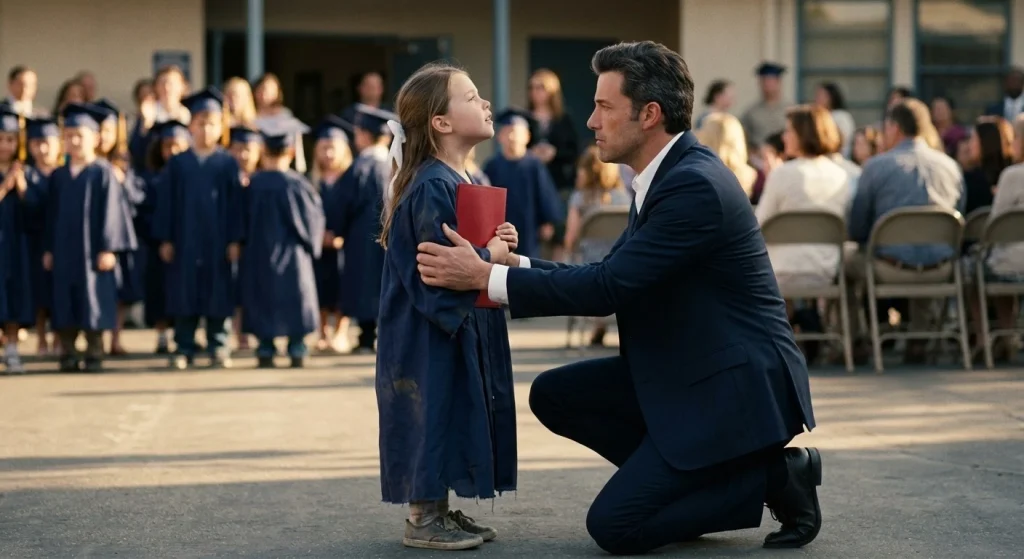

Lila Carter was nine years old and already an expert at pretending things didn’t hurt.
She could smile when teachers asked why her grandmother wasn’t at parent-teacher night. She could shrug when kids said, “Is your mom coming?” like the question wasn’t a small knife every single time.
But standing outside Carver Primary on graduation morning, watching family after family spill out of minivans and SUVs with balloons and cameras, she felt the familiar ache sharpen into something harder to ignore.
Today she would walk across a stage alone.
Today the empty seat would be visible to everyone.
She’d rehearsed the question forty times in the bathroom mirror. But rehearsing with your own reflection and actually walking toward a stranger were very different things.
The silver SUV pulled to the curb at 8:47 a.m.
The man who stepped out was tall—charcoal suit, silver threads beginning to show through dark hair, the kind of careful posture that came from years of being watched. He looked expensive. He also looked, if she was being honest, a little sad.
That was what made her cross the sidewalk.
“Excuse me, mister?”
He turned immediately, no irritation in his face.
“Hey there.” He bent slightly. “You okay?”
“I need to ask you something strange,” she said. “Please don’t laugh and please don’t walk away until I finish saying it.”
Something shifted in his expression—surprise, maybe, then something softer.
“All right,” he said. “I’m listening.”
Lila swallowed once, hard.
“Today’s my fourth-grade graduation. It starts in a few hours. Every other kid has somebody coming—moms, dads, grandparents, somebody. My mom died when I was little. And my grandma’s too sick to leave home. Her heart.” She felt her voice starting to shake and pushed through it. “I’m going to be the only one with nobody clapping for me. So I was wondering if—” She stopped. Started again. “I know this is crazy. But would you maybe pretend to be my dad? Just for today? Just so I’m not alone up there?”
The silence lasted long enough that she started building her apology.
Then the man’s face did something unexpected.
It broke open.
Not wide—just a small crack. The kind that looks like it comes from somewhere deep.
“What’s your name?” he asked.
“Lila. Lila Carter.”
He repeated it quietly. “Lila.”
He crouched down until they were eye level. She noticed his eyes were gray.
“Why me?” he asked gently. “There are a lot of people out here.”
She looked directly at him. “Because you look lonely too. And lonely people understand each other better.”
For a moment he didn’t move.
Then a small smile crossed his face. The kind that looked like it hadn’t been used in a while.
“You’re right,” he said. “We do.”
He stood up and extended a hand like they were meeting at a business dinner.
“I’m Elliot Vance. And I’ll be your dad today.”
She shook it. Her small hand disappeared inside his.
“Really?”
“Really. But if we’re doing this,” he said, glancing toward the school, “we need a story.”
They sat on the front steps for twenty minutes constructing one.
Elliot would be her father, home from a long stretch of work travel in finance. Her mother had passed years ago. His schedule kept him away more than he liked, but he was here now. Lila helped fill in the details—her grandmother’s name, her teacher’s name, what she’d studied that year.
Elliot listened to everything carefully, like it was information he intended to keep.
What she didn’t know was who she was actually talking to. She had no idea Elliot Vance’s name was printed across skyscrapers downtown, that his company managed more money than she could imagine, that three assistants were currently texting his phone which he had silenced in his pocket.
She only knew he hadn’t laughed.
He hadn’t walked away.
He had listened.
While they built their cover story, he shared pieces of his own real one without her asking. He’d had a daughter once—Amelia. Leukemia had taken her at five. His marriage collapsed in the grief that followed. He had spent the years since then at his desk, in boardrooms, on planes to cities where nobody knew his face, working so hard and so constantly that whole seasons had passed without him noticing.
“I wasn’t even supposed to be near here this morning,” he admitted. “Wrong turn. Delayed meeting.”
Lila thought about that.
“Maybe it wasn’t wrong,” she said.
He looked at her sideways.
“Maybe not,” he agreed.
When they walked through the school’s front doors together, a billionaire and a nine-year-old in a faded yellow dress, neither of them was entirely pretending anymore.
The auditorium filled fast.
Every folding chair in the parent section was occupied by someone carrying flowers or holding up a phone. The noise was joyful and overwhelming.
Lila sat in the front row with the other students, gripping her program card until the edges bent. Every time another student’s name was called, applause burst from some corner of the room—a mother’s voice rising above the rest, a grandfather whistling, siblings cheering.
She stared at the stage curtain and counted her own heartbeats.
Just get through the walk. Just take the certificate. Don’t look at the audience.
“Lila Carter.”
The words hit her like cold water.
She stood. Her legs felt like they’d forgotten how to work properly. She crossed the stage one careful step at a time, keeping her eyes forward, her jaw tight.
Principal Nguyen handed her the certificate. “Congratulations, Lila. You earned this.”
She nodded and turned to face the exit.
Then she heard it.
One voice. Loud. Deliberate.
“That’s my girl! Way to go, Lila!”
Her head snapped toward the audience before she could stop herself.
Elliot was on his feet in the fifth row, applauding harder than anyone else in the auditorium. He was tall enough that people around him turned to look. Then other parents began standing. Then more. Applause rippled outward in a wave she hadn’t expected and couldn’t stop.
For one second, the room felt like it was for her.
Actually, genuinely, unmistakably for her.
Her chest filled with something she couldn’t name—too bright and too sharp to be simple happiness, not quite crying, not quite not.
She walked off the stage on shaking legs.
When the ceremony ended, families swarmed the aisles. Children ran into open arms. Cameras went off in bursts. The noise became enormous.
Lila moved to the edge of the crowd and waited.
She told herself she was being realistic. She told herself that the day had already given her more than she’d expected. That it was fine if he slipped out now. That she wouldn’t blame him.
He walked straight toward her.
Not toward the exit. Not toward his car.
Straight toward her.
Before she could say anything, he crouched and pulled her into a hug—firm and real, the kind that makes the noise around you go quiet.
“You were incredible up there,” he said quietly. “I mean that.”
She pressed her face against his shoulder and let herself, just for one second, believe it was true.
They took photos afterward. Elliot next to her with the certificate. Ms. Alvarez smiling nearby. A group of curious classmates crowding in because they’d seen him stand and they wanted to know who this person was.
“Is that your dad?” one girl asked.
Lila answered without hesitating. “Yeah. That’s my dad.”
Each time she said it, it felt a little less like lying.
Eventually Elliot checked his watch.
“I should head out soon,” he said quietly. “My driver’s been waiting.”
The words landed like something cold.
She looked down at her shoes. “Thank you. For everything. You didn’t have to—”
“Would you let me walk you home?” he interrupted gently. “I’d like to meet your grandmother.”
She looked up fast.
“You actually want to?”
“I do.”
The walk was six blocks, and Lila spent most of it talking. She pointed out the public library where she went after school, the corner store where the owner sometimes gave her a piece of candy when Nora was short on money, the mural painted on the laundromat wall that she thought was the most beautiful thing in the neighborhood even if nobody else agreed.
Elliot listened to every word without checking his phone once.
But when they reached her building, the familiar shame crept in.
She saw it the way she imagined he would—the broken buzzer panel, the graffiti across the mailboxes, the smell of garbage rising from somewhere below the stairwell. The three flights of stairs they climbed because the elevator had been broken for eight months.
Elliot didn’t say a single word about any of it.
At the apartment door, Lila knocked their signal: three taps, pause, two more.
Nora answered in her housecoat. Her eyes went from Lila to the tall stranger and sharpened immediately—the look of someone who’d spent seventy-five years learning how to read people fast.
“Who is this?”
“Grandma, this is Mr. Vance. He came to graduation. He stood up and clapped for me so I wouldn’t be alone.”
Nora studied Elliot for a long time.
Then she stepped back from the door.
“Place is small,” she said. “Come in anyway.”
The apartment smelled like chamomile and menthol. The couch sagged. The television was old. But the surfaces were clean and the photographs on the wall were arranged carefully—Lila at different ages, a younger Nora, a woman Lila’s age who had her eyes.
Lila’s mother.
Elliot sat on the edge of the couch like he was afraid of taking up too much space.
Nora settled into her recliner and folded her hands in her lap.
“I’m going to ask you directly,” she said, “because I’m old and I don’t have time to work up to things. Why would a man like you spend an afternoon pretending to be this child’s father?”
Elliot didn’t shift or deflect.
“Because she was brave enough to ask for something most grown adults would never admit they needed,” he said. “And because I had a daughter her age once. Leukemia took her when she was five.”
Nora was quiet.
“I’m sorry,” she said finally.
“When Lila asked me this morning, I thought I’d stay for the ceremony and then move on,” Elliot continued. “But somewhere during the afternoon, I realized I didn’t want to. I didn’t want to walk away.”
He leaned forward slightly.
“I’m not here to take her from you. I know how much you love each other. I can see it in this apartment. What I’d like—if you’d allow it—is to help. Medical bills. Better housing. Whatever you need. And if you’re willing, I’d like to stay in her life. Not pretend. For real.”
The room was very still.
Nora spoke slowly. “Do you understand what you’re promising? I’m not going to be here forever. That girl has already lost her mother. If you walk into her life and disappear in six months, it won’t just hurt her. It will break something in her that was already cracked.”
Elliot met her eyes.
“I won’t disappear.”
“You’re saying that very easily.”
“I know,” he said. “I’ll have to prove it over time. I understand that.”
Nora turned to Lila.
“Baby. What do you want?”
Lila felt the tightness climb up the back of her throat.
“I want him to stay,” she said quietly. “I know it sounds crazy. But when he stood up today and called my name like that—” She stopped, tried again. “It was the first time in a really long time that I felt like maybe I mattered to somebody.”
Nora’s eyes filled.
She reached across and took Lila’s hand.
Then she looked back at Elliot.
“Lawyers,” she said clearly. “Paperwork. Background checks. This gets done properly or it doesn’t get done.”
“Whatever it takes.”
“And you start slow. You don’t swoop in and rearrange her life overnight. She’s a child, not a project.”
“Understood.”
“And if you ever—ever—let her down the way the rest of the world has, you will have to answer for it. I may be old and sick but I will find the energy.”
Something close to a real smile crossed Elliot’s face.
“I believe you completely,” he said.
In the weeks that followed, Elliot kept every one of those promises.
A family attorney drafted a formal guardianship agreement. A second specialist was brought in to review Nora’s heart condition—on Elliot’s medical plan, at no cost to them. A social worker made three home visits, reviewed the documentation, asked Lila careful questions in private, and submitted a favorable report.
It was not easy. Nothing about it was quick.
Child services opened a file after a well-meaning teacher made a call about Lila’s “new father figure.” There were court hearings and home evaluations and uncomfortable questions from a judge who had seen too many cases like this fall apart.
Elliot showed up to every single one. On time. With counsel. With documentation.
Six months later, the judge signed off on a formal guardianship arrangement. Elliot would be Lila’s legal guardian while Nora remained her primary home caregiver—a structure that gave Nora peace and Lila protection.
The night the paperwork was finalized, Nora made soup from scratch despite the protest of her knees and her doctor’s warnings about standing too long.
They ate at the small kitchen table—Nora, Lila, and Elliot crowded together because the table only comfortably seated two.
“This is a terrible table,” Elliot said.
“It was free,” Nora replied without looking up.
“I’m going to buy a better one.”
“You are not coming in here and changing my furniture.”
“It’s a dining table, not a landmark.”
“It is a landmark. It is my landmark.”
Lila watched the two of them argue over soup and felt something settle in her chest—quiet and warm and entirely unfamiliar.
This, she thought. This is what it’s supposed to feel like.
Two years later, Nora passed away at home in her sleep, peacefully and without pain, which was exactly what she had asked for.
Lila was eleven. Old enough to understand. Old enough to grieve properly.
Elliot did not disappear.
He sat with her through the funeral. He sat with her afterward when the apartment felt too empty. He did not try to fill the silence with the wrong words. He learned, slowly, when she needed to talk and when she needed to just be near someone.
On the first anniversary of Nora’s death, Lila placed flowers at her grandmother’s grave and then stood very still for a while.
“She liked you,” she said quietly to Elliot. “She didn’t say it. But I could tell.”
“I liked her too,” he said. “She scared me, which means she respected me. Those usually go together.”
Lila smiled despite herself.
“She would’ve said that was exactly right.”
At twelve, Lila tested into the district’s advanced academic program. Elliot drove her to the placement interview and waited in the parking lot for two hours reading reports on his phone, the way fathers in movies always did but real ones sometimes didn’t.
She came out clutching the acceptance letter.
He got out of the car before she reached it.
“Well?”
She held up the paper.
He picked her up off the ground—not dramatically, just quickly, the way you do when you’re genuinely proud and your body moves before your brain does.
“That,” he said, setting her back down, “is something Amelia would have done too.”
He rarely talked about Amelia. When he did, it was never sad exactly—more like the way you mention someone who is still part of your life, just differently now.
Lila thought that was exactly the right way to carry it.
On the morning of her thirteenth birthday, Lila woke up to a card on the kitchen table.
Inside it said: I am proud to know you. Every single day. — E.
She kept it in the drawer of her nightstand.
Later that evening, eating takeout on the couch with the television on and nothing particularly important happening, she thought about the morning four years ago when she had crossed a sidewalk on shaking legs toward a stranger who looked sad.
She had asked him for one afternoon.
She had gotten the rest of her life.
And across the couch, Elliot Vance—billionaire, founder, the man whose name was on skyscrapers—was arguing with the television about a basketball call that had nothing to do with either of them, and looking, for the first time in a very long time, entirely at home.
Lila tucked her feet under her and let the ordinary noise fill the room.
It was, she decided, exactly enough.
Original fictional stories. AI-assisted creative content.