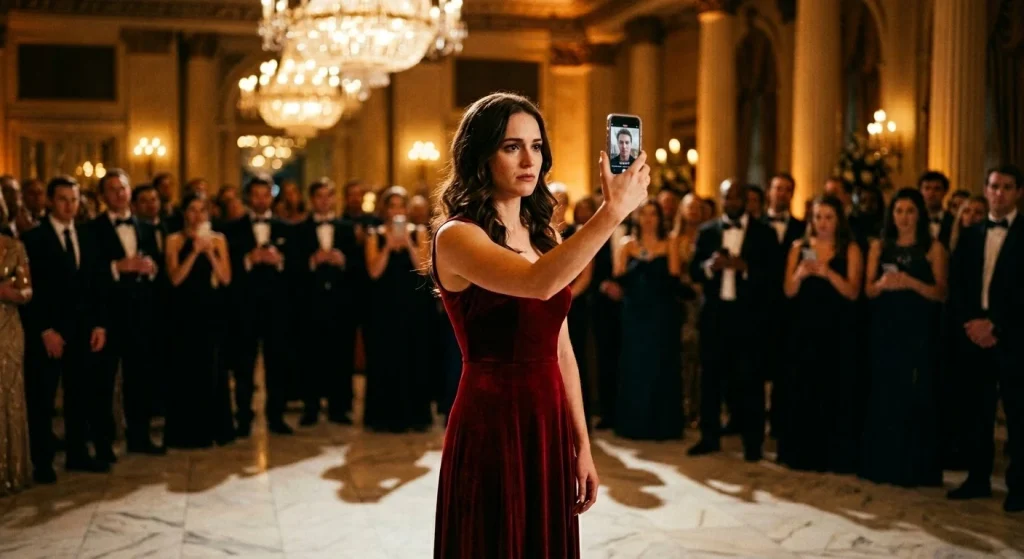

The ballroom was the kind of place that made you feel like you didn’t belong just by walking through the door.
Ellie had worked enough of these events to know the rules. Eyes down. Tray steady. Smile when spoken to. Disappear when not.
She carried a round of champagne flutes past clusters of men in tuxedos and women who smelled like money. The chandeliers threw gold light across everything — the marble, the silk, the diamonds — and all of it felt like it was laughing at her, quietly, the way rich people did.
She was almost to the bar when she heard him.
“Hey. You.”
She turned.
Alex Mercer stood near the center of the room, arm slung around the waist of a woman in a silver backless gown. He was handsome in the calculated way of men who had always been told so — tan jaw, sharp eyes, a smile that never quite reached those eyes.
He was pointing at Ellie.
“Someone told me you used to dance.”
She went still.
“Professionally,” he added, with a grin designed for the crowd around him.
Soft laughter drifted through the nearest cluster of guests.
The woman in silver — Cassidy, Ellie had heard someone call her — looked at Ellie the way people look at something they don’t find threatening but still want to dismiss. “Alex, stop.”
“No, I mean it.” He stepped slightly forward, projecting. “If you can really dance, I’ll leave Cass right now and marry you tonight.”
More laughter. Louder this time.
Ellie’s fingers tightened under the tray. The glasses trembled, just barely.
“What?” Alex said, his smile sharpening. “Too scared?”
For one second, the whole room blurred — the light, the music, the faces turned her way. She thought about the hospital bill on her kitchen counter. The letter from the landlord. Her mother’s voice, three years gone now: You have something in you, Eleanor. Don’t let anyone make you forget it.
She lifted her eyes and looked at him directly.
She didn’t cry.
That seemed to knock a few watts off his smile.
Ten minutes later, Alex caught up with her in the hallway outside the kitchen service entrance, away from the crowd. The golden corridor was quiet, just the muffled pulse of the band bleeding through the walls.
He leaned against the wall like he owned it.
“Come on,” he said, low and almost gentle. “I’m serious. Fifty thousand. You take the floor, you dance for the room, money’s yours.”
Ellie stared at him.
“Fifty thousand dollars,” she repeated.
“Wired tonight.”
She thought about the number. What it could do. What it meant.
Then she thought about the way he’d said it — too scared — with the whole room listening, set up to laugh.
“And if I don’t?”
He shrugged. “Then everyone in there spends the rest of the night remembering you froze.”
She felt something shift inside her. Not fear. Something closer to clarity.
“Okay,” she said.
He blinked. “Yeah?”
“I accept.”
His smile came back, looser now, satisfied.
She turned back toward the kitchen.
Fifteen minutes passed.
The music in the ballroom softened into a slow number, and the crowd thinned into couples and small conversations. Alex had moved back to Cassidy’s side. He’d already half-forgotten about it — these things usually fizzled; the girl would quit or just go home.
Then the golden doors at the end of the ballroom opened.
No announcement. No spotlight. Just a shift in the room’s attention, one person noticing, then the next, until the whole floor had turned without knowing why.
Ellie walked in wearing a crimson gown.
It was floor-length, the fabric deep and warm and alive under the chandelier light — the kind of dress that moved like it had its own opinion about where it wanted to go. Her hair fell loose over her shoulders. Her chin was up. Her face was completely calm.
She was not carrying a tray.
Alex’s hand dropped from Cassidy’s waist.
Cassidy’s smile vanished.
The room held its breath as Ellie walked the length of the marble floor, each step easy, unhurried. She stopped in front of Alex and Cassidy, close enough that the crimson hem nearly touched his shoes.
She looked at him.
“You thought I was ashamed because I was serving drinks,” she said quietly. “I wasn’t. I was ashamed because I kept letting people like you decide what I was worth.”
The room was completely silent.
Cassidy let out a short, clipped laugh. “It’s just a dress, honey.”
Ellie turned to her, not unkindly.
“It was my mother’s,” she said. “She danced in this ballroom twenty years ago. Before she got sick. She told me one day I’d walk in here — not as someone’s entertainment, but as myself.”
Her voice held steady. Just barely.
Alex’s face was hard to read now. The smug edge was gone.
The band, almost on cue — or maybe the conductor had been watching — eased into something slower, something with space in it.
And Ellie danced.
She didn’t announce it. She just moved.
One turn, slow and exact, the crimson fabric sweeping out across the marble like a flame catching air. Then another. Then a full sequence — footwork that made the space around her feel intentional, a body that remembered every hour it had spent becoming this. She had trained for six years before the money ran out, before her mother’s diagnosis changed everything, before she’d taken whatever work she could find.
It had never left her.
She danced like it hadn’t.
No one laughed.
No one moved.
When she stopped, the room stayed frozen for a full three seconds before someone — somewhere near the back — started to applaud. Then the next person. Then the whole room, slowly, one pair of hands at a time, until the applause filled the ballroom properly.
Alex stood very still.
“I’ll give you the money,” he said.
She looked at him. “You already did.”
He frowned.
Ellie held up her phone.
“Your challenge. Your offer. Your exact words.” She let the screen face him for one moment, then lowered it. “All recorded. Time-stamped. Clear as anything.”
The color left Cassidy’s face.
Alex opened his mouth.
“The money,” Ellie said, before he could speak, “will go to the hospital wing my mother died in. Not because you bought me.”
Her voice caught, just once, and then steadied.
“Because tonight, everyone in this room saw exactly who you are.”
She looked out at the crowd. The guests who had laughed. The ones who had pulled out their phones. The ones who were staring at their shoes.
Silence.
Then she turned, the crimson gown flaring once under the chandeliers, and walked back toward the golden doors.
Behind her, she heard Cassidy’s voice, tight and low: “Alex. Fix this.“
And Alex Mercer — who had grown up in rooms like this, who had never once been short of a word in his life — said nothing.
Because there was nothing to say.
The story was already recorded.
The room had already seen it.
And somewhere in a hospital across the city, a wing that had never had enough — that had made families sit in chairs and wait and hope and sometimes lose — would have fifty thousand dollars by morning.
Ellie pushed through the golden doors.
She didn’t look back.
For the first time in a long time, she didn’t need to.
Three weeks later, the recording went everywhere.
Not because Ellie posted it. She didn’t.
It was the guests who had filmed on their phones — the ones who’d started the night laughing and ended it applauding — who shared it. Hundreds of times over by the next morning. Millions by the end of the week.
Alex’s company board noticed. His sponsors noticed. His publicist called three times before noon.
By Friday, he had issued a statement — carefully worded, diplomatically hollow — and announced a donation to the hospital “in keeping with his family’s values of community investment.”
Cassidy’s interior design firm lost four clients in ten days.
Ellie found out about most of this secondhand, from a friend who kept sending her links she mostly didn’t open.
She was busy.
The hospital had called. They wanted to know if she’d be willing to come perform at their annual fundraising gala — they had a ballroom, they said, and a stage, and they thought what she did deserved to be seen properly.
She said yes.
This time, no tray required.
Original fictional stories. AI-assisted creative content.