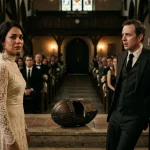

The church was packed with money.
Every seat held someone who owed Lucas Moreno a favor or wanted one. Three hundred guests in tailored suits and silk dresses, a string quartet, and a flower arrangement that cost more than most people’s cars.
Lucas had waited three years for this day.
He’d taken two steps up the stone staircase when she appeared.
A little girl, maybe nine. Dirty hoodie. Scuffed sneakers. Hair half-pulled from a ponytail. She exploded from the crowd like a thrown stone, and people lurched sideways to avoid her.
Phones went up instantly.
The music stopped.
Lucas turned slowly. His security guard, Davis, was already moving.
“Step back, kid—”
She dodged under his arm, grabbed the lapel of Lucas’s jacket with one small fist, and looked straight up at him. No trembling. No tears. Just a pair of dark eyes locked onto his like she’d rehearsed this moment a thousand times.
“If you go in,” she said quietly, “you won’t come out the same.”
The crowd went still.
Lucas looked at her the way he looked at difficult contracts — measuring the threat. She held his gaze without flinching.
“What do you know?” he said, his voice cold and flat.
She turned her head and pointed directly through the open church doors.
“Her.”
Then her finger swung to the left, toward the entrance, where Marcus Webb — Lucas’s personal attorney of eleven years — stood in a gray suit, holding a leather folder.
Marcus went rigid.
He didn’t move. Didn’t speak. But the color left his face in one fast pull, and three people standing near him noticed.
Whispers broke out across the stairs like a fuse catching.
Lucas reached into his jacket and produced a thick fold of cash. He held it out to the girl, his expression neutral. It was a gesture he’d made dozens of times — clean, efficient, no emotion attached.
“Take this,” he said. “Walk away.”
She didn’t look at the money.
Not even a glance.
“I want you alive,” she said.
Silence hit the crowd like a pressure drop before a storm.
Someone in the back row said “Oh my God” just loud enough to carry.
Then the church doors swung open.
Valeria stepped into the light.
Her dress was exactly what everyone had expected — ivory silk, fitted through the waist, a long train that whispered across the stone. She was exactly what everyone had expected. The kind of beautiful that made people feel like witnesses to something rare.
She stopped when she saw the girl.
Every person on those stairs watched her face for confusion, for surprise, for the natural bewilderment of a bride encountering chaos on her wedding day.
It wasn’t there.
Her eyes landed on the girl and stayed. Still. Knowing.
It lasted only two seconds before she reassembled herself — a small, careful smile sliding back into place — but Lucas had been watching her for three years. He knew every expression she owned.
That wasn’t confusion.
That was recognition.
The girl tilted her head at Valeria and smiled slowly, like she’d been waiting for exactly this.
“She knows me,” the girl said.
Lucas turned to Valeria.
“Val.”
Her smile held. “Lucas, this is obviously some kind of—”
“Do you know her?”
“Of course not. She’s a child who walked in off the—”
“Do you know her.”
Not a question anymore. A line in the ground.
Valeria’s smile didn’t break, but something underneath it did. Her fingers tightened on her bouquet, knuckles going white against the white flowers.
The girl reached into the front pocket of her hoodie and pulled out a folded piece of paper. It was worn along the creases, like it had been opened and refolded many times.
She held it out to Lucas.
He took it. Unfolded it.
It was a photograph — printed in black and white on standard paper, the way someone prints something fast and cheap from a home printer. But the image was clear enough.
Valeria. Marcus Webb. A restaurant table, close together, leaning in. The timestamp in the corner was from eight months ago. Three weeks after Lucas had signed over power of attorney to Marcus for his overseas holdings while he recovered from surgery.
Lucas looked at it for a long time.
“Where did you get this?” he asked the girl.
“My mom,” she said. “She works at the restaurant. She took it because she recognized him from the news.” She paused. “Then she got fired.”
Valeria stepped forward. “Lucas, that is completely out of context—”
“Stop talking.”
His voice was quiet. That was worse than shouting. Everyone on those stairs seemed to understand that at the same moment.
He turned to Marcus.
Marcus opened his mouth.
“Don’t,” Lucas said.
He looked at the photo again. Then he looked at Valeria — really looked at her, the way you look at a door after you’ve just realized it was never locked.
“How much?” he said.
“Lucas—”
“How much were you going to walk out with? After the prenup contested itself through Marcus’s firm for two years and I was too exhausted to fight anymore?” He folded the photograph once, carefully, and put it in his breast pocket. “I had the whole thing structured. You knew that. Which means he told you.”
Valeria said nothing.
That was its own answer.
Lucas looked at his three hundred guests — the business partners, the friends, the people who’d flown in from four countries to watch him make the worst decision of his life.
He straightened his jacket.
“Reception’s canceled,” he said. “Catering’s already paid, so if anyone wants to stay and eat, please do.”
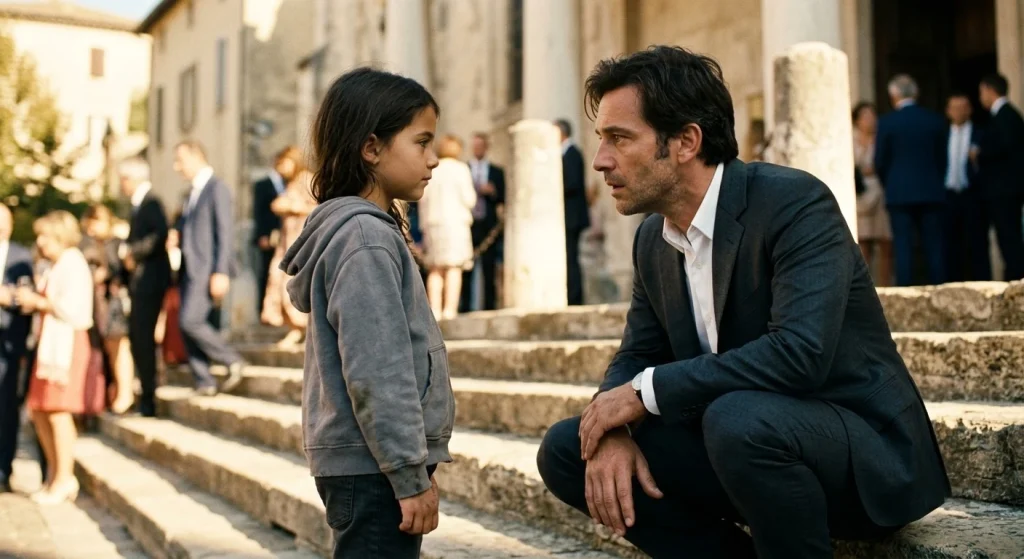
Then he crouched down in front of the girl.
She was still watching him steadily, hands now loose at her sides.
“What’s your name?” he asked.
“Bea.”
“Where do you live, Bea?”
“Two blocks over. The yellow building.”
He nodded slowly. “Your mom lost her job because of this?”
Bea shrugged in the careful way kids shrug when something hurts but they’ve decided not to show it. “Three weeks ago.”
Lucas stood. He turned to Davis. “Get the car.”
Then to the crowd — not to Valeria, not to Marcus, just the crowd: “My attorney will be in touch with some of you. Not the one standing by the door.”
A few people laughed despite themselves. The tension broke like a wave hitting sand.
Marcus tried to leave. He made it four steps before two of Lucas’s other security staff — who had been standing quietly at the base of the stairs the entire time — stepped into his path.
“Mr. Webb,” one of them said politely, “we’d like you to stay a few more minutes.”
Valeria stood on the church steps in her ivory dress as the crowd dispersed around her, the train of her skirt collecting dust from the stone. She still held the bouquet. She didn’t seem to know what to do with her hands.
Lucas walked down the steps with Bea beside him.
“Are you going to be okay?” she asked.
He considered the question. “Better question is whether I was okay before.”
“That’s not really an answer.”
“No,” he agreed. “It’s not.”
The car was waiting at the curb. Lucas opened the back door, then paused.
“I’m going to call your mom,” he said. “Not to make things weird. Just to make sure she has what she needs while she finds something new.”
Bea looked at him for a moment the way kids look at adults when they’re deciding whether to believe them.
“Okay,” she said finally.
He nodded. Got in the car.
As it pulled away, he looked once through the back window at the church — the guests milling on the steps, Valeria a white shape standing very still in the middle of it all, Marcus being walked firmly toward a separate vehicle.
Lucas faced forward.
His phone buzzed. A text from his CFO: Already saw the video. Want me to call the forensic accountant?
He typed back: Yes. Start with the overseas accounts.
Then he put the phone face-down on the seat, leaned his head back, and closed his eyes.
For the first time in months, he felt like he could breathe.
Six weeks later, Marcus Webb was disbarred pending criminal charges for breach of fiduciary duty and conspiracy to commit fraud. The forensic audit recovered $2.3 million moved through shell accounts over fourteen months.
Valeria’s civil suit against Lucas for “emotional damages” was dismissed in under an hour.
Bea’s mother started as an office manager at Moreno Capital the following Monday.
And Bea herself received, on her tenth birthday, a card in the mail with nothing written inside it — just a photograph. Her and Lucas on the church steps. Him crouched down to her level. Both of them looking at the camera with the same expression: like people who’d just survived something and were only beginning to realize it.
She put it on her nightstand.
She kept it there for years.
Original fictional stories. AI-assisted creative content.