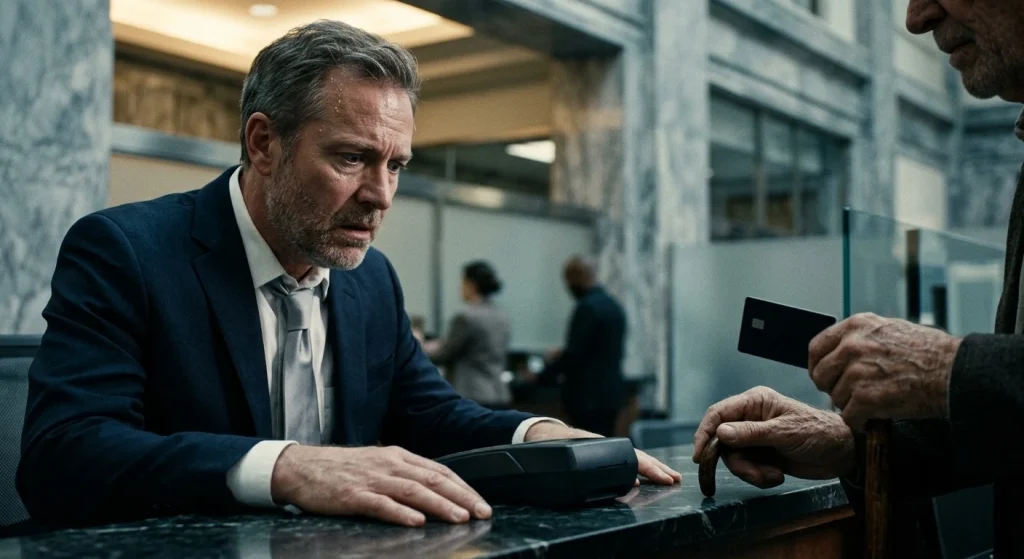

The card hit the marble counter like a rifle shot.
Everyone in the First National lobby turned. Conversations stopped mid-sentence. A teller’s pen rolled off her desk.
The old man gripped his cane with both hands, shoulders square, eyes fixed on the teller behind the glass.
“I said check my balance.”
His voice was low. Graveled. The kind of voice that had once cut through artillery fire and still carried the same weight.
The teller — barely twenty-two, name tag reading Kayla — looked up, then sideways, then reached for her phone.
Charles Hayes was midway through his second espresso when his assistant knocked.
“Sir, there’s a situation at the main counter.”
Charles set down the cup, smoothed the lapels of his navy suit, and walked out.
He’d built the retail floor of First National with an eye toward theater. Marble columns. Vaulted ceilings. Lighting calibrated to make customers feel small and money feel large. He liked it that way.
The old man at the counter didn’t look small.
He stood maybe five-ten, hunched slightly at the shoulders, a worn flannel shirt under a canvas jacket with a single pin on the breast pocket — a service medal Charles didn’t bother to identify. His slacks were pressed but old. His shoes were resoled.
A retiree, Charles thought. Wrong branch. Wrong attitude.
He walked up with a smile that never reached his eyes.
“Is there a problem here?”
The old man turned. His eyes were dark, sharp, and entirely unimpressed.
“No problem,” he said. “I want my balance.”
Charles glanced at the card on the counter. Matte black. No logo. Just a sixteen-digit number embossed in gray.
He picked it up and held it at arm’s length, the way someone might examine a piece of food they weren’t sure about.
“Sir,” he said, loud enough that the nearest customers could hear, “I think you might be in the wrong bank.”
One of the security guards near the door suppressed a smile. A woman in line pressed her lips together.
The old man didn’t move. Didn’t blink. Just tightened his grip on the cane.
“No,” he said quietly. “I’m not.”
Charles held his gaze for a moment, then turned to Kayla. “Run it.”
It was meant to be dismissive. A gesture to end the scene quickly, escort the man out with a printout, and get back to his espresso.
He slid the card into the terminal himself. Typed the last four digits the old man provided. Hit enter.
The terminal processed.
Charles waited, arms crossed.
The screen loaded.
He uncrossed his arms.
Leaned slightly forward.
His head tilted.
He typed the query again. Cleared the screen. Re-entered.
Same result.
The color left his face starting at the temples and moving downward, like paper catching water.
“Sir?” Kayla whispered.
Charles didn’t answer. His eyes moved across the screen once more, then stopped.
He straightened slowly.
“This account,” he said, barely audible — then cleared his throat — “this account holds primary equity interest in Meridian Capital Group.”
Kayla frowned. “I’m sorry, what does that—”
“Meridian Capital Group,” Charles repeated, his voice stripped of everything it had contained sixty seconds ago, “is the parent holding company of First National Bank.”
The lobby went silent in a way lobbies almost never go silent.
A man near the ATM stopped mid-transaction. The woman in line behind the veteran put her hand over her mouth. Someone near the entrance lowered their phone — then raised it again.
The old man said nothing.
Charles turned to face him. His mouth opened. Closed.
“I didn’t—” he started.
“You didn’t know,” the old man said. “That’s true.”
He reached into his canvas jacket and removed a photograph. Worn at the corners, creased down the middle from decades in a wallet. He laid it on the counter without ceremony.
It showed two men standing in front of a building — the same building they were standing in now, except the marble was raw and the sign above the door was freshly painted. Both men were young. One was clearly the old man, forty years younger, in a different uniform but the same bearing.
The other man was Richard Holt. Founder of First National. Dead seventeen years.
“Richard and I broke ground on this branch in 1987,” the veteran said. “I put in forty percent of the original capital. Never sold a share.”
Charles looked at the photograph for a long time.
“That’s—” he started again.
“Impossible?” the veteran said. “No. Inconvenient. There’s a difference.”
He picked up the photograph and returned it to his jacket.
“I’ve been coming in here twice a year for eleven years,” he said. “Different tellers every time. Never once a problem.” He paused. “Until today.”
Charles straightened his tie. An old instinct.
“Sir, I want to apologize — there was clearly a misunderstanding—”
“Was there?”
The words were soft. The lobby heard them anyway.
“You said I was in the wrong bank. Loud enough for eight people to hear.” The veteran’s eyes didn’t move. “You picked up my card like it was garbage. You waited for someone to laugh. A few did.”
Charles opened his mouth.
“I’m not asking for an explanation,” the old man said. “I’ve had worse said to me in worse places. I’m telling you what happened so there’s no confusion about what happens next.”
He reached back to the counter and took his card.
“I came in today to make a wire transfer and review the board meeting minutes from Q3.” He slid the card into his breast pocket. “Instead I spent twenty minutes being treated like a vagrant by the man running my bank.”
The words my bank landed like something physical.
Charles felt his legs shift beneath him. An involuntary thing.
“I’ve been patient with this branch’s performance reviews,” the veteran continued. “Tolerant of the overhead decisions I didn’t agree with. I don’t interfere with operations.” He looked at Charles directly. “I believe in letting people do their jobs.”
A pause.
“You’re no longer able to do yours.”
Charles heard it. The lobby heard it. The security guard near the door heard it and quietly moved away from the exit.
“I don’t understand,” Charles said, though he did.
“Yes you do.” The veteran reached into his jacket again — this time producing a small card. He placed it on the counter. “That’s my attorney’s number. You’ll be hearing from him regarding transition of duties before the end of business Friday.”
He picked up his cane.
“The wire transfer can wait until next week,” he said. “I’ll call ahead.”
He turned toward the door.
The lobby parted without anyone deciding to part.
He walked slowly. No rush. The cane clicked against marble with the patience of someone who had learned long ago that urgency was for people who doubted their own position.
At the door, he stopped.
He didn’t turn around.
“Respect,” he said, “is the only currency this place ever required of you.”
He pushed through the door into the afternoon light.
Behind him, the lobby stayed completely still for five full seconds.
Then Charles Hayes’s phone rang.
It was the board.
By Thursday morning, the framed portrait of Charles Hayes that had hung in the executive corridor since 2019 was in a box near the loading dock.
By Friday afternoon, the veteran — whose name was Howard Reeves, a fact that now appeared in three separate financial publications — signed the papers transferring management oversight to an interim director he’d personally vetted.
He did it at a small desk in a back office, with a cup of coffee the new branch manager had brought him without being asked.
“Cream?” she’d said when she set it down.
“Black,” he’d answered. “Always.”
He signed his name in the same deliberate hand he’d used in 1987, folded the copies into an envelope, and stood up.
“Thank you,” the interim director said.
Howard Reeves nodded.
“Do good work,” he said simply.
He walked out.
Nobody filmed it.
Nobody needed to.
Original fictional stories. AI-assisted creative content.