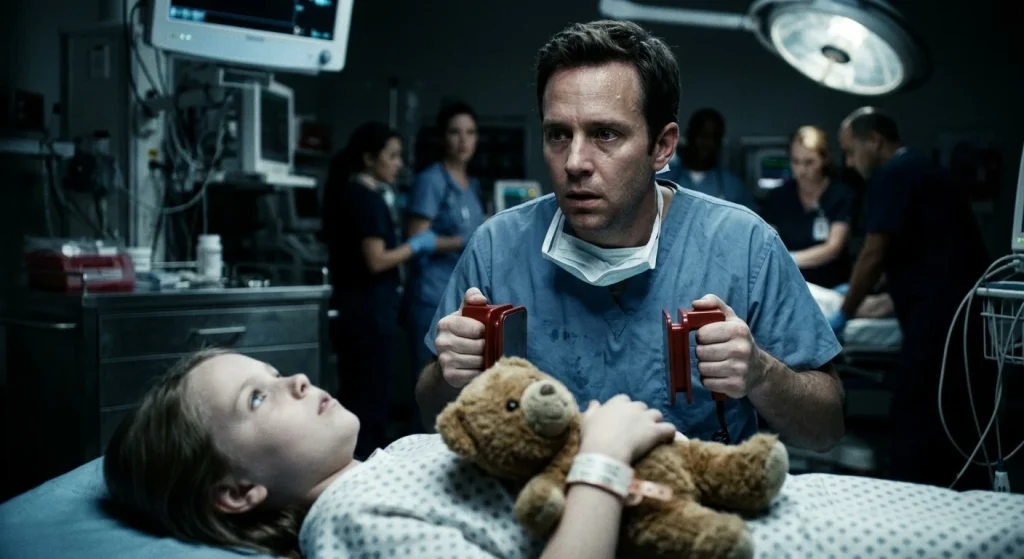

“Move! Move! Move!” the nurse screamed.
The stretcher slammed through the double doors, wheels shrieking against the tile. Monitors wailed. Staff scattered like startled birds.
“Talk to me,” Dr. Daniel Hayes said, already gloved, already moving.
“Nine-year-old female, found unresponsive at home, BP crashing in transit,” the paramedic barked. “We lost her pulse twice on the way in.”
“Get me a line. Now.”
Daniel’s hands worked fast — clinical, mechanical, safe inside the routine. Routine was armor. Routine didn’t let you feel anything.
The girl was small. Too small. One pale hand clutched a worn teddy bear, its ear chewed soft from years of nervous fingers.
“BP’s dropping,” a nurse said. “Sixty over forty and falling.”
“Second line, now!”
The oxygen mask slipped. Her chest rose in shallow, desperate pulls.
Then her hand shot out.
She grabbed his wrist.
Hard.
Daniel froze. Nine-year-olds didn’t grip like that. Not when they were crashing. Not ever.
“Doctor?” the nurse said.
Daniel couldn’t answer. He was staring at fingers wrapped around his forearm with a strength that made no clinical sense.
The girl’s lips moved. Cracked. Barely a whisper.
“Don’t let me die again.”
The room didn’t stop. The monitors kept screaming, the fluorescents kept buzzing, but something inside Daniel went utterly, terribly still.
“…What did you say?” he asked.
Her eyes opened halfway. Unfocused. And yet they found him, exactly him, like she’d been looking for his face her whole life.
“Daniel,” she breathed.
“Doctor, we need to move her to trauma two,” the nurse said, oblivious, professional, already pushing.
Daniel didn’t move.
“How do you know my name?” His voice cracked on the last word.
Nobody had told this child his name. He didn’t wear a nametag that said Daniel — it said Dr. Hayes. Parents used titles. Kids used titles. Nobody called him Daniel. Nobody except—
The girl lifted the teddy bear an inch off her chest, like it cost her everything.
Tied around its arm was a hospital bracelet. Faded. Cracked plastic. Ten years old if it was a day.
Daniel’s stomach dropped through the floor.
He knew that bracelet.
He had put a bracelet exactly like it on a different wrist, a different year, a different storm outside the windows.
“That’s not possible,” he whispered.
“Doctor Hayes, her pressure’s in the toilet, we need to move,” the nurse snapped.
He heard himself say “go,” but his feet felt bolted to the tile. The gurney rolled past him toward trauma two, and the girl’s fingers slid off his wrist, leaving four white marks on his skin.
“I saw you die,” he mouthed to no one, because ten years ago he had.
They wheeled her into Trauma Two. Daniel followed on legs that didn’t feel like his.
“Vitals,” he barked, forcing the doctor back into his body.
“Sat’s dropping, seventy-eight percent. Heart rate one-forty and climbing.”
“Push another round of fluids.”
“Already in.”
The girl’s head lolled toward him. Her eyes cracked open again.
“You promised,” she rasped, “you’d save me this time.”
“Stop talking,” Daniel said, too sharp, too scared. “Save your energy.”
“You cried,” she whispered. “After. In the stairwell. Where nobody could see.”
Daniel’s hands stopped moving.
Nobody had seen that. Nobody, not one living soul, had seen a twenty-six-year-old resident sit on a stairwell landing at 4 a.m. and sob into his own scrubs after a child died on his table.
“Who told you that,” he said, and it wasn’t really a question anymore. It was a plea.
Her lips curved, faint, sad. “Nobody told me. I was there.”
“Charging to two hundred,” a nurse called, “she’s dropping into V-fib—”
“Clear!”
The girl’s small body jolted off the table.
Flatline.
“Charging again—”
“Doctor, do we call it—”
“No.” Daniel’s voice came out of somewhere he didn’t recognize. “Not this time.”
Ten years fell on him like a wall.
Same hospital. Same kind of storm outside, rain slicing sideways against the glass. A different little girl, same age, same fear in her eyes. His hands, shaking, so much less sure back then.
“We’re losing her,” the attending had said.
“Do something,” Daniel had begged, a first-year resident who didn’t yet have the authority to do anything.
“The defibrillator’s not charging fully,” a nurse had hissed. “It’s the backup unit — the good one’s still in for repair.”
“Then get another one!”
“There isn’t one on this floor.”
He remembered the flat, endless tone of the monitor. He remembered a small hand going limp in his. He remembered a promise he’d whispered like a coward, too late for anyone but himself to hear.
“I’m sorry. I couldn’t save you.”
“Doctor Hayes!” The nurse’s voice cut through the memory like a blade. “We’re losing her—now!”
Daniel blinked back into Trauma Two. The monitor screamed its flat, endless tone.
“Time of dea—”
“NO.” He grabbed the paddles out of the nurse’s hands. “Charge to three hundred.”
“Doctor, protocol says—”
“I don’t care what protocol says. Charge it.”
“Charging.”
“Clear!”
The shock cracked through the small body. Nothing.
Daniel’s eyes burned. His hands shook on the paddles, the same hands that had shaken a decade ago, except this time he wasn’t going to let them freeze.
“I won’t fail you again,” he said, low, broken. “Not this time.”
“Charging to three-sixty.”
“Clear!”
The shock hit. The room held its breath.
The flat tone cracked — a stutter, a stumble, then—
Beep.
Beep.
Beep.
Nobody moved. Nobody breathed.
The girl’s eyes snapped open.
Not confused. Not dazed the way a revived heart usually left a person. Aware. Present. Knowing, in a way that made the hair rise on Daniel’s arms.
She turned her head, slow and deliberate, until she was looking directly at him.
A small, eerie smile touched her mouth.
“I told you,” she whispered. “This time you’d listen.”
Daniel stepped back so fast he hit the crash cart.
The nurse looked between them, baffled. “She’s… she’s stable. Sinus rhythm. I don’t—how—”
Daniel didn’t answer. He was staring at a nine-year-old he’d never met, who knew his first name, his worst memory, and a stairwell nobody had ever seen him cry in.
“Get her up to Pediatric ICU,” he said, voice hollow. “I’ll be right there.”
He needed five minutes. He needed the truth. He needed to know he wasn’t losing his mind.
Daniel found Nurse Patricia Alvarez in the break room, the same woman who’d worked the floor for twenty-two years, the same woman who’d been on shift the night everything went wrong a decade ago.
“Patricia. I need you to remember something.”
She looked up from her coffee, reading his face immediately. “You look like you saw a ghost, Daniel.”
“Maybe I did.” He sat across from her. “Ten years ago. My first year. The girl who coded on the fourth floor during that storm. Do you remember her name?”
Patricia’s face changed. Careful. Guarded. “Why are you asking about her now?”
“Please.”
“Emma,” she said quietly. “Emma Cole.”
The name hit him like a physical blow. He’d buried it so deep he’d almost convinced himself he’d forgotten it.
“The defibrillator,” Daniel said. “The one that failed. Do you remember why the good unit was out?”
Patricia’s jaw tightened. “Why does this matter after ten years?”
“Patricia.”
She glanced at the door, lowered her voice. “There were budget cuts that quarter. Dr. Webb — he was head of equipment procurement back then — he’d delayed the maintenance contract to save money. The unit on four had been flagged as unreliable for two weeks before that night. Everybody knew. Nobody wanted to be the one to say it out loud, because Webb was already climbing, and climbing men don’t like being embarrassed.”
“You knew,” Daniel said. “You all knew, and you let a first-year resident carry that.”
“You were an easy story,” Patricia said, not unkindly, just honestly. “A scared kid who froze. Nobody wanted the real story. The real story had a name and a title attached to it.”
Daniel’s hands curled into fists on the table. “Marcus Webb is Chief of Medicine now.”
“I know.”
“He built his career on the back of a lie that let a nine-year-old girl die.”
Patricia said nothing, which was its own kind of answer.
Upstairs, the new girl was sitting up in her bed, small and pale against the white sheets, the teddy bear tucked against her side, the bracelet still tied to its arm.
“Her name’s Lily Foster,” the charge nurse told Daniel at the door. “Parents are on their way from the hotel — they were in town for a wedding. Found her unresponsive in the bathroom. No history of cardiac issues, no history of anything. It’s like her heart just… stopped.”
“Any family history of arrhythmia?”
“Nothing on file. It’s strange, Doctor. She shouldn’t have coded like that. Not a healthy nine-year-old.”
Daniel stepped into the room alone.
Lily’s eyes tracked him the second he crossed the threshold, sharp, alert, entirely too aware for a child who’d been clinically dead twenty minutes earlier.
“You found her,” she said.
“Found who?”
“The nurse. Patricia. You asked her about me.”
Daniel’s mouth went dry. “I asked her about a girl named Emma.”
“I know,” Lily said simply.
He pulled a chair beside the bed, hands trembling in his lap. “Who are you?”
“I’m Lily.”
“That’s not what I asked.”
Her small fingers traced the worn ear of the teddy bear. “I don’t know how to explain it. I just know things. I know the stairwell. I know the rain that night. I know a man named Webb told you the machine was fine when it wasn’t.” She looked up. “I know you carried something for ten years that was never yours to carry.”
Daniel’s throat closed. “How.”
“Does it matter how?” Lily asked, and for one unsettling second, the voice coming out of a nine-year-old sounded decades older. “Or does it matter what you do now that you know?”
He didn’t sleep that night. He sat at his kitchen table with a decade-old incident report he’d requested from records under a favor and a fake pretext, reading it by lamp light like it might rearrange itself into something less damning.
Equipment malfunction — Unit 4B defibrillator flagged for maintenance 14 days prior to incident. Maintenance contract delayed pending budget review — approved by M. Webb, Director of Clinical Resources.
Resident physician D. Hayes noted as primary attending at time of code.
There it was. His name, front and center. Webb’s name buried three lines down in a memo nobody had ever been asked to read aloud.
Daniel’s phone buzzed. A text from the hospital.
Lily Foster’s parents have arrived. Mother is asking for the doctor who worked the code. Says she needs to speak with you personally.
He drove back to the hospital at 2 a.m., the incident report folded in his coat pocket like a loaded weapon.
Lily’s mother was younger than Daniel expected, hollowed out with fear, mascara long since cried away. She stood the second he entered the family room.
“Are you the one who brought her back?”
“Yes, ma’am. I’m Dr. Hayes.”
Her hand flew to her mouth. “Hayes,” she repeated, like the name meant something.
“Mrs. Foster?”
“I need to ask you something and I need you to not think I’ve lost my mind.” Her voice shook. “My daughter has never been sick a day in her life. But three months ago she started having dreams. She’d wake up crying about a stairwell. About rain. About a doctor named Daniel who cried after she died.” She stared at him. “I thought it was just a nightmare. Some kids have vivid nightmares. But she kept saying the same name, over and over. Daniel. Daniel Hayes.”
Daniel’s knees nearly buckled. “Three months ago.”
“Before any of this happened. Before we even knew we were coming to this city, to this hospital.” Her eyes filled. “Doctor, what is happening to my daughter?”
He didn’t have an answer that belonged in a hospital or a medical chart. So he told her the only true thing he had.
“Ten years ago I lost a patient in this building,” he said. “A girl the same age as Lily. I’ve never told anyone how much that night broke me. Your daughter knew things about that night that no living person could know.” He swallowed hard. “I don’t have a name for what’s happening. But I know it’s real, and I know I’m not going to waste it pretending it isn’t.”
Mrs. Foster gripped his hand, hard, the same grip her daughter had used on his wrist in the trauma bay.
“Then whatever this is,” she said, “you make it count. You hear me? You make it count.”
The next morning, Daniel walked into Chief of Medicine Marcus Webb’s office without an appointment, the incident report in his hand.
Webb looked up from his desk, silver-haired, polished, the picture of a man who’d never once had to apologize for anything.
“Dr. Hayes. I don’t recall an appointment.”
“You didn’t approve maintenance on Unit 4B ten years ago,” Daniel said, no preamble, no fear left to spare. “You knew it was flagged. You let it fail. And you let everyone believe a scared resident froze, instead of admitting a defibrillator you cut corners on cost a nine-year-old her life.”
Webb’s expression didn’t crack, not immediately. That was the scariest part — a man who’d had ten years to build the wall around this.
“That’s an old, closed case, Doctor. I’d think carefully before you throw around accusations that could end your career.”
“It’s not an accusation. It’s a memo with your signature on it.” Daniel set the folder on the desk. “I have a copy. I have a colleague willing to confirm what everybody on that floor already knew. And I have a mother in this building right now whose daughter is somehow carrying memories that shouldn’t exist — memories of a night you buried.”
“You’re talking about coincidence dressed up as ghost stories.”
“I’m talking about a paper trail,” Daniel said. “Ghosts don’t leave those. Bureaucrats do.”
Webb’s jaw tightened. “You’ll be finished here. Nobody will believe—”
“They’ll believe documents,” Daniel cut in. “I’m taking this to the board this afternoon. You can be there to explain your signature, or you can spend the meeting explaining your absence.”
He almost didn’t make the board meeting.
Lily coded again at 11:40 a.m.
Daniel was three floors away reviewing charts when the overhead page cracked through the hospital.
“Code blue, Pediatric ICU, room 412. Code blue.”
He ran. He didn’t remember choosing to run, his body simply did it, faster than it had ever moved in his life.
“What happened?” he shouted, skidding into the room.
“Sudden V-fib, no warning,” the nurse said. “We’re bagging her, no pulse.”
Lily’s small body jolted with compressions, the teddy bear knocked to the floor, the bracelet catching the light.
“Charge to two hundred,” Daniel ordered, and this time there was no hesitation in his voice, no decade-old freeze creeping back into his hands.
“Charged.”
“Clear!”
Her body jumped. The monitor stuttered.
“Still V-fib.”
“Epi, now. Charge to three hundred.”
“Charged.”
“Clear!”
The shock hit. For one endless second, nothing.
Then the line stumbled into rhythm.
Beep.
Beep.
Beep.
The room exhaled as one.
Lily’s eyes fluttered open, and this time there was no eerie knowing in them — just a frightened nine-year-old girl looking for her mother.
“Mom?” she whispered.
“I’m here, baby, I’m here,” Mrs. Foster sobbed from the doorway, rushing to her side.
Daniel stood back, chest heaving, and understood something with sudden, total clarity: this time, he hadn’t frozen. This time, there had been no promise whispered too late. There had only been the work, done right, done fast, done without the fear that had once cost a child her life.
He picked the teddy bear up off the floor and set it gently back in Lily’s arms.
She looked at him, clear-eyed now, no longer carrying whatever borrowed weight had ridden in with her.
“Thank you,” she said, simply, like any nine-year-old thanking a doctor. Nothing ancient in it. Nothing knowing. Just gratitude.
Whatever had spoken through her in the trauma bay was quiet now. Maybe it always had been the truth trying to find its way out through the only door still open. Maybe it had gotten what it needed.
The hospital board meeting happened three hours later, without Daniel needing to say much at all. Patricia had already come forward on her own, unwilling to carry the silence one more year now that someone had finally asked. Two other former staff members followed, once they realized the story could no longer be buried with a first-year resident’s name stapled to it.
Marcus Webb resigned within the week, ahead of the state medical board’s formal investigation into equipment procurement fraud spanning three separate incidents over twelve years. His resignation didn’t stop the inquiry. It only meant he faced it without a title to hide behind.
Daniel gave a full statement. So did the incident report, finally read the way it should have been read a decade earlier — every line, every signature, every name in its rightful place.
Six weeks later, Lily Foster was discharged, healthy, laughing, tugging her mother’s sleeve toward the hospital gift shop for a candy bar like the whole thing had been an inconvenient blip in an otherwise ordinary childhood.
Daniel walked them to the front doors himself.
“You did good, Doctor Hayes,” Mrs. Foster said, hugging him without warning, fierce and grateful. “Whatever this was. You did good.”
Lily tugged his sleeve too, solemn for one last second. “You kept your promise,” she said. “The second time.”
Daniel crouched to her eye level. “I did. Thank you for making me keep it.”
She smiled — a nine-year-old’s smile, easy and untroubled — and ran ahead to the automatic doors, teddy bear swinging from one hand, bracelet gone now, cut away and given to her mother as a keepsake nobody quite understood but everybody wanted to hold onto.
Daniel stood in the lobby and watched them go, watched sunlight replace fluorescent light on Lily’s face for the first time in a week.
For ten years, a stairwell at 4 a.m. had owned a piece of him no one ever saw. Tonight, for the first time, he walked past that same stairwell without flinching.
The debt was paid. The lie was buried under its own weight, not a child’s. And whatever had reached across ten years to grab his wrist and demand one more chance had gotten exactly what it came for — not vengeance, not haunting, just the truth, finally spoken out loud, finally believed.
Daniel Hayes went back to work that afternoon like any other doctor on any other shift. Except now, when the doors burst open and a stretcher came screaming through, his hands didn’t shake anymore.
They just worked. Steady. Sure. Done being afraid of a night that finally, completely, belonged to the past.
Original fictional stories. AI-assisted creative content.