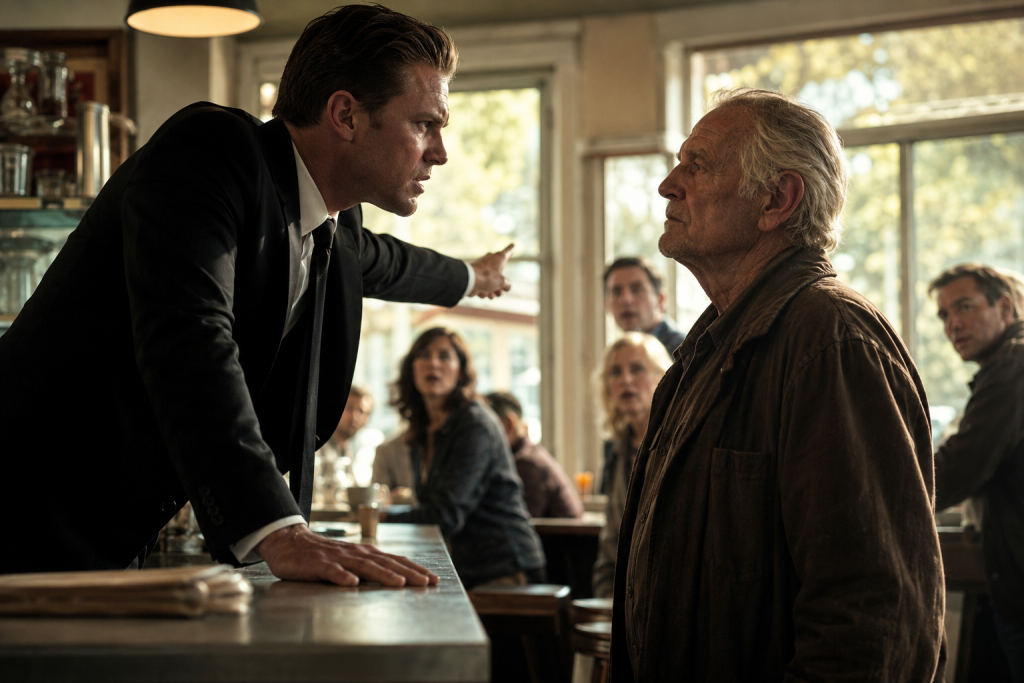

The morning rush hit the café like a wave — orders barked, cups clattering, the espresso machine hissing nonstop.
Emma wiped down the counter, smiling through the chaos. “Next!”
That’s when the door opened, and the noise seemed to dim.
A man in a torn brown coat stepped inside. His beard was rough, his hands cracked from cold. He shuffled to the end of the line, eyes down.
A woman in a blazer wrinkled her nose. “Can someone… handle this?”
“I’m fine,” the man murmured. “Just waiting.”
When his turn came, he stepped up slowly.
“Just a small coffee, please,” he said quietly, sliding a few worn coins across the counter.
Emma reached for a cup. “Coming right up, sir.”
“Don’t.”
The voice cut through the café like a blade.
A man in a tailored black suit walked out from the back office, two security guards flanking him. His hair was slicked back, his watch gleaming under the lights.
“This place has standards,” he said, not even looking at the old man. “You need to leave. Now.”
The old man didn’t move. He lifted his head — and froze.
So did the man in the suit.
“Marcus,” the old man whispered.
The café went dead silent. Someone’s phone stopped mid-scroll.
Marcus’s jaw tightened. For one heartbeat, something flickered across his face — fear, maybe. Then it vanished, replaced by a cold, practiced smile.
“Everyone, back to your orders,” he said smoothly. “Minor issue.”
He turned to the security guards. “Give us the room.”
They hesitated, then stepped back near the door.
Marcus walked closer, voice dropping to a hiss. “What are you doing here?”
“I wanted coffee,” the old man said simply.
“You wanted to humiliate me.” Marcus glanced around at the watching customers. “In my café. In front of my staff.”
“Your café?”
Marcus snapped his fingers. One of the guards brought over a slim silver briefcase and set it on the counter.
Marcus opened it. Stacks of cash filled one side. Folded papers sat on the other.
“Take it,” Marcus said, low and fast. “Fifty thousand. Cash. You disappear, you never come back, and we both pretend this never happened.”
Emma’s hand flew to her mouth. A few customers exchanged glances.
The old man looked at the money. Then at his son.
“Three years ago,” he said, “you told the lawyers I signed everything over. That I gave it to you willingly.”
“I don’t have time for this,” Marcus said through his teeth.
“You said I was sick. Unstable. That I couldn’t be trusted to run a business.”
“You couldn’t.”
“You said I disappeared on my own.”
Marcus’s hand twitched toward the briefcase, pushing it an inch closer. “Take the money, old man.”
“I didn’t come for your money.” The old man’s voice was steady now, steadier than it had been all morning. “I came to see what kind of man you became.”
Marcus leaned in, voice dropping so only the old man — and Emma, frozen nearby — could hear.
“You lost everything,” he said. “The house. The business. Your name on anything that matters. You are nothing now. Do you understand that? Nothing.”
The old man’s hand trembled as he reached into his coat. He pulled out a folded, yellowed paper.
But his voice didn’t shake at all.
“No,” he said. “I lost a business. I lost a house. I lost my health, sleeping in shelters for three winters.” He set the paper on the counter. “But I never lost my name. And I never lost this.”
He unfolded it and turned it so the whole café could see.
It was an ownership contract — old, official, stamped. At the bottom, a signature.
“That’s the original transfer agreement,” the old man said, louder now, his voice carrying. “The one with MY signature. Not the one Marcus filed with the courts three years ago — the one with a signature that isn’t mine.”
Marcus’s face went white. “That’s — that’s fake. That’s an old draft—”
“I spent three years getting copies of this,” the old man continued, ignoring him. “From a storage unit I almost lost. From a notary who remembered me. From a lawyer at a free legal clinic who believed me when no one else would.”
A young man near the front had his phone up now, recording.
“Put that away,” Marcus snapped, but his voice cracked.
“There’s a forensic handwriting analysis attached,” the old man said, pulling out a second paper. “Filed with the county clerk yesterday morning. Along with a sworn statement from the notary who says he never notarized anything for me in the year Marcus claims I signed this away.”
The café was utterly still. Even the espresso machine had stopped hissing.
“You’re done, Marcus,” the old man said quietly. “Not because of the money in that briefcase. Because of the truth in this folder.”
Marcus lunged for the papers. “Give me that—”
Emma stepped between them, holding up both hands. “Sir, I think you should leave.”
“This is MY café!”
“Not according to this,” the old man said, gently sliding the papers toward the recording phone, toward the crowd, toward the world.
By that evening, the video had three million views.
By the next morning, two detectives walked into the café and asked for Marcus by his full legal name.
He didn’t come back for his briefcase.
One week later, the café reopened under a new sign — the old man’s name, freshly painted, gold letters catching the morning light.
Emma stood behind the counter on opening day, and the old man walked in wearing a clean, simple coat. He didn’t go to the office upstairs.
He picked up an apron.
“Sir, you don’t have to—”
“I want to,” he said, tying it on. He looked at the line forming at the door — a few people in worn coats among them, hesitating the way he once had.
He waved them forward. “Come on in. Coffee’s on the house today.”
One man in a thin jacket blinked. “For… me?”
“For anyone who’s cold,” the old man said, smiling for the first time all week.
By the door, a small wooden sign now hung where Marcus’s framed magazine covers used to be.
It read: No one becomes invisible here.
Emma watched the old man pour coffee for the man in the thin jacket, watched the warmth return to a stranger’s face — and she understood, finally, exactly what kind of man had really owned this place all along.
Original fictional stories. AI-assisted creative content.