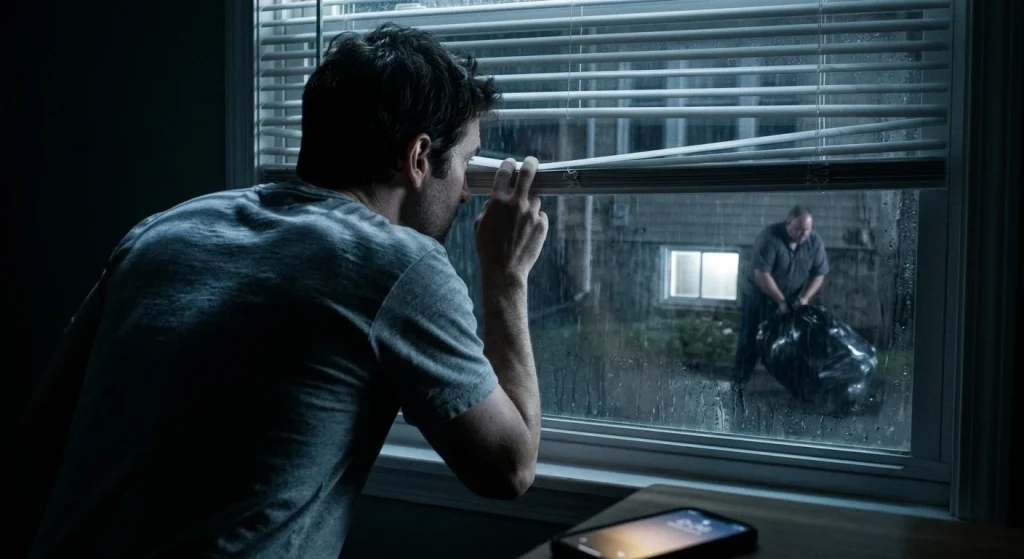

Tom told himself it was nothing. A late-night project. An old rug. Something heavy and completely ordinary.
He kept telling himself that right up until the shape shifted under the tarp, and his hands went cold around the binoculars.
It was past midnight. The rain hadn’t let up in hours — steady, punishing, the kind that turns streets into rivers and keeps people inside. Tom had been home from the office barely an hour, still in his tie, when a sound from across the street made him kill the lights and move to the window.
Now he stood in the dark, barely breathing, watching his neighbor, Jim Miller — the man who’d helped him carry boxes in when he moved, who left homemade chili on the porch every Christmas — drag something heavy through his basement.
Something the exact length of a person.
The shape was wrapped in thick black plastic, sealed with tape, and Miller was struggling with it, repositioning his grip every few feet, breathing hard. The basement light was on. The window was exposed. It was as if he didn’t care if anyone saw.
Then, without warning, he stopped.
Miller straightened slowly. He let go of the tarp. And he turned his head — not toward a sound, not toward a door — but directly upward. Directly at Tom’s window, one hundred feet away, across a dark and rainy street.
Their eyes met through the binoculars. Tom knew it. Felt it like a fist in his chest.
Miller smiled.
It wasn’t a surprised smile. Not a caught-in-the-act panic. It was slow, wide, and deeply pleased — the smile of a man whose evening was going exactly as planned. He reached into his pocket and pulled out his phone without breaking eye contact.
Tom’s nightstand lit up.
His phone buzzed like a living thing, rattling against the wood in the dark room. Tom stared at it. One ring. Two rings. He crossed the room on legs that barely worked and picked it up.
The caller ID just said: Jim.
He answered.
“It’s impolite to spy on your neighbors, Tom.” Miller’s voice was conversational. Almost warm.
Tom’s own voice came out wrecked. “What — what did you do? What’s in the—”
“Turn around,” Miller said softly, “and ask me yourself.”
The line went dead.
One second of silence.
Then: a mechanical click. Sharp, deliberate, unmistakable.
His bedroom door — which he had locked — was unlocking.
Tom spun around. The knob was turning. Slow and steady, the way someone who has all the time in the world would turn it.
He didn’t think. He didn’t have time to think.
He grabbed the desk chair and threw it sideways through the bedroom window, glass exploding outward, and launched himself after it — through the frame, over the ledge, slamming down hard on the porch roof. He scrambled down the rain gutter with his palms shredding against the metal, hit the wet grass, and ran.
He ran four blocks through the rain before he pulled out his phone and called 911.
He ran until his legs gave out in the parking lot of a gas station, its orange fluorescent sign buzzing overhead, and sat on the wet asphalt with his back against a newspaper box, gasping.
He told them everything. He told them about the basement window, the tarp, the call, the door.
“Sir,” the dispatcher said, “units are already en route to Millfield Lane. We received a welfare check request earlier this evening.”
“From who?”
A pause. “We’re not at liberty to say. Sir, we’re going to need you to stay where you are.”
He stayed.
Two patrol cars. Then a third. Then an unmarked sedan.
Tom watched from behind the gas station glass doors, a cup of bad coffee cooling in his hands, as the lights strobed across the wet street three blocks away.
A detective named Reyes came to him forty minutes later. She was compact and unhurried, with the practiced stillness of someone who had delivered news like this before.
“Mr. Callahan.” She sat across from him at the small table by the window. “We’ve secured the premises. Mr. Miller and an associate are both in custody.”
“And the tarp?” His voice was almost normal now. Not quite. “What was in the tarp?”
Reyes looked at him for a moment. Something careful was happening behind her eyes.
“Before I answer that,” she said, “I need to ask you a few questions about your wife. Claire Callahan.”
The coffee cup stopped halfway to his mouth.
“She’s at her sister’s,” Tom said. “She left Tuesday. She needed some space, we’ve been—” He stopped. “Why are you asking about Claire?”
Reyes clasped her hands on the table. “Mr. Callahan, when did you last speak to your wife directly? Phone, video call, in person — any contact.”
Tom set the cup down.
The gas station hummed around him. Rain tapped the glass.
“Text,” he said. “Tuesday night. She said she got there safe.”
“Did you call her?”
“She said she needed space. I was giving her space.” His throat was tightening. “Detective. What was in the tarp?”
Reyes didn’t flinch. She held his gaze and said, evenly, “We believe the remains are your wife’s.”
The words didn’t arrive all at once. They came in pieces, each one slower than the last, rearranging everything Tom thought he understood about his marriage, his house, his life, the texts he’d been answering for three days.
“We’re still working to confirm identity,” Reyes continued, “but we found her cell phone at the scene, and her fingerprints match what’s on file from her nursing license application. I’m sorry.”
Tom stared at the table.
“Miller,” he said. “Why?”
Reyes was quiet for a moment. When she spoke again, her voice was measured, careful.
“We’re still building the picture. But based on what we’ve found so far — financial records, communications on Miller’s device — it appears your wife made contact with Miller approximately eight weeks ago.” She paused. “Mr. Callahan, are you aware of the terms of your life insurance policy?”
The number surfaced in his mind. Two point four million. Claire had insisted on the amount. In case something happens to you, she’d said. You work a dangerous commute.
He nodded slowly.
“We believe your wife contracted Miller to kill you,” Reyes said. “In exchange for a portion of the policy payout.” She let that sit. Then: “Something went wrong between them. We don’t know yet whether it was a payment dispute, a change of plan, or something else. But Miller turned on her.”
Tom looked up.
“She hired him to kill me,” he said.
“Yes.”
“And he killed her instead.”
“Yes.”
Silence. Rain against glass. The coffee had gone completely cold.
“The man in the basement window,” Tom said. “The one actually dragging her — that wasn’t Miller.”
“No. An associate. Miller positioned himself at your door while his partner kept you occupied at the window. If you hadn’t gone through that glass when you did—”
She didn’t finish the sentence. She didn’t need to.
Six weeks later, Tom sat in Courtroom 4B and watched James Miller enter a guilty plea to first-degree murder, conspiracy, and two counts of criminal solicitation. His associate, a man named Gary Pruitt, took a deal and testified against him.
The prosecutor laid out the financial trail in eleven minutes flat. Eight weeks of encrypted messages. Partial cash payments traced back to a shell account Claire had opened the previous spring. Texts from Claire’s phone planning the staging, the timing, the cover story.
Miller stood with his hands folded and said nothing.
The judge sentenced him to life without parole before noon.
Tom sat in the back row and didn’t move until the courtroom had emptied. Detective Reyes paused beside him on her way out.
“You okay?”
Tom considered the question seriously.
“She looked me in the eye every day for nine years,” he said. “Made me coffee. Asked about my day.”
Reyes waited.
“I keep thinking I should have known.” He shook his head slowly. “I keep thinking what the right answer to that even looks like.”
Reyes put her card on the bench beside him. “There’s a victim’s advocate number on the back. They’re good people.”
She left him there.
Tom sat alone in the empty courtroom for a long moment. Fluorescent lights buzzed overhead. Somewhere outside, traffic moved and people went about their days, completely unaware that someone in a back row was quietly reconstructing what he believed about the world.
He picked up the card.
He stood.
He walked out into the cold, bright afternoon and called the number before he’d even reached the parking lot.
Miller would spend the rest of his life in a cell. Pruitt would spend the next twenty-two years in one. Claire’s estate — including the life insurance proceeds she had arranged, and the joint accounts she’d quietly been drawing down — was now subject to forfeiture proceedings, the proceeds redirected under the Slayer Rule.
She had planned everything perfectly, except for one thing: she’d trusted the wrong man.
And Tom had been watching the wrong window.
The phone rang twice. Someone answered.
“This is Tom Callahan,” he said. “I was told you could help.”
Original fictional stories. AI-assisted creative content.