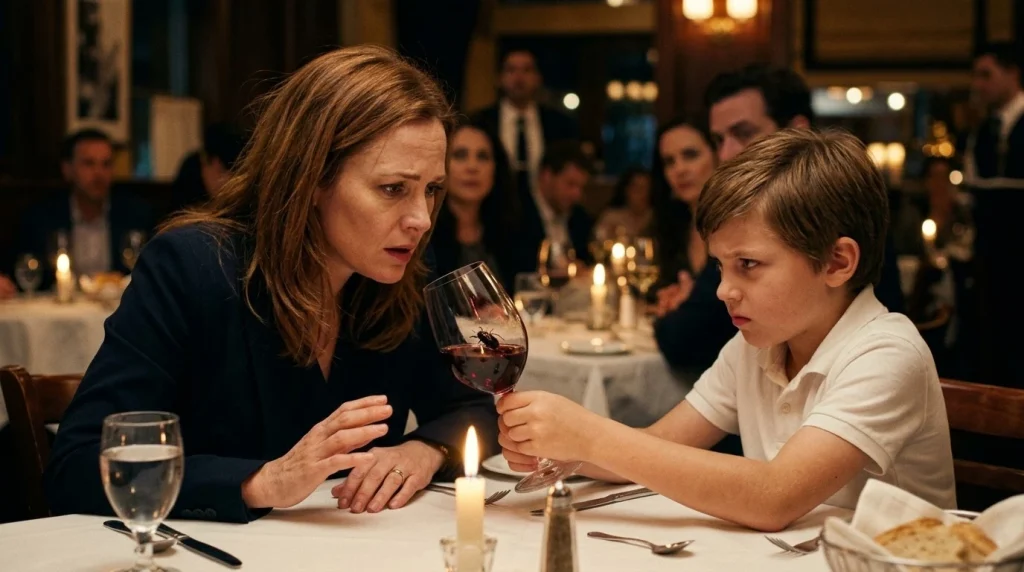

The reservation had taken six weeks to get. Table twelve at Ardent — the kind of place where the lighting was warm by design and the silence cost extra.
Diana Calloway sat across from her business partner, Marcus, running her finger along the stem of her Bordeaux. The wine had been poured tableside. She hadn’t touched it yet.
She almost did.
The glass was halfway to her lips when a small hand shot across the table and grabbed it.
She felt the impact before she understood it — the wine splashed cold across her wrist, hit the white tablecloth in a dark fan, and the glass was gone. In the hands of a boy. Maybe ten. Maybe younger. White polo shirt, scuffed sneakers. Completely out of place.
The entire section went quiet.
“What in the world—” Marcus started.
“Give that back,” Diana said. Her voice was low and controlled, the way she’d trained it to be in boardrooms. “Right now.”
The boy didn’t move. He was holding the glass away from her, his small chest heaving, staring down at something inside it.
“There’s something in here,” he said.
“I don’t care what’s in there. That is mine, and you need to put it down before I call the manager.”
“I’m trying to help you.”
“You are making a scene.” Diana stood, her chair scraping back. Around her, a dozen eyes watched. A woman at the next table pressed a hand to her mouth. A waiter had frozen mid-step near the kitchen door. “I don’t know whose child you are, but your parents are going to hear about this.”
The boy held up the glass.
He turned it slowly toward the light.
Diana saw it then.
A beetle. Large, dark, glossy. Its legs still moving faintly, its body half-submerged in the red wine. The wings caught the amber light of the chandelier and threw it back like oil.
She didn’t breathe.
“I saw it when they poured it,” the boy said quietly. “I was going to say something but — you were about to drink it. I didn’t have time.”
Marcus was on his feet now. “Jesus.”
The waiter arrived, his face pale. “Ma’am, I—”
“You poured this,” Diana said. She kept her voice steady only by clenching her hand at her side. “You stood at this table, you poured this glass, and you didn’t see that?”
“I — I don’t know how that happened, the bottles are sealed—”
“I don’t want explanations yet.” She turned back to the boy. He was still holding the glass out. His hands weren’t completely still. She realized he was nervous. He had done something he knew would get him in trouble, and he had done it anyway.
She took the glass carefully from him.
“What’s your name?”
“Eli.”
“Who are you here with, Eli?”
He pointed toward a table near the window. A woman — his mother, clearly, same jaw, same eyes — was halfway out of her chair, watching the scene with her hand pressed to her chest.
“Does she know what happened?”
“I didn’t tell her. I just — I saw it, and I moved.”
Diana looked at him for a long moment. The anger she’d felt thirty seconds ago had gone somewhere she couldn’t locate anymore. In its place was something quieter and much harder to name.
She set the glass down on the table, away from her. She reached into her jacket — the Loro Piana blazer that had cost more than most people’s rent — and pulled out the folded card she kept in the inner pocket. Her personal card. Not the business one.
She held it out to Eli.
“My direct number is on the back,” she said. “When you’re older and you’re looking for work — a job, an internship, anything — you call that number. You ask for Diana. They’ll put you through.”
Eli stared at the card. “I’m ten.”
“I know. Keep it anyway.”
He took it carefully, like it might break.
His mother had reached them now, breathless, her hand finding Eli’s shoulder. “I am so sorry, whatever he did—”
“He saved me from swallowing a beetle the size of a quarter,” Diana said. “Your son has better instincts than every adult in this room tonight, including me.”
The woman looked at Eli. Eli looked at the floor.
“She’s not mad?” the woman asked him.
“I’m not mad,” Diana confirmed.
Behind her, Marcus had already flagged down the restaurant manager, who was moving toward them with the expression of a man preparing to negotiate. Diana turned to face him, the soiled tablecloth and the ruined glass as her evidence.
“I’d like to speak with the owner,” she said. “Not you. The owner. And I’d like the kitchen to send something to that table by the window — whatever they want, full cost to the house. The boy and his mother are guests of Ardent tonight.”
“Ms. Calloway, I assure you—”
“I’ve been coming here for four years.” She kept her voice even. “I’ve sent clients here. I’ve celebrated two company closings at this restaurant. And tonight a ten-year-old child was watching my wine more carefully than your staff.” She paused. “Get me the owner.”
The manager went.
Marcus exhaled slowly beside her. “You okay?”
“I’m fine.” She looked down at the glass again — the beetle still floating, still, in the red. “I almost wasn’t.”
She sat back down. She didn’t order another wine. She ordered sparkling water, watched them open it sealed in front of her, and spent the rest of the dinner thinking about what it meant that a child had been paying attention when no one else was.
When she left, she passed Eli’s table. He and his mother were working through what looked like a chocolate dessert, something architectural and expensive. Eli was eating with the focus of someone who had never had anything like it before.
He looked up when he saw her.
She stopped. “Good call,” she said.
He nodded seriously. “You’re welcome.”
She smiled — a real one, the kind she didn’t hand out at board meetings. “Keep the card.”
Outside, the night air was cool. Marcus walked beside her toward the car.
“You know he’s going to call that number in eight years,” Marcus said.
“Good,” Diana said. “I hope he does.”
Three months later, she commissioned a full kitchen audit of every restaurant on her company’s corporate account list. Ardent’s contract was not renewed. The manager who had tried to smooth things over was quietly let go by the end of the fiscal quarter, and the owner — who had finally appeared that night, mortified and apologetic — overhauled the kitchen’s sourcing protocols entirely.
None of that made the papers.
But Eli’s mother framed the business card and hung it in their hallway.
She told anyone who asked: My son saved a woman’s life with a glass of wine and got a future out of it.
She wasn’t wrong.
Original fictional stories. AI-assisted creative content.