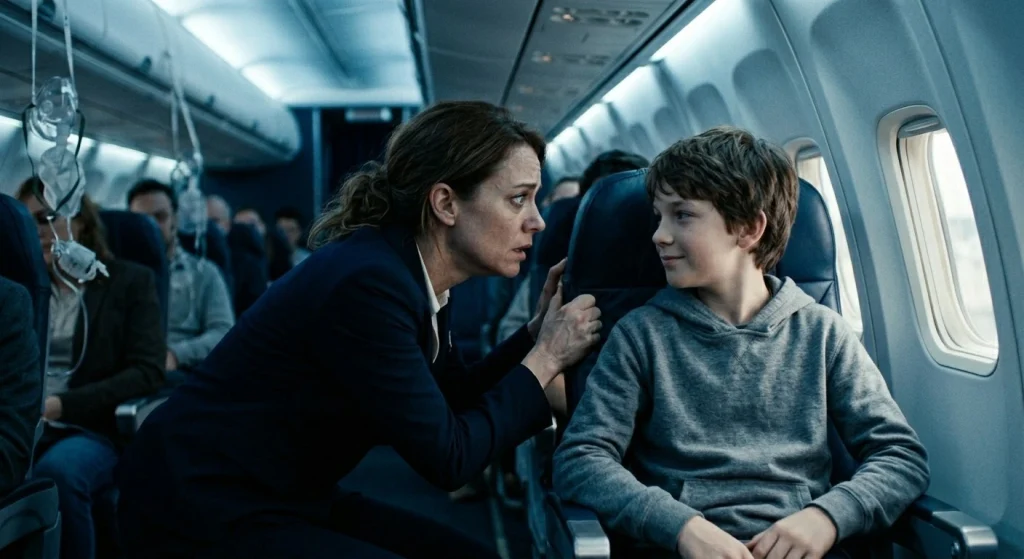

The oxygen masks dropped at 34,000 feet, and for three full seconds, no one moved.
Then everyone moved at once.
Seat belts tightened. Hands gripped armrests. A woman in 14C pressed her phone to her chest like it could protect her. The man beside her was already texting someone—fast, fingers shaking, not even looking at the screen.
The turbulence had started forty minutes ago. Mild. Annoying. The kind that spills drinks and earns nervous laughs.
That was forty minutes ago.
Now the cabin was tilting, the overhead bins rattling, and the hum of the engines had changed pitch in a way that nobody wanted to think too hard about.
Then came the sound from the cockpit.
Not words. Not static. Something between a groan and a crash, followed by silence so complete that every passenger heard it and understood: whatever was behind that door was no longer entirely in control.
Flight attendant Mara Chen had been doing this job for eleven years. She had handled medical emergencies, drunk passengers, a fire in the lavatory that still gave her nightmares. She had never once run down an aisle.
She ran now.
“Does anybody know how to fly a plane?” she shouted. “An airplane — does anyone here know how to fly one?”
Nobody answered.
Not because no one could speak. Because the question rewired something in every person who heard it. If she had to ask — publicly, out loud, to 200 strangers — then both pilots were gone. That’s what the question meant. That was the only math that made it necessary.
A man in a business suit half-stood. “I have a private license. Single engine—”
“Commercial Boeing,” Mara cut him off, voice flat. “737.”
The man sat back down.
More silence. The kind that weighs something.
Then the boy in 22B turned his head.
He was maybe twelve. Window seat. He’d spent most of the flight with earbuds in, reading something on a battered tablet. He didn’t look scared. He didn’t look excited either.
He just looked… ready.
“I can fly it,” he said.
His voice didn’t crack. Didn’t rise at the end like a question. He said it the way someone says I’ve got it when they catch something before it hits the floor.
Mara stared at him.
The man in 22A — a heavyset guy in his fifties, red-faced with fear — turned and looked at the boy like he’d just spoken in tongues.
“Kid,” Mara said carefully, crouching to eye level. “I need you to be honest with me right now. This isn’t—”
“I know what it is,” the boy said. He pulled out his earbuds. “How long ago did something happen in the cockpit?”
“About four minutes.”
“Altitude?”
Mara blinked. “I — thirty-four, maybe thirty-three thousand. Descending.”
“Autopilot still active?”
“I don’t know.”
“That’s the first thing we need to know.” He unbuckled his belt. “Can you get me in there?”
She didn’t move.
“I understand why you’re hesitating,” he said. “I would be too. But you asked the cabin if anyone could fly this plane. Nobody else raised their hand. So the question isn’t whether you trust me. It’s whether you have a better option.”
Mara looked down the aisle. Faces stared back at her — pale, waiting, some already crying. A toddler in the front row had gone completely silent, which was somehow worse than crying.
She straightened up.
“Come with me.”
The man in 22A grabbed the boy’s arm as he stood.
“You’re twelve years old,” the man said.
The boy looked at the hand on his arm. Then at the man.
“I know,” he said. “Let go, please.”
Something in his tone made the man release him.
The cockpit door was locked from the inside. Mara had the override key — every senior flight attendant did, for emergencies. This was the first time in her career she’d had to use it.
The lock disengaged with a click that sounded enormous.
The door swung open.
Captain Dave Reilly was slumped forward, forehead against the side panel, breathing but unresponsive. First Officer Kim Hatch had managed to stay upright but her face was gray and her hands kept slipping off the yoke. She was conscious — barely.
“Carbon monoxide?” the boy said immediately.
“We don’t—”
“Both pilots down, same time, no other symptoms — it’s either CO or a pressurization event.” He was already moving past Mara, dropping into the jump seat, eyes scanning every instrument. “The cabin masks deployed so pressure’s being managed. That means CO. You need to kill the bleed air from engine one. There’s a switch on the overhead—”
“I can’t—”
“Mara.” He said her name — he’d read it off her lanyard — and his voice was calm. Not cold. Calm the way deep water is calm. “I’m going to tell you exactly what to do. I need you to do it without asking why, because we’re losing altitude and we have maybe six minutes before this gets harder to fix. Okay?”
She looked at him. Twelve years old. Hands steady. Eyes on the instruments.
“Okay,” she said.
“Bleed air switch, engine one. Overhead panel, top row, third from the left. It’s red. Flip it off.”
She found it. Flipped it.
“Good. Now tell me what the altitude reads.”
She looked. “Thirty-one eight.”
“Rate of descent?”
“Negative — twelve hundred. Is that bad?”
“It’s manageable. We’re going to level this off.” He slid into the co-pilot’s seat and put his hands on the controls. Kim Hatch made a weak sound of protest.
“I’ve got it,” he told her, the way he’d said it in the cabin. I’ve got it. Settled and certain. “I need you to stay with me. Don’t move the controls. Can you do that?”
Kim’s eyes focused on him, clouded, struggling. “You’re…a kid.”
“I know. Stay with me anyway.”
Back in the cabin, nobody spoke.
Passengers had heard pieces — the boy’s voice, Mara’s voice, the sound of the cockpit door. The man in 22A had pressed his face against the seat gap and heard enough to relay a version to the rows behind him, which spread, transformed, and terrified people in equal measure.
A woman named Linda, flying home from a cancer follow-up she’d been dreading for months, pressed her hands together in her lap and closed her eyes.
The man next to her — a stranger, a sales rep named Greg who normally would’ve had his headphones in — reached over and put his hand on top of hers without saying anything.
She didn’t pull away.
The man in 22A sat back down in his seat and stared at the empty seat beside him.
He had grabbed a child’s arm and told him he was too young.
He thought about that.
In the cockpit, the boy’s name was Daniel.
Nobody knew that yet. Nobody had asked.
He had the descent rate slowing. Eleven hundred. Nine hundred. Leveling.
“Nearest airport,” he said.
Mara scanned the radio. “What frequency—”
“121.5. Emergency band. It’s already monitored.”
She keyed the radio. “This is Flight 2247, we have a medical emergency in the cockpit, both pilots incapacitated, we need vectors to the nearest field—”
Static. Then a voice — calm, professional, immediate.
“Flight 2247, this is Denver Center. We have you on radar. What is the status of your aircraft?”
Daniel leaned slightly forward. “Tell them we have a pilot. Unscheduled. Requesting priority landing, we’ll need emergency services on the ground.”
Mara relayed it, word for word.
A pause from Denver Center.
“Flight 2247, confirm: you have someone at the controls?”
“Confirmed,” Mara said. “He — yes. Confirmed.”
Another pause. Shorter.
“Flight 2247, turn left heading two-seven-zero. You are cleared direct Denver International. Descend and maintain one-five thousand. Emergency vehicles will be standing by.”
Daniel turned the heading. Smooth. Precise.
Mara watched his hands.
“How do you know how to do this?” she asked.
He didn’t answer right away. The instruments clicked. The engines settled into a different register — lower, controlled.
“I can’t tell you that,” he said.
She opened her mouth.
“I’m not trying to be mysterious,” he added, still not looking at her. “There are people I have to protect. If I tell you how I know, I put them in danger. What I can tell you is that we’re going to make Denver.”
Mara stared at the side of his face.
Twelve years old.
Steadier than anyone she’d ever seen in a crisis.
“Okay,” she said. For the second time. And like the first time, she meant it completely.
The descent took twenty-two minutes.
Daniel talked to Denver Center seven more times. Calm. Measured. Correcting their heading twice when wind shear nudged them sideways. He asked Mara to monitor Kim Hatch’s breathing and let him know if it changed. He talked Kim through staying conscious by asking her simple questions — what was the gate number when they boarded, what city was she flying toward, what did she have for breakfast.
“Eggs,” Kim said, voice thin.
“Good. Keep talking to me. What kind?”
“Scrambled.”
“Good. Was there toast?”
“Sourdough.”
“Did you eat the crust?”
A sound that might have been a laugh. “Nobody leaves the crust.”
“I leave the crust,” Daniel said.
“That’s wrong.”
“Probably. Stay awake.”
Mara went back to the cabin once — to tell them.
She stood at the front, hands holding the intercom, and looked at 200 faces.
“We have someone at the controls,” she said. “We are on approach to Denver International. We have ground services waiting. We are going to land safely.” She paused. “I need everyone to remain seated with belts fastened. That’s all.”
She started to hang up the intercom.
Then she added: “He’s doing great.”
She didn’t say who he was.
She didn’t need to.
Every person on that plane already knew.
The man in 22A sat very still for the rest of the descent.
He thought about the hand he’d put on the boy’s arm.
He thought about his own son, who was eight, who wanted to be an astronaut, who asked questions that adults kept telling him were too big for his age.
He thought: we tell them that. We keep telling them that.
He thought: and then we’re surprised when they stop raising their hands.
The wheels touched runway at Denver International at 2:17 PM.
Clean. Textbook.
The cabin erupted before the tires had even fully settled — clapping, sobbing, someone shouting oh my God in a way that was entirely prayer and zero profanity.
Emergency vehicles lined the runway in a row, lights going, waiting.
Mara sat on the jump seat with her face in her hands for exactly four seconds. Then she stood up.
In the cockpit, Daniel completed the post-landing checklist — or as much of it as he could — and then sat back.
Captain Reilly was being held steady by two paramedics now who had come aboard before the door even finished opening. Kim Hatch was already on a stretcher, sitting up, and the color was coming back to her face.
She looked at Daniel.
“Kid,” she said.
“Daniel,” he said.
“Daniel.” She held out her hand.
He shook it.
“You’re going to have a lot of questions to answer,” she said.
“I know.”
“From the FAA. From the airline. Probably from people I can’t even name.”
“I know.”
“Is there anything you want to say? Before all of that starts?”
He thought about it.
“I want to get off the plane first,” he said. “I’ve been sitting for six hours.”
Kim Hatch laughed. It hurt her chest and she didn’t care.
In the jetway, the passengers filed past Daniel one by one.
Some said nothing — just touched his shoulder, or squeezed his arm, or made eye contact long enough to mean something.
The woman named Linda stopped.
“Thank you,” she said. Just that. Two words with a weight behind them that Daniel felt in his sternum.
“You’re welcome,” he said.
The man in 22A was near the end of the line.
He stopped.
He opened his mouth.
Closed it.
Tried again.
“I grabbed your arm,” he said.
“You did,” Daniel said.
“I shouldn’t have.”
“No.”
The man nodded. He looked like someone trying to find a bigger sentence and failing to locate it. Finally he said: “My son is eight. He — he wants to be an astronaut.”
Daniel looked at him.
“Tell him to learn the math,” Daniel said. “Don’t let anyone tell him he’s too young to start.”
The man’s jaw tightened. He nodded again, harder this time. He walked on.
The last person out of the jetway was Mara.
She stopped beside Daniel, and they stood together in the fluorescent hallway while the noise of the airport moved around them — announcements, rolling luggage, the distant bark of a gate change.
“Last chance,” she said. “How do you know how to do that?”
Daniel looked at her.
“I told you.”
“I know what you told me.” She tilted her head. “I’m asking anyway.”
A beat.
Something moved across his face — not a smile, not quite. More like the shadow of a decision.
“There are twelve of us,” he said. “That’s all I’ll say. We train together. We stay quiet. We show up when we’re needed.”
Mara stared.
“Twelve,” she repeated.
“Twelve.”
“Children.”
“Some of us.”
Mara looked at him for a long moment. Then she looked at the gate behind her, at the empty plane, at the paramedics still working inside the jetway.
She looked back at him.
“Well,” she said. “You showed up.”
“Yeah,” Daniel said.
He picked up his backpack — the battered one, with the tablet inside — and walked toward the terminal.
He didn’t look back.
He never needed to.
Three weeks later, the FAA completed its investigation. Captain Reilly and First Officer Hatch had been incapacitated by a faulty bleed air valve on engine one — a slow CO leak that had seeped into the cockpit air system over the course of the flight. Both made full recoveries.
The official report listed the aircraft as “recovered by an unnamed minor passenger with undisclosed aviation training.”
That was all it said.
The airline tried to find him for a press conference. They found his name on the manifest — Daniel Voss, age 12, seat 22B — but the contact information led to a P.O. box in a town that didn’t appear to exist on any map.
The man in 22A went home and signed his son up for aerospace camp.
Linda went to her follow-up appointment. The scan came back clean.
Greg, the sales rep, texted the woman named Linda when he landed. He’d gotten her number on the jetway. They got coffee three weeks later.
They’re still getting coffee.
And on a quiet Tuesday morning, six weeks after Flight 2247 touched down in Denver, a second flight had an emergency somewhere over the Midwest.
The cockpit went silent.
And in seat 14A, a girl who looked about thirteen put down her book, unbuckled her belt, and stood up.
She was calm.
Not brave.
Not dramatic.
Just calm.
End.
Original fictional stories. AI-assisted creative content.