
The elevator doors opened on the forty-second floor, and the noise of the city died.
The Crystal Ballroom floated above everything. Glass floors. Gold columns. Chandeliers so dense with light they looked like collapsed suns. The guests moved beneath them like people who had never been told no.
Diane Hartwell stood near the bar, champagne untouched, eyes scanning the room the way she always did — counting exits, counting threats.
Her assistant appeared at her elbow. “The Harmon table is asking if you’ll speak before the toast.”
“Tell them maybe.”
“They won’t like that.”
“They never do.”
She turned back to the room. And stopped.
A girl had just walked through the main doors.
No escort. No invitation card visible. No nerves.
Simple black dress. Hair loose. Barely any jewelry. Maybe twenty-two, maybe less.
But the crowd parted around her like water around a hull — not from recognition, from something else. Something instinctive.
“Who is that?” Diane asked.
Her assistant squinted. “She’s not on the list.”
“I know she’s not on the list. I’m asking who she is.”
No answer came. Because no one knew.
At the center of the room, at the table that never had to be labeled because everyone already knew whose it was, Richard Harmon sat with the easy stillness of a man who had built everything in this room and most of the city beneath it.
Sixty-one years old. Silver at the temples. A face that had learned to give nothing away.
He was mid-sentence with the senator on his left when the room’s energy shifted.
He felt it before he saw it. Twenty years at the top of a power structure teaches you that — the exact texture of a room changing.
He looked up.
The girl was walking straight toward him.
No hesitation. No detour. No performance of not knowing where she was going.
He didn’t move. Didn’t speak. Just watched her come.
She stopped three feet from his table.
“You’re in the wrong place,” he said. Quiet. Certain.
She looked at him for the first time. Held it.
“No,” she said. “I’m exactly where I need to be.”
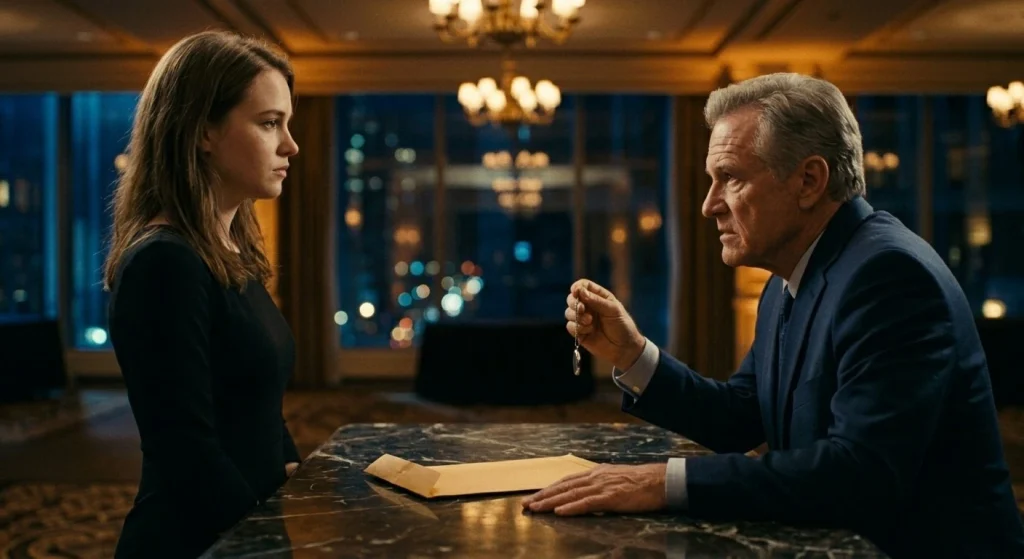
She reached into the small bag at her side and placed something on the marble table in front of him.
A silver locket. Old. Oval-shaped. Engraved on the back with letters too small to read from a distance.
The senator beside Richard said nothing. Neither did the two men flanking him.
Richard Harmon stared at the locket.
He did not touch it.
Not yet.
Diane had moved closer without meaning to.
She wasn’t the only one. A slow, unconscious drift had pulled half the room toward the center table, conversations dissolving mid-word.
She watched Richard’s hand move forward — and stop.
Then move again.
His fingers closed around the locket. He turned it over. Worked the clasp.
The room had gone genuinely silent. Not the polite silence of a toast. The silence of people who suddenly understood something was happening that they were not supposed to be watching.
Richard opened the locket.
His face changed so fast it was almost violent. Shock moved through him like a current — visible in his jaw, his eyes, the sudden rigidity of his shoulders.
His other hand went to his collar. Slow. Automatic. Like a reflex from a long time ago.
He pulled the collar aside.
There — on a chain against his skin — was an identical locket.
Same oval shape. Same engraving. Same age.
The woman at the table behind him stood up abruptly. Margaret Harmon. Richard’s wife of thirty years. Her chair scraped loud against the glass floor.
“That locket,” she said. Her voice was shaking. “It was supposed to be destroyed.”
Richard looked up at the girl. The certainty was gone from his face. In its place was something rawer.
“Who sent you?”
The girl didn’t flinch.
“No one sent me.”
A beat.
“I came because of her.”
Margaret went white. Her hand found the back of her chair.
“That’s impossible,” Richard said. Almost a whisper.
The girl tilted her head slightly. Just a fraction. Like she’d expected exactly that word.
“My mother said you’d say that too.”
The silence lasted three full seconds.
Then it broke — not with noise, but with motion. Margaret sat back down heavily. One of Richard’s men put a hand on the table. The senator quietly pushed his chair back.
Richard stood up.
He was taller than the girl by almost a foot. He’d spent a lifetime using that kind of physicality — the simple pressure of his presence — to end conversations.
It didn’t work.
She held her ground and looked up at him without blinking.
“What is your name?” he asked.
“Claire.”
“Claire what?”
“Claire Voss.” A pause. “For now.”
The last two words landed like a door swinging open.
Margaret made a sound — not quite a word. Not quite a gasp.
Richard said: “You need to leave.”
“No.”
“This is not the place—”
“You chose this place.” Her voice didn’t rise, but it sharpened. “You hold this gala every year. Every year you sit at this table and the whole city comes to you. So I came to you.” She glanced once at the locket, still open in his hand. “You recognize it. I can see that you do. The photo inside — you know whose it is.”
He hadn’t looked at the photo yet. He looked now.
His face didn’t crumble. Men like Richard Harmon didn’t crumble in public. But something went out of him — some structural tension — like a building losing one of its main supports.
“She’s been dead for twenty-three years,” he said.
“She died eight months ago.”
The room absorbed that.
“She raised me alone,” Claire said. “She worked two jobs. She never asked you for anything. Not after the first time you told her she was lying.”
Margaret stood again. “Richard—”
“Don’t.” He held up one hand. Not angry. Exhausted. “Just — don’t.”
He looked at Claire.
“The photo in that locket,” he said slowly. “It matches mine.”
“Yes.”
“Which means she kept it.”
“Yes.”
He closed his eyes for just a moment.
“Why now? Why here?”
Claire reached into her bag again. This time she set down a sealed envelope. Legal size. A return address in the upper corner — a law firm, a city three states away.
“She wrote everything down before she died. Dates, letters, medical records. Her attorney filed it last month.” Claire looked at him steadily. “I didn’t come here for money. I came here because she asked me to give you the locket in person.” She paused. “She said you’d know what it meant.”
Richard Harmon picked up the envelope. Held it.
Margaret said, very quietly: “You knew.”
He didn’t deny it.
“Richard.” Her voice broke on the second syllable. “Did you know?”
“I suspected.” He set the envelope back down. His jaw tightened. “I chose not to.”
The words fell into the room like stones.
Margaret picked up her clutch from the table. She didn’t look at him. Didn’t look at Claire.
“Call the car,” she said to no one in particular.
“Margaret—”
“Don’t.” She straightened. Her voice had gone flat and precise, the way it gets when emotion burns past expression into something colder. “You suspected. For twenty-three years. While I sat beside you at every table, in every room, while you built this—” she gestured at the ballroom, the columns, the hundred watching faces — “while you let her raise a child alone.”
She looked at Claire then. A long look. Not warm. But not unkind.
“I’m sorry,” she said. “Not for him. For her.”
Then she walked out through the crowd, and it parted for her exactly as it had parted for Claire, and for exactly the same reason.
The guests stood very still.
Richard Harmon looked at the envelope. At the locket in his palm. At the girl across the table.
“She never cashed the check,” he said finally. “I sent it once. Twenty-three years ago. She sent it back.”
“I know.”
“She didn’t want anything from me.”
“She wanted you to know she existed,” Claire said. “And she wanted me to know where I came from.” She reached across the table one more time. Picked up her locket — hers, not his. Clasped it shut. “I know now.”
She turned to leave.
“Claire.”
She stopped. Didn’t turn.
“The attorney’s filing,” Richard said. “There will be a process. I won’t—” He stopped. Started again. “I won’t contest it.”
A long pause.
“Okay,” she said.
She walked back through the crowd. The parting happened again — slower this time, more conscious. People stepped aside not from instinct but from something closer to respect. She didn’t look at any of them.
At the door, she stopped once. Looked back at the room — at the chandeliers, the glass floor, the hundred people in their expensive silence.
She had been born in a two-bedroom apartment with water-stained ceilings and a mother who worked double shifts.
She did not belong here.
But she had come anyway. Done what she came to do.
She pushed through the door and let it close behind her.
Two weeks later, Richard Harmon’s attorneys released a formal statement acknowledging a previously unknown heir and confirming the opening of a legal process to establish the terms of her standing in the estate.
He did not attend the press briefing.
He did not appear at the following year’s gala.
The ballroom was just as bright. The chandelier light still fell through the glass floors like burning stars.
But the center table had a different man at it. Someone younger. Someone still building.
And in a small apartment across the city, Claire Voss sat at a kitchen table with a cup of coffee and a folder of papers, reading the formal documentation of who she was and where she came from — and finally, after twenty-two years, she didn’t have to take anyone’s word for it anymore.
It was there in black and white.
It was enough.
Original fictional stories. AI-assisted creative content.