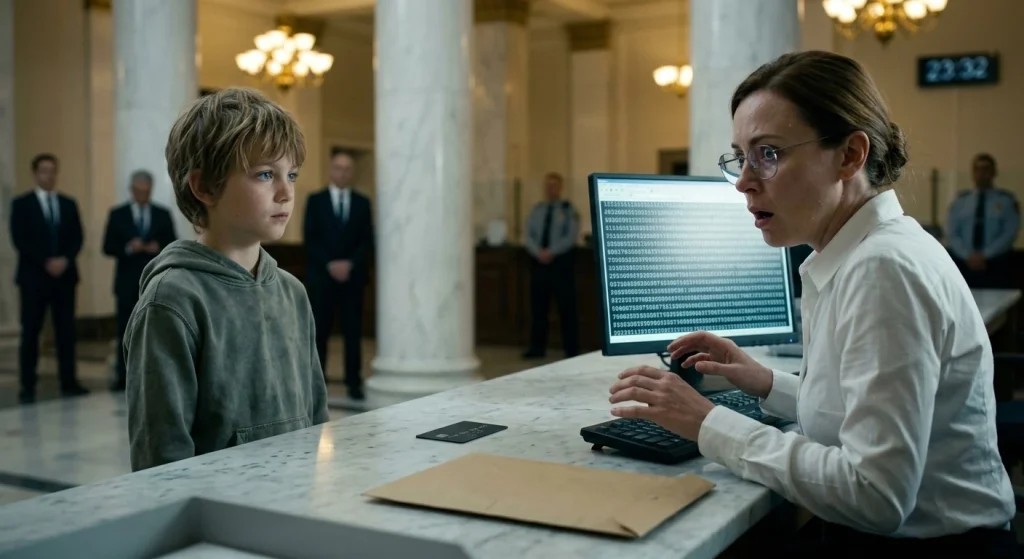

The lobby of First National was the kind of place designed to make you feel small.
High ceilings. Cold marble. The kind of silence that said money lives here, and you probably don’t.
The boy walked in wearing dirty sneakers and a hoodie two sizes too big. He was maybe twelve. Maybe thirteen. He looked like he’d ridden a bus for a long time to get here.
A woman near the door actually laughed under her breath.
A man in a tailored suit nudged his colleague and tilted his head toward the kid like he was pointing out a stray dog.
The boy didn’t notice. Or didn’t care.
He walked straight to the counter.
Sandra had worked teller window three for nine years. She could spot a problem customer in under four seconds. Homeless man with a wrinkled check — stall and call the manager. Teenager with a prepaid card — minimum wage smile. College kid disputing an overdraft fee — waste of everyone’s time.
This boy was a new category.
She took him in — dirty clothes, no bag, a battered envelope clutched in one hand — and her smile curdled into something flat and professional.
“Can I help you?” she said, in the tone that meant please leave.
“I’d like to check my account balance,” the boy said. His voice was quiet. Even.
“Do you have an account with us?”
He placed the envelope on the counter. Inside was a folded document — the kind printed on thick paper with a notary seal on the corner. Then, beside it, he set down a black card. Not plastic. Metal. With no name on the front. Just a single embossed number series.
Sandra stared at it.
“This better be fake,” she said, already reaching for it.
She swiped it through the terminal. Her fingers moved fast — she’d done this ten thousand times.
Then they slowed.
Her brow pulled together.
She typed a command. Hit enter. Waited.
The numbers that came back didn’t look right. She blinked. Typed again. The system refreshed.
The same numbers.
A string so long it didn’t fit on one line of the display.
“What…” she whispered.
“Just tell me the number,” the boy said.
Sandra looked up. Her face had gone the color of old paper.
“I—” She swallowed. “I need a moment.”
Behind the boy, a small crowd had drifted closer. A woman in designer sunglasses had lowered them. Two men in suits stood at half-attention, drawn in without quite knowing why.
“What’s happening?” a customer behind the boy muttered.
Nobody answered. They were all watching Sandra.
She called her manager over with one trembling finger.
Marcus — forty-three, twenty years in banking, seen everything — leaned in and looked at the screen. He went very still.
He looked at the boy. Then at the screen. Then at the boy again.
“Step back, please,” he said quietly to Sandra.
She stepped back. Almost tripped over her chair.
Marcus picked up the desk phone. Dialed an extension nobody in the lobby had ever heard him use.
“Yes,” he said softly. “You’re going to want to come down. Now.”
The next three minutes were strange.
Nobody talked. Not really. The lobby had the electric stillness of a room where everyone knows something has shifted but nobody’s willing to say it first.
The boy stood at the counter. He didn’t fidget. He didn’t look at his phone — he didn’t even have a phone. He just waited, hands in his pockets, watching the door to the back offices the same way someone watches a train they know is already on time.
Sandra, off to the side, was whispering to a colleague.
“It’s not a joint account,” she said. “It’s not a trust. It’s a— I’ve never seen this classification before. Executive override access. Full control. Every branch.”
“Every branch of what?”
She looked at him.
“Every branch,” she repeated. “All of them.”
The door opened.
A tall man in a dark suit came through it. Late fifties. Silver at the temples. The kind of calm that comes from never having needed to rush.
He was on the phone, but he ended the call the moment he saw the boy.
He walked across the lobby floor with long, deliberate steps. The crowd parted for him without thinking about it.
He stopped at the counter.
He looked at the boy for a moment — just a moment — then did something that made Sandra’s breath catch.
He dipped his head.
Slightly. Formally.
“Sir,” he said.
The word fell into the lobby like a stone into still water.
The security guard took an involuntary step back.
Sandra pressed her fingers to her mouth.
The boy looked up at the man with the same calm, unreadable expression he’d worn since he walked in.
“You’re late,” the boy said.
“I came as fast as I could.”
The man — his name was Harlan, though very few people in this lobby would ever know that — took out his own phone and typed something quickly. Throughout the building, things happened.
Doors locked with a soft click.
Staff members who had been drifting closer suddenly straightened and looked at each other.
The background noise of the lobby — keyboards, printers, the low hum of machines — stopped.
The boy reached out and picked up the metal card from the counter. Slid it into his pocket alongside the envelope. Then he looked at Sandra.
She was frozen. Eyes wide. The expression of someone watching a movie where the genre has abruptly changed.
“You should be careful,” the boy said quietly, not unkindly. “People judge too fast.”
“W-who are you?” Sandra whispered.
He didn’t answer that directly. He glanced once around the lobby — at the customers with their phones now lowered, at the man in the tailored suit who’d been laughing a few minutes ago and was now looking at the floor, at the guard who was studying his own shoes.
Then he looked at Sandra one more time.
“You work for me,” he said simply.
He turned and walked toward the door.
Harlan followed, two steps behind, at the right distance.
Nobody moved.
The glass doors opened and the boy walked out into the afternoon light, unhurried, the same as when he’d walked in.
Except now the entire lobby was watching him go.
It took Sandra three days to work up the nerve to look up the account documentation.
The paper trail was airtight. An estate. A trust. A network of holding companies that traced back through six layers to a single name — a name she recognized from the brass plaque in the building’s lobby that she had walked past ten thousand times without once reading.
The building she worked in.
The bank she’d spent nine years of her life at.
She sat at her desk for a long time.
Then she opened a drawer, took out her resignation letter — the one she’d been meaning to submit for a while now — and placed it face-down on her desk.
She wasn’t resigning because she was forced to.
She was resigning because she suddenly understood, with the clarity of someone who has just seen a thing they cannot unsee, exactly what kind of person she had become.
The kind who laughs at a boy in dirty sneakers.
The kind who says this better be fake before she’s even looked at what she’s holding.
She put the letter in an envelope, wrote Marcus’s name on the front, and walked it to his office.
“Sandra—”
“It’s fine,” she said. “It’s the right thing.”
And for the first time in a long time, she meant something she said.
Meanwhile, across town, the boy sat in the back seat of a black car and watched the city go by.
Harlan was in the front. After a while he glanced in the rearview mirror.
“You could have announced yourself,” he said. “Avoided the whole scene.”
“I know,” the boy said.
“Then why didn’t you?”
The boy thought about it.
“Because I wanted to see who they really were,” he said.
A long pause.
“And?”
The boy looked out the window.
“I got my answer.”
Six weeks later, Sandra was offered a position at a nonprofit that matched financial literacy tutors with underserved middle school students.
She took it. No hesitation.
The salary was sixty percent of what she’d made at the bank.
She didn’t care.
She started the following Monday — and on her first day, one of her students walked in wearing dirty sneakers and a hoodie two sizes too big.
She smiled at him — a real one, not the flat professional kind — and pulled out a chair.
“Welcome,” she said. “Let’s get started.”
Some things don’t need a name to teach you something.
Some lessons just walk in, lay a black card on the counter, and wait.
Original fictional stories. AI-assisted creative content.