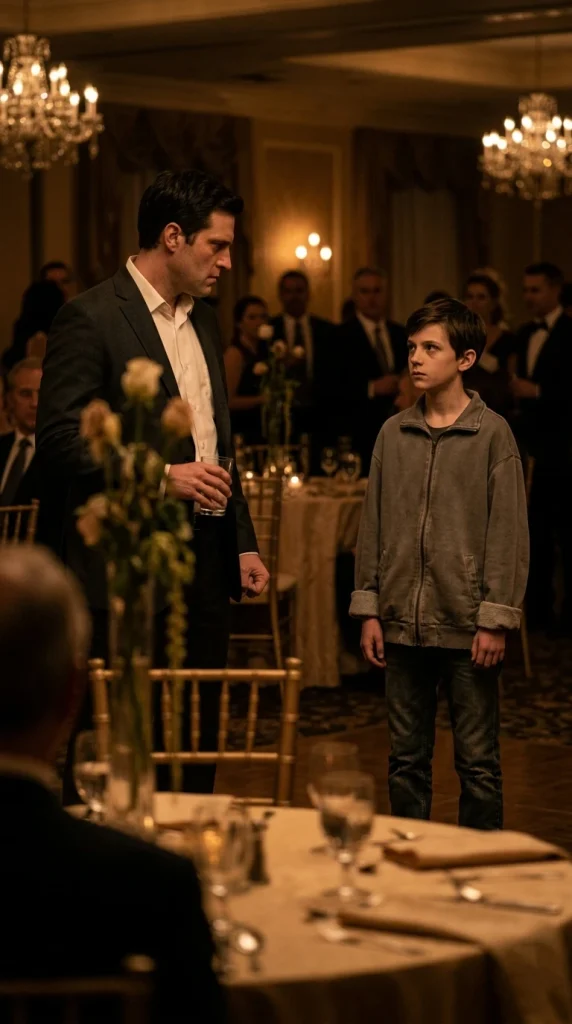

Ethan Caldwell had not wanted to come tonight.
He had come because Margaret had asked him three times and he had run out of ways to say no that didn’t start a conversation about how he was doing. He was not doing. That was the answer. He was not doing anything except existing in the same rooms as his life.
The banquet hall was full of people he half-recognized — colleagues, friends of friends, people who had sent flowers two years ago and had since returned to their own lives. He didn’t blame them. He had wanted to return to his own life too. He just couldn’t find the door.
Lily sat in her wheelchair at the edge of the dance floor. She hadn’t asked to come either. She never asked for anything anymore. That was the part that broke him the most — not the wheelchair, not the silence from the doctors, not the slow erosion of what the injury had taken. It was that she had stopped wanting things.
He stood beside her with a glass of water he wasn’t drinking and watched the room.
That was when the boy appeared.
He came from the edge of the crowd — not running, not hesitating. Moving with a kind of quiet certainty that had no business being in a twelve-year-old. He was wrong for the room in every visible way: oversized jacket with the cuffs rolled twice, sneakers splitting at the toe, dark eyes scanning the space without flinching. The formally dressed guests parted for him without noticing they had.
He stopped three feet from Ethan.
Looked up at him directly.
“Let me dance with your daughter,” he said. “I can make her walk again.”
The room continued around them. Someone laughed quietly at a nearby table. A waiter crossed behind the boy with a lowered tray.
Ethan looked at him for a long moment.
Something cold moved through his chest — not anger yet. The thing before anger. The thing that decides which direction anger goes.
“Walk away,” he said.
He kept his voice low. He was good at that. Claire used to say he was the calmest furious person she had ever met.
The boy didn’t move.
Ethan took one step toward him. Closed the distance to two feet.
The boy held his ground. His expression didn’t shift — not afraid, not defiant. Just certain. The way you are certain of something you’ve already lived through.
A beat of silence stretched between them. Somewhere in the room a glass clinked against another. The ambient murmur of grief-heavy conversation continued without pause.
Then the boy said, quietly and without looking away:
“Just give me one chance.”
Ethan stared at him.
Behind him — he felt it before he saw it — Lily’s hand lifted two inches off her own lap and brushed his forearm.
He turned.
She was looking at the boy. Not through him. At him. With the particular quality of attention she used to save for things she was trying to memorize.
“Let him try, Dad,” she said.
Her voice was so quiet he almost didn’t catch it over the room.
He turned back to the boy.
The boy was still standing there. Still not moving. Still looking at him with those dark, certain, grief-worn eyes.
Ethan’s jaw was tight. His hand was still curled into a fist at his side.
He stood there for what felt like a long time.
Then he opened his hand.
—
He didn’t say yes that night. That was not who he was.
But he didn’t call security. And he didn’t walk away.
He took the boy’s name. He took nothing else.
Noah Reyes. Twelve years old. No permanent address.
Ethan went home and sat in the kitchen until two in the morning and did what he always did when something didn’t make sense — he looked for the facts underneath it.
What he found was this: Noah had a sister. Emma. Six years old when she stopped walking. Conversion disorder — the body shutting down under weight it couldn’t carry. Eight months later, after Noah had worked with her every day using music and movement and something the case notes couldn’t name, Emma had walked out of their building on her own.
Six weeks after that, the state had separated them.
Ethan read the case file three times. Then he called his attorney.
—
Noah came to the penthouse the following Tuesday.
He stepped inside and looked around once — floor to ceiling — and said nothing about it.
He sat on the floor in front of Lily’s wheelchair. Cross-legged. Unhurried. He set a small Bluetooth speaker on the coffee table.
“Can I play something?” he asked.
“Sure,” Lily said.
The music was low and slow. Something between a tide and a heartbeat.
He didn’t ask her to stand. Didn’t mention her legs.
“What did you used to like?” he asked.
She was quiet for a moment. “Drawing. Swimming. My mom used to sing this one song in the car. I don’t remember the name.”
“What did it feel like?”
Her throat moved. “Safe.”
Noah nodded. He began to move — not dancing, not yet. Just his upper body. Slow arcs, his torso loose and fluid.
“Dance doesn’t start in your legs,” he said. “It starts here.” He touched his sternum. Then he reached forward and touched her temple with two fingers, gently. “And here.”
Lily watched him.
Ethan, from the kitchen, watched them both.
—
Three weeks in, Lily’s right foot shifted.
A millimeter. Then two.
She looked down at it. Her jaw trembled.
“Dad,” she said. Her voice was shaking. “Dad, I felt that.”
He was on his knees before he knew he’d moved — on the floor beside her chair, both hands wrapped around hers.
“I know,” he said. His voice had gone somewhere he didn’t recognize. “I saw it.”
Lily’s face crumpled and she cried — not quietly, not carefully, but the way you cry when something has been locked for two years and someone finally turns the key.
He held her. His shoulders shook.
Across the room, Noah sat still and watched. He didn’t move toward them. He let them have it.
But his own eyes were wet. And he didn’t try to hide it.
—
It took six weeks to find Emma.
Not because she was hidden. Because the system was slow and not designed for people trying to find each other through it.
Ethan hired a family law attorney. He made calls at ten at night. Dr. Harris submitted a formal letter documenting Lily’s progress. Margaret Caldwell, to her credit, said nothing against it anymore.
The day Noah saw his sister again, Ethan drove them himself.
Emma was eight now. Small and serious, wearing sneakers that lit up when she walked. She ran to Noah before he was fully out of the car.
He caught her and held on. Didn’t say anything.
Ethan stood by the car with his hands in his pockets and looked at the sky.
Lily watched through the window from the backseat.
“Hey,” she said quietly.
He turned.
“Thank you,” she said. “For not walking away.”
He held her gaze for a moment.
“Thank you,” he said, “for making me stay.”
—
Three months later, Lily took six steps.
No bars. No walker. Just Noah’s hand held out in front of her, music low in the room, both of them moving in the same slow rhythm.
Six steps. Then she sat back down and said, “Okay. That’s enough for today.”
Noah grinned — the first real grin Ethan had ever seen from him. It cracked open his whole face.
“You’re the worst patient I’ve ever had,” Noah said.
“You’ve had exactly two patients.”
“And you’re still the worst.”
Lily laughed.
Ethan stood in the doorway and said nothing.
He didn’t need to.
—
Emma moved into the guest room in January.
Ethan filed for guardianship the same week.
One night he found Noah in the kitchen at midnight, sitting at the counter with a glass of water, staring at the city.
“Can’t sleep?” Ethan asked.
“Just thinking.”
“About what?”
“Whether I did the right thing. At the banquet. Walking up to you.”
“You did.”
“You almost called security.”
“I almost did.” Ethan looked at his glass. “Then Lily touched my arm. And I thought — if I’m wrong, I lose nothing. If she’s right, I lose everything by walking away.”
Noah was quiet for a moment.
“She’s going to run eventually,” he said. “Not soon. But eventually.”
Ethan’s breath moved out of him slowly.
“Yeah,” he said. “I know.”
They sat in the dim kitchen, city lights scattered below them.
Neither of them said anything at all.
Original fictional stories. AI-assisted creative content.