
The evening rush hit Mason’s Diner the way it always did — all at once.
Plates clattered. The grill hissed behind the counter. Waitresses weaved between tables with trays balanced on tired arms. Outside, Chicago’s South Side hummed its usual broken lullaby of distant sirens and passing cars.
Nobody paid attention to the man in the corner booth.
That was fine by him.
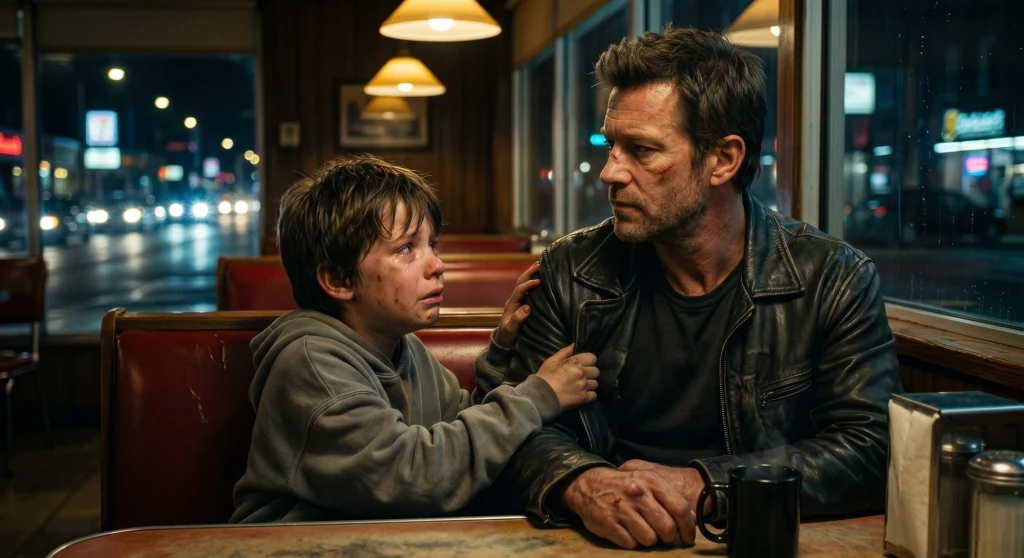
Daniel Hayes sat with his back to the wall, the way he always sat. Black coffee. No sugar. No food. Just a clear view of every door and window in the place.
He had the kind of hands that made people look twice — scarred knuckles, thick fingers, calluses that didn’t come from office work. A faded scar split the skin between his eyebrow and his cheekbone like a permanent reminder of something he never talked about.
He took a slow sip and set the mug down.
Then the front door flew open.
A boy stumbled inside like he’d been thrown from a moving car. Nine years old, maybe ten. Oversized hoodie swallowing his frame. Dirt on his face. Shoes untied. Eyes so wide they looked like they might crack.
He didn’t stop at the counter. Didn’t ask for help. Didn’t even look at anyone else.
He ran straight to Daniel’s booth and grabbed his jacket sleeve with both hands.
“Please,” the boy gasped. His voice was barely there. “They’re coming. Don’t let them take me.”
Daniel’s hand froze around his coffee mug.
The diner noise faded. The grill, the chatter, the clinking silverware — all of it dropped to nothing. All he could hear was this kid’s ragged breathing.
“Sit down,” Daniel said quietly.
The boy slid into the booth across from him, trembling so hard the table shook.
“What’s your name?” Daniel asked.
“Ethan.”
“Ethan. Look at me.”
The boy raised his eyes. Tears cut clean lines through the dirt on his cheeks.
“Who’s coming?”
Ethan swallowed. “Two men. They — they killed my dad.”
Daniel didn’t blink. His jaw tightened by a fraction. That was it.
“When?”
“Three days ago.” Ethan’s voice cracked. “Dad found out something about them. About what they were moving through the neighborhood. He told me he was going to the police. He made me promise not to say anything. But they came to our apartment and —”
He stopped. His whole body seized up.
“Breathe,” Daniel said.
Ethan sucked in air like he’d been drowning.
“I was hiding under my bed,” he whispered. “I heard everything. I heard them — I heard what they did. And one of them saw me through the crack in the door. He pointed at me and said —”
“Said what?”
“‘The kid saw us. He’s a problem.'”
Daniel’s hand curled into a fist under the table.
“I ran. I’ve been hiding for three days. Sleeping in a laundromat two blocks from here. But tonight they found me. I saw their car pull up outside and I just — I ran in here.”
Daniel leaned back. He looked at the door. Then back at the boy.
“You sure they followed you?”
Before Ethan could answer, the front door swung open.
Two men walked in.
They weren’t in a hurry. That was the first thing Daniel noticed. Men who rush are scared. Men who walk slow think they own the room.
The taller one had a neck tattoo — dark ink crawling up past his collar like something trying to escape. His eyes swept the diner the way a predator scans a field. Calculated. Patient.
The shorter one had his right hand inside his coat. He wasn’t scratching an itch.
Every head in the diner turned. Forks stopped moving. A waitress named Rosa, mid-pour with a coffee pot, stood frozen behind the counter.
The tall one spotted Ethan instantly.
He smiled.
“There he is,” he said, loud enough for everyone to hear. “Hey, buddy. Time to go home.”
Ethan pressed himself against the booth like he was trying to melt into the vinyl.
“That’s not my home,” he said. His voice shook, but he said it.
The shorter man took a step forward. “Kid, don’t make this harder than it needs to be.”
“He’s not going anywhere with you.”
Both men stopped.
Daniel stood up.
The chair legs screamed against the tile floor. The sound cut through the diner like a blade.
He wasn’t the tallest man in the room. But when he stood, something shifted. The air changed. A few diners near the door grabbed their coats and left without a word.
The tattooed man tilted his head. “Who the hell are you?”
“Nobody you want to know.”
The shorter man pulled his hand halfway out of his coat. The dull metal of a pistol grip caught the overhead light.
“Sit down, old man,” he said. “This isn’t your business.”
Daniel didn’t sit down.
He looked at the gun. Then at the man holding it. Then at the tattooed one.
“Here’s what’s going to happen,” Daniel said, his voice flat, almost bored. “You’re going to walk out that door. You’re going to get in your car. And you’re going to drive until you forget this diner exists.”
The tattooed man laughed. It was a short, ugly sound.
“Or what?”
“Or I’m going to make you wish you had.”
For three seconds, nobody moved.
Rosa set down the coffee pot with a quiet clink.
An old man in a trucker hat near the window slowly pulled out his phone and dialed 911.
The shorter man made his choice.
He pulled the gun fully out and raised it.
Daniel moved.
Not like a man who thinks about fighting. Like a man whose body remembers violence the way a pianist remembers keys.
His left hand grabbed the nearest metal chair and swung it hard. It caught the armed man square across the forearm. The gun clattered to the floor and spun under a table. The man screamed — a wet, animal sound.
The tattooed man lunged.
Daniel stepped inside the lunge, caught the man’s collar, and drove his forehead straight into the bridge of his nose. Cartilage crunched. Blood sprayed across the white tile.
The man staggered back, hands covering his face.
Daniel grabbed him by the jacket and threw him into a booth. The table cracked under the impact. Ketchup bottles rolled onto the floor.
The shorter man was on his knees, reaching under the table for the gun.
Daniel kicked it away, then grabbed the man by the back of his coat and slammed him face-first into the counter. Rosa jumped back. The man slid to the floor and didn’t get up.
The whole fight lasted eleven seconds.
Daniel stood in the middle of the diner, breathing hard. His knuckles were bleeding again — fresh red over old scars. His chest rose and fell, but his face was stone.
Every person in the restaurant stared at him.
He looked down at his hands like he was seeing them for the first time.
Then he turned back to Ethan.
The boy was standing in the booth, both hands gripping the edge of the table. His eyes were wide — not with fear this time. Something else.
“Are they dead?” Ethan whispered.
“No. But they’ll remember tonight.”
Red and blue lights started painting the walls through the front window. Sirens. Getting closer.
Daniel crouched down so he was eye level with the boy.
“Ethan. I need you to tell me the truth.”
“Okay.”
“You said your dad was going to the police. Did he have proof? Documents, recordings, anything?”
Ethan nodded slowly. “He had a phone. A burner phone. He recorded them talking about the shipments. He hid it before they came.”
“Where?”
“In my room. Taped behind the radiator.”
Daniel exhaled. “Does anyone else know about it?”
“No. Just me.”
Three police cruisers screeched to a stop outside the diner. Doors slammed. Boots hit pavement.
Daniel straightened up.
“When the cops come in, you tell them everything. Everything about your dad. Everything about these two. Everything about what’s on that phone.”
“But what if they don’t believe me?”
“They will. Because I’m going to be standing right next to you when you say it.”
The diner door opened. Four officers rushed in, weapons drawn.
“Hands where we can see them!”
Daniel raised both hands, palms out. Blood ran down his fingers.
“These two men attacked a minor,” Daniel said calmly. “The boy is a witness to a homicide. He needs protective custody, and there’s evidence at his apartment — a phone hidden behind a radiator in his bedroom. You’re going to want to get there before anyone else does.”
The lead officer — a woman in her forties with sharp eyes and a sergeant’s badge — studied Daniel for a long moment.
“Who are you?” she asked.
“Daniel Hayes. Former Army Ranger, Third Battalion.”
Her expression changed. Not a lot. But enough.
“Rosa,” the sergeant called to the waitress. “You see what happened?”
Rosa nodded firmly. “Those two came in threatening a child. This man protected him. That’s what happened.”
Two other diners nodded.
The old man in the trucker hat spoke up. “I got it on video. All of it.”
The sergeant holstered her weapon.
“Cuff those two,” she ordered her officers, pointing at the men on the floor. Then she looked at Daniel. “Don’t go anywhere, Mr. Hayes. We’re going to need a statement.”
“I’m not going anywhere.”
The officers handcuffed both men. The tattooed one groaned as they hauled him up, blood still dripping from his shattered nose. The shorter one had to be dragged. He was barely conscious.
As they were led out, the tattooed man turned his head toward Daniel.
“You have no idea what you just did,” he hissed. “You have no idea who we work for.”
Daniel met his stare.
“I don’t care.”
The man’s face twisted. “You will. You and that kid — you’re both dead.”
The sergeant stepped between them. “Save it for your lawyer. You’re going to need one.”
They were shoved into separate squad cars. Doors slammed. Lights kept flashing.
Inside the diner, the adrenaline began to drain. Rosa started sweeping broken glass. The old man replayed his video for a younger officer. A cook poked his head out from the kitchen, realized the chaos was over, and went back to flipping burgers.
Daniel sat back down in his booth.
Ethan slid in across from him.
For a moment, neither of them spoke.
“Ethan,” Daniel said. “Where’s your mom?”
The boy’s face crumbled. “She died when I was four. Cancer.”
“Any family? Aunts, uncles, grandparents?”
“My grandma. But she’s in a nursing home in Indiana. She doesn’t even remember my name most days.”
Daniel rubbed his face with both hands.
The sergeant walked over and sat down on the edge of the booth.
“Ethan, right?” she said gently.
The boy nodded.
“My name is Sergeant Maria Torres. I’m going to make sure you’re safe tonight, okay? We’re going to send a team to your apartment to recover that phone. And we’re going to place you in emergency protective custody while we sort this out.”
“What does that mean?” Ethan asked.
“It means you’ll stay somewhere safe. Supervised.”
Ethan looked at Daniel. “Can I stay with him?”
Torres glanced at Daniel. “That’s not really how it works, son.”
“I don’t care how it works. He’s the only person who helped me. Everyone else just watched.”
The words hung in the air like smoke.
Torres studied Daniel again. “Mr. Hayes, do you have a record?”
“Honorable discharge. No criminal record. I work construction in Bridgeport.”
“Address?”
He gave it to her.
She wrote it down, then stood. “I’ll see what I can do. No promises. But for tonight, you’re welcome to ride with us to the station. Both of you.”
Daniel looked at Ethan. The boy’s hands were still shaking, but his eyes were steady now.
“Okay,” Daniel said.
They stood up. Daniel dropped a twenty on the table for the coffee.
Rosa caught his arm as they passed the counter.
“You’re a good man, Daniel Hayes,” she said quietly.
He didn’t respond. He wasn’t sure she was right.
Outside, the night air hit them cold and sharp. Chicago never stopped moving, even when the world fell apart. Cars passed. A dog barked somewhere down the block. Neon light from the pawn shop next door buzzed and flickered.
Ethan walked close to Daniel, their shoulders almost touching.
“Daniel?”
“Yeah?”
“Those men. They said they work for someone. Someone bigger.”
“I heard.”
“Are you scared?”
Daniel opened the back door of the police cruiser for the boy.
“No.”
“Why not?”
“Because scared doesn’t change anything. Doing something does.”
Ethan climbed in. Daniel followed.
The cruiser pulled away from the curb, red and blue lights cutting through the dark.
Three weeks later, the case blew open.
The burner phone behind the radiator held seventeen minutes of recorded conversations. Names. Dates. Dollar amounts. Routes. Every detail of a drug trafficking ring that had been operating through three South Side neighborhoods for over two years.
Ethan’s father, Marcus Cole, had been a warehouse manager. He’d stumbled onto the operation when he noticed shipments that didn’t match invoices. He’d started recording. He’d planned to go to the FBI.
They killed him two days before his meeting.
The two men from the diner — Victor Salcedo and Ray Kinney — were charged with first-degree murder, attempted kidnapping, witness intimidation, and conspiracy to distribute. Their boss, a property developer named Arthur Creel who used his construction company to move product, was arrested at his lakefront condo at six in the morning while eating breakfast.
The federal prosecutor called it one of the cleanest takedowns in a decade.
All because a nine-year-old boy remembered where his dad hid a phone.
Daniel testified at the grand jury hearing. He sat in a wooden chair in a federal courtroom, still wearing the same kind of leather jacket, and told the truth — plain and simple.
When the defense attorney tried to paint him as a violent drifter, the prosecutor entered his military service record into evidence. Two Purple Hearts. A Bronze Star. Three combat tours.
The attorney didn’t ask any more questions.
Ethan testified too. He sat in a special room with a child advocate and a camera. He told them everything. What he heard. What he saw. Where his dad hid the phone and why.
He didn’t cry. Not once.
When it was over, Sergeant Torres found Daniel in the hallway outside the courtroom.
“Thought you should know,” she said. “The judge granted you temporary guardianship.”
Daniel stared at her. “What?”
“Ethan’s grandmother is in no condition to care for him. There’s no other family. CPS reviewed your background, and the boy requested it. Loudly. Multiple times.” She almost smiled. “A judge signed off this morning.”
Daniel leaned against the wall. He looked at the ceiling.
“I don’t know anything about raising a kid.”
“You knew enough to stand between him and a bullet three weeks ago. That’s more than most people manage in a lifetime.”
The courtroom door opened. Ethan walked out, holding a juice box the advocate had given him.
He saw Daniel and stopped.
“Did she tell you?”
“She told me.”
Ethan set the juice box on a bench, walked over, and wrapped his arms around Daniel’s waist. He pressed his face into the leather jacket and held on.
Daniel stood there for a moment, arms at his sides.
Then he placed one hand on the boy’s head.
“Alright, kid,” he said. “Let’s go home.”
Six months later, Arthur Creel was sentenced to thirty-two years in federal prison. Victor Salcedo got twenty-five. Ray Kinney got eighteen and cooperated for a reduced sentence that still guaranteed he wouldn’t see daylight until he was sixty-one.
The warehouse where Marcus Cole had worked was shut down. Fourteen other arrests followed. Three corrupt city officials were removed from their positions.
Marcus Cole’s name was entered into the federal record as a protected whistleblower — posthumously. A small plaque was placed outside the warehouse by the neighborhood association. It read: Marcus Cole. He did the right thing.
Ethan stood in front of it on a Saturday morning, hands in his jacket pockets. Daniel stood behind him.
“I wish he could see it,” Ethan said.
“He can.”
Ethan looked back at him. “You really believe that?”
“I believe he’d be proud of you. That’s enough.”
They walked back to the truck together. Daniel opened the passenger door. Ethan climbed in and buckled his seatbelt without being told.
Daniel got behind the wheel and started the engine.
“Daniel?”
“Yeah?”
“Thank you. For not leaving.”
Daniel put the truck in gear.
“That was never an option, Ethan.”
They drove home through the South Side as the morning sun cut through the buildings, turning the windshield gold. The city moved around them the way it always did — loud, rough, and unforgiving.
But inside that truck, for the first time in a long time, two people who had been alone in the world weren’t alone anymore.
And that was enough.
Original fictional stories. AI-assisted creative content.