
The bag hit the sidewalk before Claire even processed what was happening.
She spun around, instinct snapping her body into motion — and then stopped.
Because the boy who’d bumped into her wasn’t running.
He was standing completely still, holding a crumpled photograph in both hands, staring up at her
like he’d been practicing what to say for weeks and had suddenly forgotten every word.
“You dropped this,” he said.
But he hadn’t picked it up from the ground. He’d pulled it out of his jacket pocket.
Claire’s eyes dropped to the photo.
And the world went very quiet.
It was her sister’s face.
Not the face from old memory — the teenager frozen in the last photograph the family ever took
together, hair pulled back, smile careful and controlled. Not the face her father had described
with quiet fury the night he told them she was gone. Not the ghost the city had whispered about
for one cold season and then forgotten entirely.
This face had lines in it. Tiredness around the eyes. Gray threading through the temples.
This face had lived.
Claire’s chest did something she didn’t have a word for.
“Where did you get this?” she asked.
Her voice came out wrong. Too small. Too careful. Like a person trying not to scare an animal.
The boy — eight, maybe nine — clutched the photograph tighter.
“She gave it to me,” he said. “She said you’d know her.”
Claire’s hand was already at her lapel. Already finding the pin. The small blue enamel bird she’d
worn for so long she’d stopped feeling it.
She looked at the boy’s hand.
There, pressed against the photograph, was an identical pin.
“Where is she?” Claire asked.
It came out like a plea.
The boy glanced up the street. Then down. A quick, practiced sweep that looked too adult for his
face.
“She couldn’t come,” he said quietly. “She said they’d watch you.”
That made Claire look over her shoulder. Down the block, into the crowd, toward the parked cars
and the dark windows above the storefronts.
She’d stopped doing that years ago. She’d made herself stop.
But old fear doesn’t die. It just waits.
Because she knew exactly who “they” were.
Her father, Martin Aldrich, had not simply been a man who cared about appearances. He had
been a man who curated outcomes. Who made phone calls that ended careers, who moved
money through trusts and shell companies the way a chess player moves pieces — without
urgency, without mercy, only purpose.
When Claire’s younger sister, Dana, had come home at nineteen with the news of a pregnancy
and a man her father had never approved of — a musician, a nobody, someone from a different
world entirely — Martin Aldrich had not shouted.
He had gone very still.
And three days later, Dana was gone.
No fight. No confrontation. No argument that anyone witnessed.
Just gone.
Martin told the family she’d run away in shame. He said it once, flatly, and no one asked twice.
Claire had been twenty-three. She’d been told, and she had wanted to believe it, because the
alternative — the thing she felt in her body even then — was too enormous to carry.
She’d worn the pin ever since.
Dana had given it to her the Christmas before everything fell apart. Two of them. One for each
sister. A stupid, sweet thing. A blue bird that meant nothing and everything.
She had never taken it off.
Not through her first marriage. Not through the second. Not through the years of quietly asking
questions that led nowhere, or the night she’d hired a private investigator who’d returned her
money without explanation and never answered her calls again.
She had never stopped believing.
And apparently, neither had Dana.
“She said you kept yours,” the boy said, “if you still loved her.”
Claire’s throat closed.
She looked at the boy again. Really looked.
The shape of his jaw. The particular way his mouth pressed together when he was thinking. The
exact shade of brown in his eyes that matched no one in her memory except one person.
“What’s your name?” she asked.
“Noah.”
“How old are you, Noah?”
He told her.
Eight years old.
Claire did the math in the space of a breath.
Eight years ago, Dana would have been thirty-one. Already in hiding, already running, already
living whatever life she’d built in the years since she disappeared. Eight years ago was possible.
Eight years ago fit.
Eight years ago was exactly when everything fit.
The noise of the street came back all at once — horns, footsteps, a truck downshifting somewhere
nearby. Claire felt like she’d been standing on the sidewalk for hours when it had only been two
minutes.
“She’s sick,” Noah said.
He didn’t say it dramatically. He said it the way a child says something he’s been told to say
precisely, without inflection, because he’s been coached to keep his voice steady.
That made it worse.
“How sick?” Claire asked.
Noah shook his head. “She didn’t tell me. She just said it was time.”
Time.
After twenty-two years.
Time.
Claire crouched down so she was level with him. Right there on the sidewalk, people moving past
them on both sides, the city carrying on its indifferent business.
“What did she ask you to tell me?”
Noah reached into his other pocket. Pulled out a folded piece of paper, edges worn like it had
been handled many times.
He held it out.
Claire took it carefully. Unfolded it.
Dana’s handwriting. She would have known it anywhere — the way the letters leaned slightly
left, the loop in the lowercase g, the way she always pressed too hard with a pen.
It said three things.
A street address. A unit number. And below that, in slightly shakier letters than the rest: He
doesn’t know yet. But he should. Don’t let them take that from him too.
Claire looked up at the boy.
At the line of his jaw. The color of his eyes. The particular set of his shoulders that she recognized
the way you recognize something you’ve known in your bones without knowing why.
“Noah,” she said carefully. “Did your mother ever talk about your father?”
He shook his head. “She said she’d tell me when it was safe.”
Claire’s eyes burned.
Because she understood now what Dana had really sent him with.
Not just a message. Not just an address.
A son who deserved to know where he came from.
She stood up. Looked down at the paper. Looked at the address.
It was forty minutes across the city. Maybe less if she flagged a cab now.
“Noah.” She held out her hand. “Has anyone been following you today?”
He thought about it seriously. “A man in a gray coat was behind me for two blocks. But he went
into a coffee shop on Mercer.”
He said it so matter-of-factly that Claire almost laughed. Almost.
“Your mother taught you to watch for that.”
“She taught me a lot of things.”
Of course she had.
They took a cab east, then walked the last six blocks in a pattern that doubled back once, the way
someone taught you when they wanted you to know how to check a tail without looking like you
were checking a tail. Noah matched her pace without being asked.
The building was ordinary. Walk-up. Four floors. Intercom panel with buzzers and handwritten
labels.
Unit 3C had no name on the label. Just a small sticker of a blue bird.
Claire’s hand was shaking when she pressed the button.
Static.
Then a voice she hadn’t heard in twenty-two years.
Older. Rougher. Tired.
But hers.
“Claire.”
It wasn’t a question. It was a statement. An arrival. A thing Dana had been waiting to say for
longer than either of them could calculate.
Claire pressed her palm flat against the cold metal of the intercom panel like she could reach
through it.
“I’m here,” she said. “We’re both here.”
The door buzzed open.
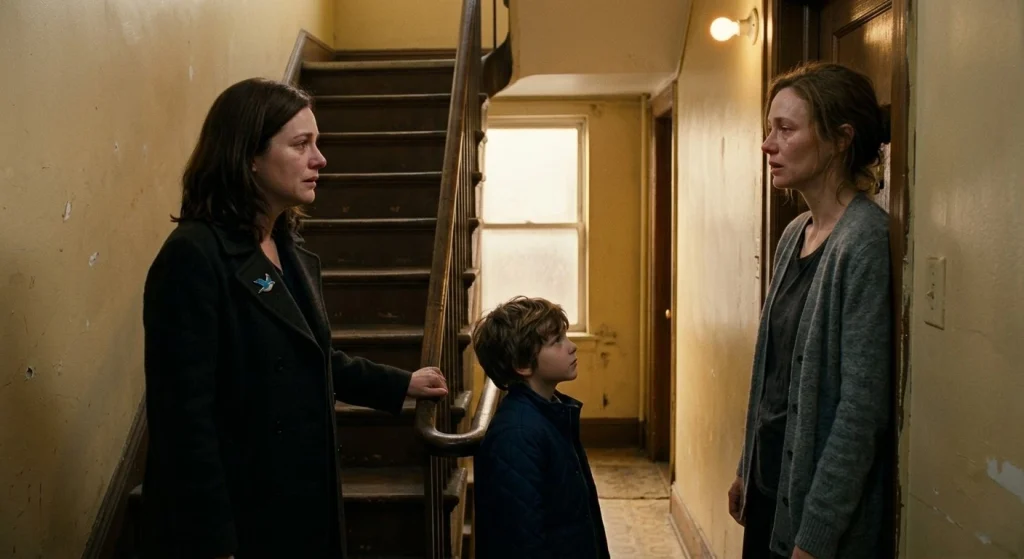
Dana was at the top of the stairs, leaning against the doorframe, one hand on the wall for support.
She’d lost weight. There were dark circles under her eyes that spoke of months, not weeks. But
she was standing. She was there.
When she saw Noah come through the stairwell door first, something in her face broke open.
When she saw Claire behind him, it finished the job.
Neither of them spoke for a long moment.
Then Noah walked forward and stood between them like he’d been doing it his whole life.
“She found me,” he said. “Just like you said.”
Dana laughed — a rough, wet sound — and pulled him in with one arm.
With the other, she reached for Claire.
Claire closed the distance.
They sat at Dana’s small kitchen table while Noah slept on the couch under a blanket he’d clearly
claimed as his own long ago.
Dana wrapped both hands around a mug of tea and told it in pieces, the way you tell a thing
you’ve been carrying in silence for two decades.
The night their father had sent two men to her apartment. The way she’d already suspected —
already packed a bag. The man she’d loved who had tried to come back for her and been warned
off with something she still didn’t know the precise shape of. The years of moving. Of building a
life that couldn’t be found. Of choosing safety over contact, over everything, until the diagnosis
made that calculus change.
“Ovarian,” she said. “Stage two. Caught it early enough.”
“Caught it early enough for what?” Claire asked.
“To treat. If I get treatment.” Dana looked at her. “But I can’t do that alone. And I can’t do it
hiding.”
Claire set down her own mug.
“You don’t have to hide anymore,” she said. “Dad’s been dead for three years.”
Dana was quiet for a long time.
“The men who worked for him aren’t,” she said finally.
“No,” Claire agreed. “But I have a lawyer who’s been building a case for seven years. A paper trail
on what he did to you. On the investigator he paid off to stop my search. On two men whose
names I have, whose bank records I have, who took money from a trust account to relocate a
pregnant woman against her will.” She paused. “I’ve been waiting for something to do with it.”
Dana looked up.
“You kept building the case even when you thought I might be dead?”
“I kept building it because I didn’t think you were dead.” Claire’s voice was very steady. “I never
thought you were dead.”
Three weeks later, a civil filing landed in the offices of Aldrich Family Holdings — the trust
structure Martin had built to protect his legacy — naming two of its former employees as
defendants in a wrongful action suit. The filing included wire transfers, a deposition from a
disbarred investigator who’d decided he had nothing left to lose, and a sworn statement from
Dana Aldrich, née Aldrich, currently residing in the city she’d been driven out of twenty-two
years prior.
The trust’s lawyers called Claire’s lawyer twice. Her lawyer did not return the calls.
The filing was not about money.
It was about record. About name. About the official, documented, public acknowledgment that
Dana Aldrich had been alive the entire time, that she had not run away in shame, and that the
story her father had told was a lie constructed to protect a man who had died believing he’d
gotten away with everything.
He hadn’t.
Dana started treatment in the fourth week.
Claire drove her to every appointment.
Noah started school — a real one, with his real name, in a city that would now know he existed.
On the first morning, Dana pinned the blue bird to his backpack.
He looked at it.
“Same as yours,” he said.
“Same as mine,” Dana agreed. “Same as your aunt’s. Three of us now.”
He thought about that seriously, the way he thought about everything.
“What does it mean?”
Dana looked at Claire across the kitchen.
“It means,” Claire said, “that we found each other.”
Noah considered this for a moment.
Then he nodded, picked up his backpack, and walked out the door into the ordinary,
unremarkable, extraordinary morning like a boy who had always known exactly where he
belonged.
Because now he did.
Original fictional stories. AI-assisted creative content.