
Six weeks after Mason left me and our newborn on the side of a mountain road during a blizzard, I still heard his voice every time the wind picked up.
“You’ll be fine,” he had said, shoving the diaper bag into my arms while snow hammered the windshield. “You always survive.”
I thought it was one of his jokes. The ugly kind he pulled when he wanted to see fear on my face. Then he pushed open the passenger door, unbuckled my seatbelt himself, and yanked out the car seat.
Lily was nine days old. Pink knit cap, one sock half-off, hiccuping the kind of cry only a baby who doesn’t know the world yet can make.
He set the carrier in the snowbank. Dropped the diaper bag next to it. Walked back to the truck.
I screamed. I pounded the window so hard I thought my wrist would snap. He cracked it one inch.
“You ruin everything when you panic,” he said. “Maybe this’ll teach you not to threaten me.”
Then he drove away.
I stood in the middle of that road holding my daughter against my chest with one arm and dragging the diaper bag with the other. The snow was so thick I couldn’t see the taillights after ten seconds. The temperature was fourteen degrees. My phone was in the truck.
I walked.
I don’t know how far. The cold turned my fingers white, and I remember thinking very clearly: if I fall down right now, we both die. So I didn’t fall. I tucked Lily inside my coat, pressed her face against my skin, and kept moving until my legs gave out near a ditch by the guardrail.
A county plow driver found us twenty minutes later.
At the hospital, the doctors used the word hypothermia and the phrase extremely fortunate in the same sentence. The deputy who took my statement wrote down abandonment with reckless endangerment. Mason’s family called it a misunderstanding. Mason vanished for two weeks and came back with a lawyer and a version of events that made me sound unstable.
By the time I was discharged, I had nowhere to go except my sister Ava’s one-bedroom in Denver. I learned fast what survival actually looked like: feeding Lily at two in the morning, answering detectives at ten, crying in the shower at noon, and reading legal filings while rocking a baby to sleep on my shoulder.
Then came the part that still makes my jaw tight.
Mason had drained our joint savings before he disappeared. Every dollar from my maternity leave fund. Every payment I’d made toward the truck. Even the money my father left me when he died. Forty-two thousand dollars. Gone.
Three weeks later, engagement photos showed up online.
Mason in a tailored navy suit. A woman named Claire Whitmore on his arm. Daughter of a Boulder real estate developer. Wedding date already set. Cream roses. Private country club. The whole production.
Ava found me staring at the photos at midnight with Lily asleep in my lap.
“Don’t,” she said.
“Don’t what?”
“Whatever you’re planning.”
“I’m not planning anything.”
She sat down across from me and folded her arms. “Liar.”
She was right.
My attorney, Dana Reyes, was a sharp woman with reading glasses she never actually put on and a habit of tapping her pen against her teeth when she was thinking. I told her what I wanted to do. She was quiet for a long time.
“Legally,” she said, “I can’t advise you to confront him at his wedding.”
“Okay.”
“But if you happened to be there. And if the documents you’re carrying happen to be public-record copies.” She tapped her pen. “I can’t stop you from handing someone a piece of paper.”
“That’s what I thought.”
She leaned forward. “You understand this isn’t just about embarrassment. The sheriff’s office is ready to move on the financial complaint. I’ve spoken to Tessa Moran, and she’ll sign an affidavit.”
“Tessa Moran?”
“Mason’s former coworker. She says he bragged about marrying Claire for her family’s money. Called you ‘the baggage.’ Called Lily ‘the mistake.'”
I felt my chest go hollow. Then I felt it fill back up with something harder.
“Get me the affidavit,” I said.
The wedding was on a Saturday in late March. Country club outside Boulder. White chairs, string quartet, chandeliers the size of car tires. I drove Ava’s Honda up the long driveway with Lily in the back seat and my heart slamming against my ribs like it wanted out.
“You don’t have to do this,” Ava said from the passenger seat.
“Yes I do.”
“He’s not worth it.”
“This isn’t about him.” I looked in the rearview mirror at Lily, asleep with her fist curled against her cheek. “It’s about her.”
Ava went quiet.
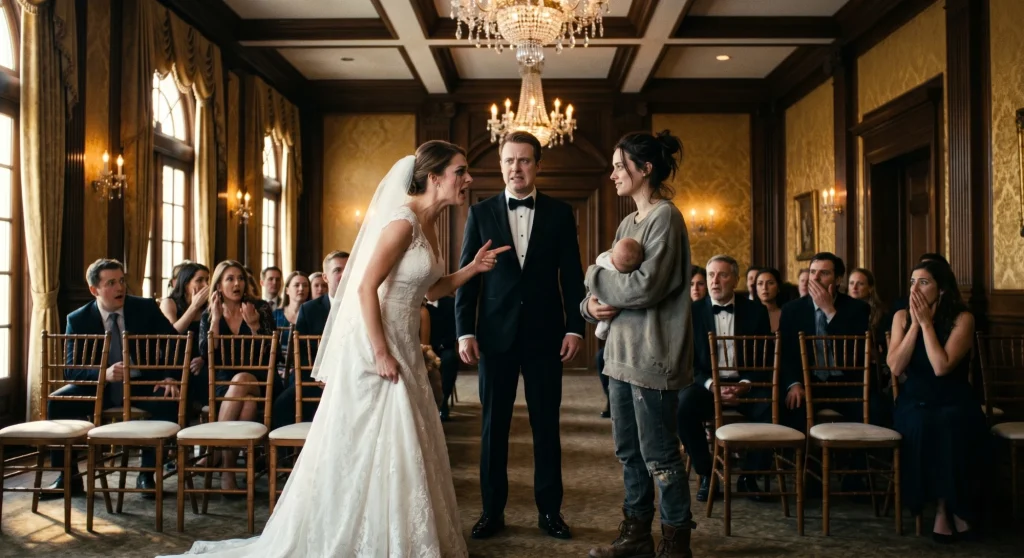
I walked in through the back entrance carrying Lily against my chest and a sealed manila envelope in my right hand. The ballroom was packed. Two hundred guests, maybe more. Champagne flutes catching light. Laughter. Music.
Mason saw me before Claire did.
His smile didn’t fade. It cracked. Like a plate dropped from a height. One second it was whole, and then it just wasn’t.
He crossed the room fast, jaw tight, voice barely above a hiss. “What are you doing here?”
“Giving you what you forgot,” I said. “And taking back what you stole.”
The string quartet stopped mid-measure. Conversations died in waves, starting from our corner and spreading outward like someone had unplugged the sound. Every head in the room turned.
Claire came down the aisle gathering her dress in one hand, confusion hardening into something sharper. She was younger than I expected. Prettier, too. But what I noticed most was how scared she looked.
“Mason,” she said, “who is this?”
He opened his mouth. I handed Claire the envelope before he found a word.
“It’s for you,” I said.
Mason lunged. “Don’t.”
That single word did more damage than anything I could have said. Claire’s face changed instantly. She took the envelope, stepped back from his reaching hand, and tore it open.
Inside were copies. I’d made sure of that. Dana had helped me organize them the night before.
First page: Lily’s birth certificate, Mason listed as father.
Second page: the sheriff’s incident report from the mountain road.
Third page: a bank statement showing a forty-two-thousand-dollar transfer from our joint account to Mason’s personal account, made the day before he disappeared.
And behind those, the one that mattered most: Tessa Moran’s signed affidavit, stating that Mason had bragged about marrying Claire for access to her family’s wealth while, in his words, “shaking off the baggage.”
Claire read fast. Then slower. By the fourth page her hands were shaking.
“Mason,” she said, so quietly the whole room leaned in. “Is this true?”
“It’s twisted,” he shot back. “She’s manipulating you. She’s been doing this for weeks.”
Claire looked at me. “Did he leave you and the baby in a storm?”
“Yes.”
“Did he take your money?”
“Yes.”
“Is that his child?”
I shifted Lily so Claire could see her face. Lily’s eyes were still closed, her tiny lips parted, completely unaware.
“Yes.”
Claire stared at my daughter for a long moment. Then she turned back to Mason with an expression so calm it was terrifying. That calmness scared him more than tears ever could. I could see it. He started talking faster, louder, stumbling over his own excuses. Stress. Postpartum. Misunderstandings. Lawyers. Me. He even said he’d always planned to come back for us on that road, as if abandonment came with a return policy.
That was when an older man in the front row stood up.
I recognized him from photos: Richard Whitmore. Claire’s father. Silver hair, dark suit, the kind of posture that said he’d built things with his hands before he built them with money. He took the papers from Claire, scanned two pages, and looked at Mason the way a contractor looks at a cracked foundation.
“Is any of this false?” Richard asked.
Mason said nothing.
The silence was the answer.
Claire lifted her bouquet, set it in a chair, and stepped away from him like he was something spoiled. Guests were whispering now. Somebody near the aisle pulled out a phone. Mason turned on me, fury stripping away the last of his polish.
“You think this means you win?”
I held his gaze. “No. I think this means you stop.”
He took one step toward me. Shoulders tensed. The same look he used to get before slamming doors or punching walls close enough to make me flinch. But two members of the country club’s security team were already moving down the aisle. Richard Whitmore did not believe in handling crises quietly.
“Sir,” one of them said, “we need you to come with us.”
Mason jerked free before they touched him. “This is my wedding.”
Claire’s voice cut across the room. “No. It was supposed to be.”
After that, the collapse came fast. Not one big explosion. A hundred small withdrawals. His best man stepped back first. Then the officiant closed his folder. Then Claire’s mother sat down hard in the front row with her hand over her mouth. When support leaves a person, it leaves like air from a tire — slow, steady, irreversible.
Richard walked toward me instead of Mason.
I braced myself.
But when he reached us, his voice was careful. “Ms. Carter. Are you and your baby safe?”
It had been weeks since anyone outside my family had asked that question first. Not whether I had proof. Not whether I planned to sue. Not whether I was trying to cause a scene. Just whether we were safe.
“Yes,” I said. Then, because truth deserved its full weight: “Safer than we were.”
He nodded once. “Good.”
What happened next moved faster than I expected. Dana stepped forward from the entrance. Behind her was the deputy who had been waiting outside. Mason’s face went from rage to disbelief when he realized this wasn’t just humiliation.
The sheriff’s office had enough to move on the financial complaint and to reopen the abandonment case with new witness testimony. Mason looked at me like I’d broken some unspoken rule between us. But there had never been rules. Only his expectation that I would keep absorbing damage quietly.
The deputy took his arm.
Mason twisted back one last time.
“You’re ruining my life.”
I pressed my cheek to Lily’s hair and gave him the only answer that mattered.
“No, Mason. I stopped letting you ruin ours.”
He was walked out through the ballroom under the chandeliers he’d picked, past the roses he’d paid for with stolen money, and into the cold bright afternoon. Nobody followed him.
I stayed long enough to collect one last thing. Richard’s assistant brought a cashier’s check from his office. The exact amount Mason had taken from our account. Richard handed it to me himself.
“Consider it a temporary correction,” he said. “My attorneys will handle the rest.”
“Thank you.”
“Don’t thank me. I should have vetted him harder.”
I shook his hand. He shook mine back like he meant it.
Ava was waiting by the car. She opened the passenger door, looked at my face, and knew without asking.
“It’s over?” she said.
I looked down at Lily, warm and sleeping against my chest, and for the first time in six weeks, I believed the answer.
“Yeah,” I said. “It’s done.”
Three months later, Mason pleaded guilty to felony financial exploitation and misdemeanor reckless endangerment. He was sentenced to fourteen months in county jail, three years of probation, and full restitution. Claire Whitmore filed a civil fraud suit against him the same week. His family stopped returning calls.
Lily took her first steps in Ava’s living room on a Tuesday in November. I was sitting on the floor with my coffee and she just stood up, wobbled twice, and walked three steps into my hands.
I didn’t cry. I laughed. And then I cried.
Dana called that evening with the final update. The restitution order had been signed. The custody agreement was ironclad. Mason had no visitation rights pending completion of a court-ordered evaluation he was unlikely to pass. The file was closed.
“How does it feel?” Dana asked.
I looked at Lily, who was chewing on a wooden block and babbling at the cat.
“Like the beginning,” I said.
And it was.
Original fictional stories. AI-assisted creative content.