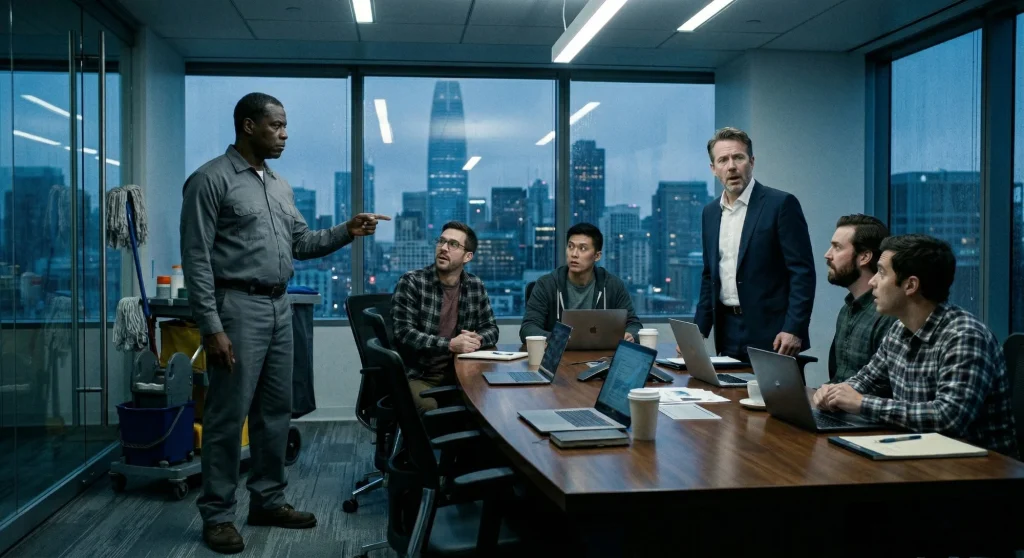

The day Daniel Carter walked back into NovaTech Solutions, he was pushing a cleaning cart.
Nobody recognized him. Not the receptionist who swiped him through security. Not the junior engineers hunched over their keyboards. Not even the framed photo wall in the lobby, where his face had been quietly removed three years ago.
He mopped the hallway outside the main conference room and listened to the hum of the building he’d helped create.
Inside that conference room, Mark Reynolds was holding court.
Mark had a way of entering a room that made everyone sit up straighter. Tailored suit. Tablet in hand. A smile that said he already knew he was the smartest person at the table.
“Morning, sir,” an engineer said as Mark passed.
Mark gave a sharp nod. He liked that. He liked all of it — the deference, the glass walls, the live dashboard that read 8,234,918 active users in glowing green digits.
He sat down at the head of the conference table. Six senior developers were already there, resumes spread in front of them.
“We’ve got forty-three applicants for the senior software architect position,” said Greg, the lead engineer.
Mark picked up the first stack.
“Then let’s move fast. I want someone who already understands our backend.”
He flipped through the resumes one by one. Stanford. MIT. Google. Amazon. Each one had three pages minimum — dense with credentials, certifications, project histories.
Then he stopped.
He held up a single sheet of paper.
“What the hell is this?”
Greg leaned over. “That one came in yesterday. Short, but the guy claims deep experience with large-scale system architecture.”
Mark read it aloud.
“Name: Daniel Carter. Experience: Software Architecture and System Design.” He paused. “That’s it. That’s the entire resume.”
A few people chuckled.
“No school listed. No company history. No references.” Mark dropped the paper on the table. “This is a joke.”
“He did mention he’d built platforms handling millions of concurrent users,” Greg said carefully.
Mark waved his hand. “Everyone says that. My nephew says that. Next.”
Just then, the conference room door opened.
A janitor pushed a cleaning cart inside. He wore a plain gray uniform. His name badge read DANIEL.
He moved quietly toward the corner and began wiping down the window ledge.
Mark glanced at him, then back at the resume. Then back at the janitor.
His eyes narrowed.
“Hold on.” Mark held up the paper. “Is this you?”
The janitor looked up. “Sir?”
“Daniel Carter. Did you submit this resume?”
A beat of silence.
“Yes.”
The room shifted. Engineers exchanged glances. Someone stifled a laugh.
Mark leaned back in his chair. “You’re serious.”
“I am.”
Mark set the paper down slowly. “You applied for a senior software architect position at one of the fastest-growing tech companies in the country.”
“That’s correct.”
“And you’re currently mopping our floors.”
“I am.”
The laughter broke through. Two engineers at the far end of the table didn’t even try to hide it.
Greg shifted uncomfortably, but Mark was enjoying himself.
“Tell me something, Daniel.” Mark stood up. “Do you have any idea what this company does?”
“You run a productivity platform with roughly eight million daily active users,” Daniel said. “Cloud-native stack. Microservices architecture. Real-time sync engine with eventual consistency across distributed nodes.”
The laughing stopped.
Mark blinked.
Then he smiled again, wider this time, like he’d caught the punchline.
“You read our press releases. Cute.” He turned to the room. “Anyone can Google our tech stack.”
One of the engineers, Ryan, leaned forward. “Alright, janitor man — what language is the core sync engine written in?”
Daniel didn’t hesitate. “Rust. With a thin Python orchestration layer and a custom gRPC protocol I designed for the event bus.”
Ryan’s smile faded.
Mark cut in before the silence could settle.
“Enough.” He pointed at Daniel. “This company was built by one of the best engineering teams in the country. You think pushing a mop qualifies you to sit at this table?”
Daniel set down his cleaning cloth. “I don’t need to sit at this table.”
“Then why are you here?”
“I wanted to see something.”
“See what?”
Daniel looked directly at Mark. “Whether anyone in this building remembers who built the system they’re all sitting on top of.”
Nobody laughed this time.
Mark’s jaw tightened. He picked up the resume and tore it slowly in half.
“What are you even doing here?” Mark’s voice rose to a shout. “Get out!”
The engineers around the table barely reacted, eyes still on their papers.
Mark turned to them, smirking. “We need to tell security to stop letting just anyone walk in here.”
A few of them chuckled. Ryan shook his head with a grin. Someone muttered, “Stick to the mop.”
A younger developer named Priya, sitting at the far end of the table, didn’t laugh. She watched Daniel’s face and saw something the others missed.
He wasn’t embarrassed. He wasn’t angry.
He was studying them.
Daniel looked directly at Mark. His voice was calm, steady, and loud enough for the whole room.
“You have no idea what you just did.”
The chuckling stopped. The room went dead quiet.
Daniel slowly pulled off his rubber gloves and dropped them on the conference room floor. The sound of rubber hitting polished tile was the only noise in the room.
Nobody moved.
Daniel turned, walked out through the doorway with a confident, unhurried stride, turned right, and disappeared.
The gloves lay on the floor. The room stayed frozen.
Mark stared at the empty doorway. Something about the way Daniel had looked at him — not with anger, but with certainty — made his stomach tighten.
Priya broke the silence. “He knew our gRPC protocol. That’s not public information.”
Mark waved it off. “He probably talked to someone in engineering. These janitors hear everything.”
“The custom protocol, though,” Priya pressed. “That’s not on any blog post. Not even in our internal wiki. Only the original architecture docs reference—”
“Drop it, Priya.” Mark’s voice went flat. “We’re not entertaining this.”
Priya closed her mouth. But she wrote something on her notepad and underlined it twice: Who designed the event bus?
Outside the building, Daniel walked through the lobby and out the front doors into the San Francisco sun. He didn’t rush. He crossed the street, set his backpack down on a bench, and pulled a small phone from his pocket.
The screen showed a terminal app — plain text on a black background. He typed four characters.
INIT
A response appeared instantly: CORE ACCESS CONFIRMED. DCarter_Admin. AWAITING COMMAND.
Daniel typed one more word.
SHUTDOWN
The terminal responded: EXECUTING. CORE LOCK ENGAGED. SESSION SEALED.
He slipped the phone back into his pocket and sat down on the bench. He looked up at the glass tower across the street — the building he’d helped create — and waited.
Inside the conference room, the meeting continued for exactly ninety more seconds.
Mark was mid-sentence when Greg interrupted.
“Uh… Mark?”
“What?”
Greg pointed at the dashboard screen on the wall.
The number had frozen.
8,234,918.
Then it disappeared.
The screen turned red.
SYSTEM ERROR — CORE SERVER CONNECTION LOST
Everyone stood up at once.
“What happened?” Mark barked.
Greg was already typing. “The app just went offline.”
Across the office floor, the chaos spread like wildfire. Monitors flickered. Phones rang. Engineers shouted over each other.
“My dashboard’s dead!”
“The API gateway isn’t responding!”
“Users are flooding support — the app is crashing worldwide!”
Mark grabbed Greg by the shoulder. “Fix it. Now.”
Greg’s fingers flew across his keyboard. Then he stopped.
“I can’t.”
“What do you mean you can’t?”
“The core system is locked. I don’t have access.”
“Override it!”
“I tried. Every admin credential is being rejected.”
Ryan ran into the room, laptop open. “Mark, it’s worse than we thought. The shutdown wasn’t external. It came from inside the system.”
Mark’s blood went cold. “Inside?”
Ryan turned his screen around.
The system log showed a single command, executed forty-five seconds ago.
User: DCarter_Admin Command: SHUTDOWN_CORE —force —lock
Mark stared at the name.
“Who is DCarter_Admin?”
Greg pulled up the account history. His face went white.
“That’s… that’s the original root administrator account. It was created when the platform was first built.”
“By who?”
Greg swallowed. “By the original lead architect. The one who designed the entire core system.”
Mark felt the floor tilt under his feet.
“What was his name?”
Greg looked at the screen.
“Daniel Carter.”
The conference room went dead silent.
Priya put her hand over her mouth. She looked down at her notepad. The question she’d written — Who designed the event bus? — stared back at her.
“Oh my God,” she whispered. “He was telling the truth.”
Ryan slammed his laptop shut. “The janitor? The janitor built our platform?”
Greg scrolled through the archived commit logs. “First commit: March 14th, five years ago. DCarter_Admin. He authored the core sync engine, the distributed data layer, the event bus, the session management system — basically everything below the API layer.”
“That’s eighty percent of our backend,” Ryan said.
Mark’s face was the color of old paper.
Greg kept scrolling. “His account was never deactivated. It was just… forgotten. No one even knew it existed.”
“And he still had root access?” Mark’s voice was barely a whisper.
“Full root. He could do anything. And he just did.”
Mark’s phone rang. He looked at the screen. The chairman of the board.
He declined the call.
It rang again immediately.
He declined again.
Priya stood up. “Mark, the memory leak he mentioned — the one in the session handler. I looked it up. It’s real. It’s in the v2.3 codebase. We’ve been routing around it with a caching workaround for three years.”
Nobody spoke.
“He knew because he wrote the original code,” she said. “Everything he said was true.”
Mark didn’t say a word. He turned and ran.
Down the hallway. Past the rows of engineers staring helplessly at blank screens. Past the receptionist answering a phone that wouldn’t stop ringing.
He slammed through the front doors and hit the sidewalk.
The cleaning cart sat abandoned near the entrance.
Across the street, a man in a gray janitor uniform stood on the opposite sidewalk, holding a small backpack. He was calm. Unhurried.
Mark sprinted across the road.
“STOP!”
Daniel turned around.
Mark was breathing hard, his suit jacket flapping. “What the hell did you do?”
“I turned off the system.”
“You shut down a platform used by eight million people!”
“Yes.”
“WHY?”
Daniel looked at him with no anger. No satisfaction. Just clarity.
“Because the system still belongs to me.”
Mark’s face twisted. “That’s insane. NovaTech owns everything.”
Daniel unzipped his backpack and pulled out a thin folder. He opened it.
Inside were documents. Old ones. Dated five years back.
The first page was a contract. At the top, in bold type:
Lead Software Architect — Daniel Carter NovaTech Solutions — Founding Technical Agreement
Mark scanned the page. His eyes caught a highlighted section.
Daniel read it for him. “Section 4.2. The core system architecture, including the sync engine, event bus, and distributed data layer, remains the intellectual property of the architect unless a separate transfer agreement is executed and filed.”
Mark looked up. “We bought the technology.”
“You bought the interface layer. The frontend. The branding. The user-facing product.” Daniel tapped the contract. “The backend — the thing that actually makes your app work — was licensed. Not sold.”
“That’s — that can’t be right.”
“Your legal team missed it. Or ignored it. I sent three letters over two years. No one responded.”
Mark’s hands were shaking. “This is extortion.”
“No. Extortion is when someone takes something that doesn’t belong to them and charges you to give it back.” Daniel closed the folder. “I’m not charging you anything. I’m showing you what you took.”
Mark’s voice dropped. “What do you want?”
“I already told you. I wanted to see if anyone remembered.”
“Remembered what?”
“That I built it. That I was in this building before there were glass walls and live dashboards. That I wrote the first line of code in a studio apartment in Oakland while eating ramen I couldn’t afford.”
Mark said nothing.
Daniel continued. “You hired me five years ago as a contract architect. I worked fourteen-hour days for eleven months. When the platform launched and the investors came in, you restructured. My contract was terminated. I was told my services were no longer needed.”
“That was a business decision.”
“It was. And I accepted it. But you also removed my name from every internal document. Every commit log. Every credit page. You told the board you built the core system yourself.”
Mark’s face was gray now.
“And then,” Daniel said quietly, “you stood in front of a room full of people today and laughed at me for claiming I understood the technology. You tore my resume in half.”
Mark opened his mouth. Nothing came out.
“I didn’t come here for revenge,” Daniel said. “I came here for the truth.”
A black town car pulled up to the curb behind Daniel.
The back door opened. A woman in a tailored blazer stepped out. She was holding a leather briefcase.
“Mr. Carter?” she said.
“Right here.”
She turned to Mark. “Mr. Reynolds, my name is Patricia Okafor. I’m Mr. Carter’s attorney.”
Mark stiffened.
Patricia opened her briefcase and handed Mark a stapled document.
“This is a formal cease-and-desist and IP reclamation notice. Under the original founding agreement, my client retains full ownership of the core system architecture currently powering NovaTech’s platform.”
Mark’s voice cracked. “You can’t do this.”
“We already have. As of nine minutes ago, my client exercised his contractual right to revoke the operating license.”
“That’s why the system is down?”
Patricia nodded. “The platform is running on unlicensed proprietary code. It has been for five years.”
Mark looked at Daniel. “Turn it back on.”
Daniel shook his head. “Not my call anymore.”
Patricia handed Mark a second document. “This is a licensing proposal. Mr. Carter is willing to negotiate a fair, long-term license for the continued use of his architecture. The terms are reasonable.”
Mark stared at the paper. His hands trembled.
“You’ll also find a clause requiring full public acknowledgment of Mr. Carter’s role as the original architect, restoration of his name in all internal and external documentation, and a formal apology issued to the engineering team.”
Mark looked up. “A public apology?”
“You publicly humiliated a man in front of his peers for claiming credit for work he actually did,” Patricia said evenly. “Yes. A public apology.”
Mark’s phone buzzed. Then again. Then it didn’t stop.
He glanced at the screen. Sixteen missed calls. Board members. Investors. The CTO.
A notification popped up from TechCrunch:
NovaTech App Crashes Worldwide — Millions of Users Affected — Stock Down 11% in After-Hours Trading
Mark’s knees nearly buckled.
Daniel zipped up his backpack.
“I’ll give you forty-eight hours to review the terms,” Daniel said. “If you don’t sign, my attorney will file for a full injunction. NovaTech won’t be able to use a single line of my code.”
Mark whispered, “You’ll destroy the company.”
Daniel looked at him one last time.
“No. You almost did. I’m giving you a chance to keep it alive.”
Daniel turned and walked to the town car. Patricia followed. The door closed.
The car pulled away from the curb and merged into San Francisco traffic.
Mark stood alone on the sidewalk. Behind him, through the glass walls of NovaTech, he could see the entire office in chaos. Red screens. Frantic engineers. Ringing phones.
He looked down at the documents in his shaking hand.
His phone rang again. This time it was the board chairman. He answered.
“Mark, what the hell is happening? Our stock is in freefall.”
Mark closed his eyes. “I know.”
“Do you have a fix?”
Mark looked at the documents in his hand. The licensing terms. The apology clause. The full credit restoration.
“Yeah,” he said quietly. “I have a fix.”
“Then do it. Whatever it costs.”
Mark hung up. He stood on the sidewalk for a long time, watching the chaos through the glass walls of the building he’d claimed as his own. Then he walked back inside.
The next morning, Mark called an emergency board meeting. He laid out the situation in full. The room was hostile.
“You’re telling me,” the chairman said, “that our entire platform runs on code we don’t own?”
“That’s correct.”
“And the man who owns it was working as our janitor?”
“He took the job to prove a point.”
“He proved it.” The chairman rubbed his temples. “Sign whatever he wants. Get the system back online.”
Mark signed the licensing agreement that afternoon. Within an hour, the platform was restored. Eight million users reconnected. The stock stabilized by close of trading.
But the damage to Mark’s reputation was just beginning.
Two weeks later, NovaTech held an all-hands meeting.
Mark stood at the front of the room. Every employee was present. The board was watching via video link. Priya sat in the front row, arms crossed, watching Mark with an expression that was hard to read.
He cleared his throat.
“Five years ago, the core system that powers everything we do was designed and built by a single engineer named Daniel Carter. His work is the foundation of this company. His name was removed from our records, and his contributions were erased. That was my decision. And it was wrong.”
The room was silent.
“Effective immediately, Daniel Carter has been recognized as NovaTech’s founding architect. His name will appear in all technical documentation, investor materials, and our public-facing credits. We’ve also signed a long-term licensing agreement that fairly compensates him for the technology this company depends on.”
Mark paused.
“I owe Daniel a personal apology. I treated him with disrespect. I judged him by his appearance instead of his ability. That was a failure of leadership, and I take full responsibility.”
He set down his notes.
“That’s all.”
The room stayed quiet for three seconds. Then someone in the back started clapping. Then another person. Then the entire room.
In an office across the city, Daniel Carter sat at a new desk in a sunlit room. The licensing agreement was framed on the wall beside the original architectural blueprint of NovaTech’s core system — the one he’d drawn on a whiteboard in his Oakland apartment five years ago.
His phone buzzed. A text from Patricia.
“Board approved the full terms. Retroactive compensation package wired this morning. Seven figures. Congratulations, Daniel.”
He set the phone down and looked out the window at the San Francisco skyline.
The cleaning cart was gone. The gray uniform was folded in a box in his closet.
He opened his laptop and started writing code.
A new project. A new system. His name on every line from the start.
Daniel Carter was done being invisible.
Original fictional stories. AI-assisted creative content.