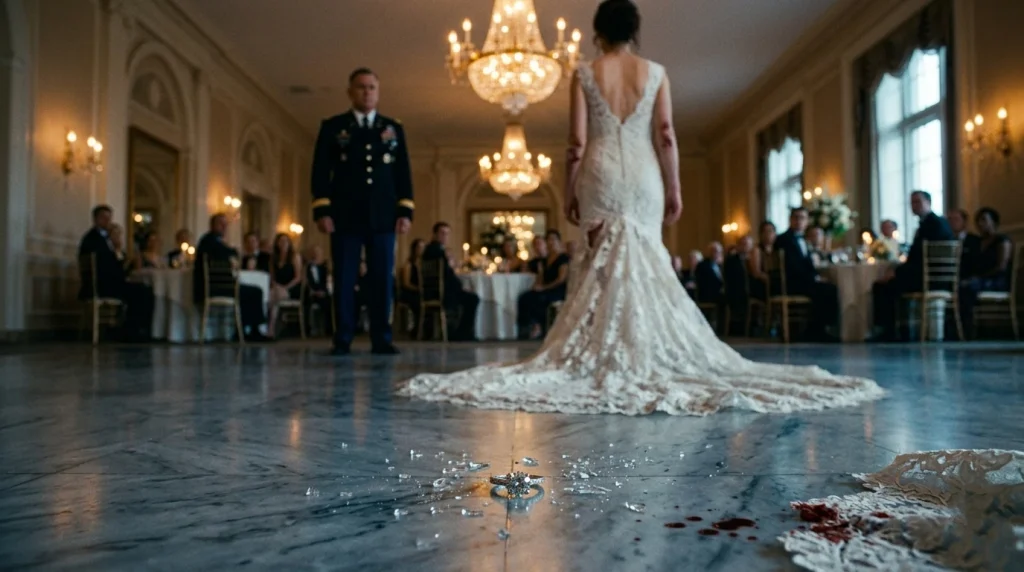

.The ballroom went silent the moment Naomi hit the floor.
Not the polite silence of ceremony. The kind that comes when three hundred people see something they cannot unsee.
She lay on the polished marble. Wedding gown around her. Broken glass beneath her palm. The veil — gone. The roses still perfect above her. The chandeliers still burning.
Nobody moved.
Grant Whitmore stood over her. Dark tuxedo. Jaw tight. Eyes already somewhere else.
“I’m not marrying you.”
His voice was flat. Like closing a door.
Naomi pressed one hand against the marble. Glass bit into her palm. She felt it. She didn’t look at it.
Behind Grant — his mother Vivian. Cream designer gown. Pearls at her throat. The expression on her face was not surprise. It was relief.
“Get up.” Her voice carried to every front row. “You’ve embarrassed this family long enough.”
Three hundred faces stared. Senators’ wives. Defense executives. Old-money families who smiled for cameras and destroyed people in private. All of them watching. None of them moving.
Grant stepped closer. Chin lifted.
“Your family is nothing. And so are you.”
Whispers moved through the room like smoke.
*Nothing? Who is her family?*
Naomi looked at the white roses. The untouched champagne. The gold-rimmed tables she had never asked for. She had wanted something small. Grant had insisted on the ballroom. Vivian had built the guest list.
She understood now.
This was never a wedding.
It was a stage.
Then the grand doors burst open.
The sound hit the room like a gunshot.
Every head turned.
A white American man in his late fifties filled the doorway. Broad-shouldered. Built like something that does not hurry because it does not need to. Full U.S. Army formal dress uniform. Medals across his chest catching chandelier light. He didn’t walk in fast. He walked in like someone who had been here before and was finishing something.
The crowd parted before they understood why.
Naomi looked up from the floor.
One word.
“Father.”
Grant went pale.
Vivian’s hand flew to her throat.
The general crossed the room. He stopped in front of his daughter. His face held grief and fury and something else — the expression of a man who has waited a long time to be in exactly this room.
He reached down and lifted her. Steady. Both hands. The way you lift someone you have been lifting since they were small.
“Captain Naomi Carter.” His voice was quiet. “Father is late.”
Naomi rose. The torn lace of her gown settled around her. The wound on her palm still open. She did not look at it.
Marcus looked at Grant.
Then at Vivian.
Then at the room.
“It is time,” he said, “to reclaim your honor.”
—
Naomi had spent years learning how to stay still when things broke around her.
Not coldness. Discipline. Her father had built it into her the way architects build load-bearing walls — invisible from the outside, holding everything up.
Her mother died when Naomi was twelve. After that, Marcus Carter was both. Strict. Hard to impress. But he polished her shoes before academy interviews. Left notes inside her textbooks. Never missed a promotion ceremony.
When she made captain, he cried. Alone. She only found out because she found the folded handkerchief still damp in his jacket pocket.
Grant found her at a veterans’ gala eighteen months ago. Quiet. Almost shy. He didn’t ask her last name first. He asked what music stayed with her. What books she carried on deployment. Whether she ever got tired of being brave.
That question opened something.
She had spent years being saluted and underestimated in the same breath. Grant made vulnerability feel safe. So when he assumed her father was ordinary military — she let him. Not from shame. To see who he would be if there was nothing to gain.
For a while, he was good.
Coffee at her desk. Patience through 2am calls. He described his mother as difficult but harmless.
Vivian Whitmore was neither.
She wore kindness like a costume and cruelty like a second skin. The first time they met, she smiled at Naomi and said, *”How inspiring. Grant has always had such a generous heart.”*
The insult was surgical. Naomi felt it immediately. Grant pretended not to see it.
The remarks escalated. Whether Naomi’s father could *contribute meaningfully* to wedding costs. Whether a simpler gown might suit her better. Whether someone without *real society training* understood what this family required.
Naomi stayed. Grant begged her to. *She’s scared of losing me. Give her time.*
So Naomi gave time. And patience. And grace. To people who read grace as weakness.
Two weeks before the wedding — Vivian went quiet.
Too quiet. Too calm. The cutting stopped. She began watching Naomi with a small, private smile.
Soldiers know when the atmosphere shifts.
Then Grant became distant.
The night before the wedding, Naomi found a folder outside Vivian’s sitting room. Her name on the cover. Inside: records. Photographs. A background report so thin it was almost funny. It listed her as a career officer. *Limited assets. No elite family connections.* And — written in the margin in ink —
*Unknown paternal influence.*
She stared at that phrase.
Then she heard Vivian’s voice through the door.
*She trapped you. She let you think she was more than she is.*
Grant: *It’s tomorrow.*
*Then tomorrow is when you end it. In front of everyone.*
Naomi closed the folder. Placed it back. Walked away.
Because one page in that file had nothing to do with her.
It was about Whitmore Strategic Group.
And suddenly Vivian’s cruelty had a different shape.
Not status. Not pride.
Fear.
—
The ballroom did not know how to hold Marcus Carter.
Washington understood power when it arrived in limousines and donor circles. This was different. He didn’t ask permission to command the room. He simply entered it — and the room reorganized around him.
He stood beside Naomi beneath the shattered arch and looked at the man who had called his daughter nothing.
“Mr. Whitmore.” His voice was low. Not raised. The voice of a man who has never needed volume. “You will repeat what you said.”
Grant’s mouth opened. Nothing came.
Vivian recovered first.
“This is a private family matter—”
“You know exactly who I am.”
A guest in the second row leaned forward. *That’s General Carter.*
Another went pale.
Grant looked at Naomi. Her name on his lips sounded different now. Smaller.
“Naomi—”
She met his eyes. And for the first time all morning — she didn’t look wounded. She looked awake.
“You said my family was nothing.” Her voice was quiet. “Say it again.”
Grant looked away.
Vivian’s fingers dug into his sleeve.
One of the soldiers behind Marcus stepped forward with a sealed leather folder.
Marcus opened it.
“Whitmore Strategic Group has spent four years presenting itself as a patriotic firm supporting military readiness and veteran housing,” he said, to the room. “Veterans who trusted your contracts. Families who believed your charity drives. Wounded soldiers whose housing grants were approved on paper and never built.”
Grant went rigid.
Vivian’s composure cracked at the edges.
“Captain Carter did not seek this investigation,” Marcus continued. “She found the pattern while reviewing veteran housing complaints. Then she did what your family apparently forgot honorable people still do.”
He paused.
“She reported it.”
Grant spun toward her.
“You reported my family?”
“I reported evidence.”
Vivian stepped forward, pearls trembling.
“You smiled in my house—”
“I smiled in your house while you insulted my father, my service, and every person you decided was beneath you.”
Silence.
“You deceived us.”
“No.” Naomi held her gaze. “You underestimated me.”
Marcus lifted another document.
“Your private investigator didn’t fail because General Carter was unimportant. He failed because you paid for gossip instead of truth.”
A few guests looked down at their programs.
The rest stared openly.
“Captain Naomi Carter graduated with honors. Two deployments. Led logistics under hostile conditions. Returned to build housing support for wounded veterans.” Marcus scanned the room. “She needed nothing from your name.”
Grant turned to Naomi. Desperate.
“You could have told me.”
“I wanted to,” she said. “Many times.”
“Then why didn’t you?”
She looked at him with something that was not anger.
“Because every time your mother looked down on me — I waited to see whether you would stand beside me.”
Grant looked away.
Because that answer was true. And he knew it. And everyone in that room knew he knew it.
—
Nobody moved as the investigators entered.
The string quartet had gone silent. The flowers still framed the aisle. The champagne untouched. But the wedding had become something else — colder, sharper, and far more honest than celebration.
Vivian pressed close to Grant.
“Fix this.”
Grant stared at Naomi the way people stare at doors they’ve already closed.
“We can still talk.”
She looked at his hand. Then his face.
“You had the whole morning to talk.”
“I was angry—”
“No.” Her voice was even. “You were obedient.”
Vivian snapped. “How dare—”
Naomi turned.
The entire room turned with her.
For months, Vivian had controlled every table, every flower, every insult wrapped in silk. But her voice sounded thin now. Small inside a room she had designed as a throne.
Naomi walked toward her.
Not quickly. Not dramatically. Steady. The torn lace trailing across the marble. The wound on her palm still open.
“You wanted me exposed,” she said. “So let’s be exposed.”
Vivian’s lips parted.
“You told your friends I was after money. You told your board I had no pedigree. You told your son I would drag him down.”
One step closer.
“Now tell them why you were really afraid of me.”
Vivian said nothing.
Marcus handed a document to the investigators. One of them nodded and spoke to hotel security.
Grant panicked.
“Mother—”
“You stupid boy.” Vivian’s voice cracked. “You were supposed to end it before this happened.”
The microphone near the arch was still live.
Her words carried across the entire ballroom.
The room went rigid.
Grant froze.
Naomi closed her eyes. Just for a moment.
There it was.
Not sudden. Not impulsive. Designed. The altar. The guests. The fall onto broken glass. Every piece of it chosen to make her look discarded before anyone thought to ask what she knew.
Marcus stepped forward.
“Mrs. Whitmore. You and your company are under formal investigation. You’ll respond through counsel.”
Vivian’s face twisted.
“You think medals make you untouchable?”
“I think truth makes you vulnerable.”
Grant turned to Naomi. One last time.
“I didn’t know about the money.”
Her expression held no fury. Only sadness.
“You knew about the cruelty.”
Three words. And they landed harder than everything else.
Because money lives in accounts. In signatures. In records that can be denied.
Cruelty had stood in the open. At every dinner table. At every event. At this altar. Grant had watched all of it — and he had said nothing.
Naomi reached up and removed her veil.
She placed it carefully on the floral arch.
Then she turned to the room.
“My father used to tell me that honor is not what people call you when they’re impressed.” Her voice trembled once. Only once. “It’s what remains when they try to strip everything else away.”
She paused.
“I came here today ready to become a wife. Instead I remembered I was already someone.”
Marcus’s eyes glistened.
Naomi removed the engagement ring.
Grant stepped forward. Automatic. Like a reflex.
She placed it on the floor between them. The diamond caught the chandelier light — bright and useless.
“I won’t throw it,” she said. “That would make it seem like it mattered.”
She walked past him.
The soldiers fell into step beside her.
Marcus stopped one moment. Facing Grant and Vivian beneath the arch they had turned into a weapon.
“You mistook humility for weakness,” he said. “That mistake will cost you more than this wedding.”
And for the first time in her life — Vivian Whitmore had nothing left to perform.
Only consequences.
—
Naomi didn’t cry until the corridor.
The ballroom doors closed behind her. Hotel staff moved carefully, pretending not to see. She stood beneath a wall of golden light, one hand pressed to her ribs, breathing like someone who had just walked out of something.
Marcus stepped beside her.
Not a general now. Just her father.
“I’m sorry I was late,” he said.
Naomi laughed. Through tears.
“You always make an entrance.”
He smiled. But it broke quickly.
“I should have been there before they touched you.”
“I thought I could handle it.”
“I know.”
“I thought if I stayed graceful enough — patient enough — they’d eventually see me.”
Marcus shook his head slowly.
“People committed to looking down rarely look closer.”
She wiped her cheek.
“I loved him.”
“I know.”
“That’s the humiliating part.”
“No.” He looked at her. “That’s the human part.”
She leaned into him. He held her carefully — mindful of the gown, the medals, the years. The little girl who used to fall asleep against his uniform after nightmares.
—
Inside the ballroom, Vivian was escorted to a private room. Counsel on speakerphone.
Grant stood near the altar. Staring at the ring on the floor until a groomsman finally picked it up and pressed it into his hand.
He called Naomi that evening. Then at midnight. Then the next morning.
She never answered.
By sunrise the story had moved through Washington.
Not the version Vivian planned. Not the poor bride cast aside by a powerful family.
The real one.
A decorated Army captain had been shoved onto broken glass at her own wedding by a groom and mother-in-law who believed she had nothing and no one. Minutes later, her father — a four-star general — walked in with a sealed federal investigation into the family business.
The headlines were merciless.
The guests were worse.
People who had smiled at Vivian for years began to remember things. Deals that felt off. Fundraisers no one could trace. Contractors who had stopped asking questions.
Power moves away from weakness. Always.
Within two weeks — three major partnerships gone.
Within a month — Grant resigned from the board.
Vivian stopped appearing at the charity events where she had once floated like royalty.
—
Naomi returned to work quietly.
Flowers at her office. Letters from women she had never met. Notes from veterans who needed her to know she had not fallen alone.
She kept one card on her desk.
From her father.
Four words.
*Proud of you. Always.*
Three months later — a military charity gala. Same city.
Not as someone’s fiancée. Not as someone’s almost-wife.
As Captain Naomi Carter.
Midnight blue. Hair swept back. Posture unshaken. When she entered, conversations paused — but not the way they had at the wedding.
Respect has a sound.
Sometimes it is silence.
Across the hall, Grant saw her.
Thinner. Humbled by the kind of loss that teaches too late. He crossed slowly. Stopped several feet away.
“Naomi.”
She turned.
For a moment she saw the man she had loved. The soft smile at the gala. Coffee cups. Late-night calls. The version of him that might have been real if he had been braver.
“I’m sorry,” he said.
She believed him. That surprised her.
But belief was not the same as return.
“I hope you become someone who would have stood up for me,” she said.
Grant’s eyes filled.
Naomi walked away.
Near the balcony, Marcus waited. Two glasses of sparkling water.
“You all right?”
She took one.
“I am.”
He studied her face.
This time, she meant it.
The lights behind them were softer than the chandeliers at the wedding. Less like performance. More like warmth.
She had been pushed to the floor in front of everyone.
She had risen as herself.
And that was the part Vivian Whitmore never understood.
Honor is not inherited through pearls or a last name.
It is revealed when the room turns against you. When the person who promised to choose you doesn’t. When every cruel voice waits for you to stay down.
Naomi Carter did not stay down.
She stood.
And by standing — she made everyone else look small.
—
Original fictional stories. AI-assisted creative content.