
Daniel Hartwell didn’t look at homeless people.
Not because he was cruel. Because he was efficient. Thirty-six years old, CEO of a tech company worth nine figures, and every second of his day was scheduled in fifteen-minute blocks.
His assistant, Karen, walked half a step behind him, rattling off the morning agenda.
“Board at ten. Chicago investors at noon. Charity gala call at three.”
“Move the gala call to four,” Daniel said, adjusting his cufflink without breaking stride.
“Done.”
He approached the glass doors of his office tower. The lobby security guard nodded. The doorman pulled the handle.
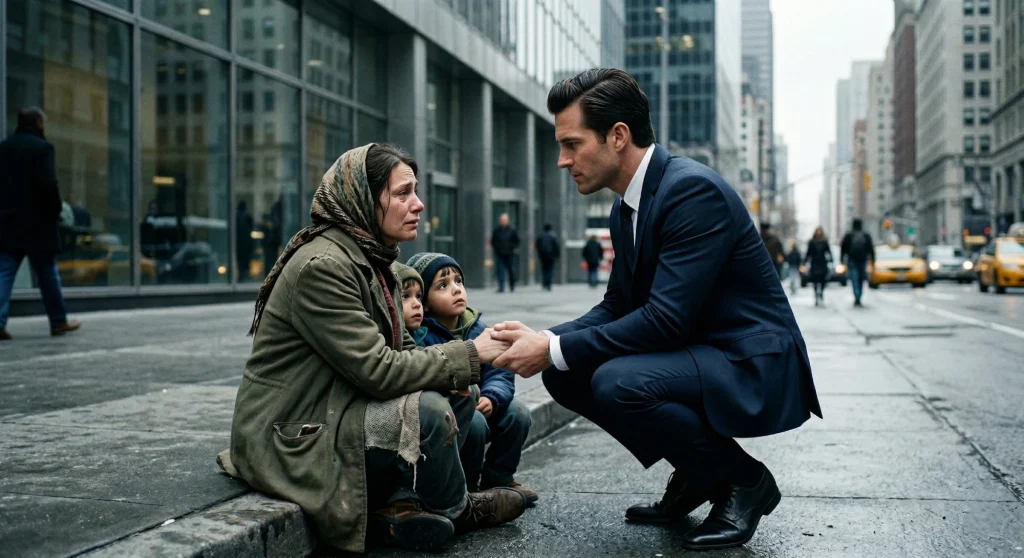
And then he saw her.
A thin woman sitting on the curb across the street. Worn coat. Taped shoes. A cardboard sign leaning against her knee.
Beside her sat two small boys. Identical.
Daniel didn’t slow down. He crossed the street with the mechanical ease of a man who donated to things without thinking about them. He pulled a folded hundred from his pocket and extended it toward her.
“Get them something warm,” he said. His smile was polite. Kind, even. But cold. The rehearsed warmth of someone who gives without connecting.
The woman reached for the bill.
Then she looked up at his face.
“Daniel?”
His smile vanished.
He tilted his head. Studied her for one long beat. The fraying scarf. The dark circles. The cheekbones sharper than he remembered.
And then recognition hit him like a freight train.
“Emma?”
Neither of them moved.
Traffic passed. People walked by. The city kept its rhythm.
But Daniel Hartwell’s world had just stopped.
Emma Collins. The woman he had once loved more than anyone in the world. The woman he had left behind five years ago.
He stared at her. Then his gaze dropped to the two boys.
Twins. Maybe four years old. Clean faces, but hollow cheeks. Donated jackets that didn’t match. One held the woman’s hand. The other stared up at Daniel with quiet curiosity.
And Daniel saw it.
The same dark eyes. The same thick eyebrows. The same small dimple in the chin.
His knees almost buckled.
“Emma,” he said, his voice low and shaking. “Whose children are these?”
She pulled the boys closer. The smaller one buried his face in her coat.
“Emma.”
She looked up. Tears sat at the edges of her eyes but didn’t fall. She’d trained herself not to cry in public a long time ago.
“They’re yours.”
The words hit him like a car wreck.
“My… what?”
“Both of them, Daniel.”
He couldn’t breathe.
“How is that possible?”
“I was pregnant when you left.”
Daniel’s mind went into freefall. He stared at the boys. Twins. His twins. Four years old. Living on a sidewalk. While he slept in a penthouse with a view of the entire skyline.
“Why didn’t you tell me?” His voice cracked.
Emma’s jaw tightened. “I tried.”
“What do you mean you tried?”
“I called you. Fourteen times. I left messages. I texted. I emailed.”
Daniel shook his head slowly. “I never got any of—”
“Your assistant answered.”
He went still.
“She told me you didn’t want to hear from me. She said if I called again, she’d involve lawyers.”
Daniel turned and looked at Karen, who was standing twenty feet away, pretending to check her phone.
His blood went cold.
“Karen.”
Karen looked up, startled. “Sir?”
“Come here.”
She walked over slowly. Her smile was professional. Practiced. But her eyes were already calculating.
“Do you remember a woman named Emma Collins calling me five years ago?”
Karen blinked. “Sir, I handle hundreds of calls—”
“She called fourteen times.”
Karen’s smile faltered.
“She was pregnant. With my children. And you told her I didn’t want to hear from her.”
Karen’s face went white.
“I was protecting your schedule—”
“You were protecting my schedule.”
Daniel repeated the words slowly. Like he was reading a verdict.
“Two children grew up without a father because you were protecting my schedule.”
Karen opened her mouth. Nothing came out.
“You’re fired.”
“Daniel, you can’t just—”
“You have thirty minutes to clear your desk. If you’re still in the building after that, security will escort you out.”
Karen’s composure crumbled. Her lip trembled. She looked at Emma, then at the boys, then back at Daniel.
“This is ridiculous. I gave you ten years—”
“And you stole five from them.” Daniel pointed at the twins. “Get out of my sight.”
Karen turned on her heel and walked away. Her heels clicked hard and fast against the sidewalk, the sound getting smaller until it disappeared.
Daniel exhaled.
He turned back to Emma.
She was staring at him with an expression he couldn’t quite read. Shock, maybe. Or the disbelief of someone who had stopped expecting anything good a long time ago.
“How long have you been on the street?” he asked.
“About a year.”
“A year.”
“I lost my job when the boys got sick last winter. Both of them, same week. Bronchitis. The ER bills alone—” She stopped. Swallowed. “The rent piled up. We got evicted in March.”
“Why didn’t you go to a shelter?”
“I tried. Waiting lists. Most places can’t take a mother with two kids.”
Daniel looked at the boys. One was sitting on the curb drawing circles in the grit with his finger. The other—the taller one—was staring directly at Daniel.
The boy stepped forward.
“Are you our dad?”
The question hit Daniel square in the chest. Simple. Innocent. Devastating.
He sank to one knee.
Two identical faces looked back at him. Curious. Unafraid. They didn’t know what a CEO was. They didn’t know about penthouses or board meetings or magazine covers. They just knew that this man had the same eyes they saw in each other every day.
“Yes,” Daniel whispered. “I am.”
The boy smiled. Small and careful, like he’d been practicing it.
“I knew it.”
“You did?”
“You look like us.”
Daniel laughed, but it came out broken. He reached for Emma’s hand and held it in both of his. She didn’t pull away.
Emma touched his shoulder with her free hand. “You don’t have to do anything.”
“Stop saying that.”
“I mean it. I didn’t plan this. I wasn’t waiting outside your building. We were just—”
“I know.” Daniel stood. He took off his coat and wrapped it around the smaller boy, who looked up at him with enormous eyes.
He pulled out his phone and dialed.
“Bring the car around. Now.”
Thirty seconds later, the black sedan pulled up.
The driver stepped out, confused. “Sir, the board meeting—”
“Cancel it.”
“All of them?”
“Every single one.”
He opened the rear door and looked at Emma.
She didn’t move.
“Daniel… I don’t want charity.”
“Good. Because this isn’t charity.”
He looked at the twins, who were already peering into the car with wide eyes.
“This is me showing up five years late. And I’m not leaving again.”
Emma’s chin trembled. She pressed her lips together. Then she nodded once and helped the boys into the car.
They drove uptown. The boys pressed their faces against the windows, gasping at buildings, at buses, at everything. One of them pointed at a hot dog cart and shouted, “Mama, look! Food on a stick!”
Emma laughed quietly. The sound startled Daniel. He hadn’t heard her laugh in five years, and it was exactly the same—soft and surprised, like joy had caught her off guard.
They arrived at Daniel’s building. The doorman held the glass open. The boys filed in, their worn sneakers squeaking on the marble floor.
“This is where you live?” one of them whispered.
“This is where we live,” Daniel said.
Emma stopped in the lobby. “Daniel—”
“Don’t argue with me.”
“I’m not arguing. I just need you to understand something.” She turned to face him fully. “I didn’t come looking for you. I don’t want your money. I want my boys to have a father. That’s it.”
Daniel looked at her for a long moment.
“Then let me be one.”
She held his gaze. Then she nodded.
They took the elevator up. The doors opened to the penthouse. The boys ran inside like they’d been released from a cage. One jumped on the couch. The other found the kitchen and opened the fridge and just stood there, staring at the food like it was a museum exhibit.
“Mama,” he said. “There’s so much.”
Emma covered her mouth with her hand.
Daniel crouched beside the boy at the fridge. “What’s your name?”
“Lucas.”
“Lucas, what do you like to eat?”
“Peanut butter.”
“What else?”
Lucas thought hard. “More peanut butter.”
Daniel smiled. The kind of smile that hurts. “We can do better than that.”
He made them sandwiches. Real ones—thick bread, turkey, cheese, the works. He cut them into triangles because one of the boys insisted triangles tasted better. He poured two glasses of milk and sat on the kitchen floor with them because the dining table felt too big.
Emma stood in the doorway, watching.
“Sit down,” Daniel said.
“I’m fine.”
“You haven’t eaten either.”
She hesitated. Then she sat on the floor beside her sons, and Daniel handed her a sandwich.
For ten minutes, nobody spoke. They just ate.
The taller boy—the one who’d asked if Daniel was their dad—finally broke the silence.
“My name’s Ethan.”
“Hi, Ethan.”
“That’s Lucas.” He pointed to the one at the fridge.
“Lucas falls asleep everywhere,” Ethan explained seriously.
Daniel nodded. “I used to do that too.”
Ethan’s eyes lit up. “Really?”
“Fell asleep in a board meeting once. Nobody told me for twenty minutes.”
Ethan grinned.
Emma wiped her eyes quickly, hoping nobody noticed.
Daniel noticed.
That evening, he called his lawyer.
“I need you to draft custody papers. Joint custody. Full paternal acknowledgment. And I need a trust fund set up for two children by end of week.”
“Two?”
“Twins. They’re four years old. Their names are Ethan and Lucas.”
The lawyer paused. “Daniel… are these—”
“They’re mine. DNA test is happening tomorrow, but I already know the answer. Just get the paperwork started.”
He hung up and made two more calls.
The first was to a family housing specialist. “I need a three-bedroom apartment, kid-friendly neighborhood, available immediately. Close to a good school. Money is not a concern.”
The second was to a pediatrician. “Two four-year-old boys. They’ve been living rough. I need full checkups. Tomorrow morning.”
When he walked back into the living room, both boys were asleep on the couch. Lucas on the left, Ethan on the right, their small bodies curled together like they’d been sleeping in tight spaces their whole lives.
Emma sat on the floor beside them, her back against the couch, staring at nothing.
Daniel sat down next to her.
“I’m sorry.”
She shook her head. “You didn’t know.”
“That doesn’t matter. I left. If I hadn’t left, none of this would have happened.”
“You didn’t know about them.”
“I knew about you.” He looked at her. “I knew you were the best thing in my life, and I walked away because I thought money mattered more.”
Emma was quiet for a long time.
“I waited for you,” she finally said. “For two years, I waited. I thought you’d come back.”
“I should have.”
“I used to stand outside your old apartment building. The one on Bleecker. Just in case.”
Daniel closed his eyes. The image of her standing on that sidewalk, pregnant, waiting for a man who never came—it hit him like a fist.
“I’m here now.”
“I know.”
“And I’m not going anywhere.”
She looked at him. “I’ve heard that before.”
“I know you have. And I know words don’t mean anything. So I’m going to show you. Every day. For as long as it takes.”
Emma studied his face. Searching for the lie. For the exit strategy. For the escape hatch that rich men always built into their promises.
She didn’t find one.
“Okay,” she said quietly.
Two weeks later, Emma and the boys moved into a brownstone in Brooklyn Heights. Three bedrooms, a backyard, a tree in the front that the boys immediately claimed as a fortress.
Daniel paid for everything, but he didn’t put his name on the lease.
“It’s yours,” he told Emma. “In your name. Nobody can take it from you.”
She stared at the lease. “Why?”
“Because you need to know that this isn’t conditional. This isn’t dependent on me. If I ever mess up again—if I disappoint you, if I fail—this home is still yours.”
Emma signed the lease with shaking hands.
The DNA test came back three days later. 99.97% match. Both boys.
Daniel framed the results and put them on his office desk.
His board members asked questions. The press caught wind of it. “Tech Billionaire Discovers Secret Twins” ran in four different outlets.
Daniel didn’t comment.
Instead, he showed up every morning at the brownstone at seven a.m. He made breakfast. He packed lunches. He walked the boys to preschool and picked them up at three.
His CFO called him during a school pickup once.
“Daniel, the Tokyo deal is falling apart—”
“Handle it.”
“It’s a hundred-million-dollar—”
“Steven, I’m watching my son try to climb a slide backwards. Handle. It.”
He hired a new assistant. A woman named Grace who, on her first day, asked what the policy was for personal calls.
Daniel looked at her.
“If a woman ever calls and says she knows me—any woman, any reason—you put her through immediately. No exceptions. No filtering. No judgment calls.”
Grace blinked. “Yes, sir.”
“If I find out you screened a single personal call without asking me first, you’ll be gone before lunch.”
“Understood.”
Three months later, Emma enrolled in a nursing program. Daniel set up childcare. He rearranged his entire schedule around the boys’ school calendar.
His investors were confused.
“You’re turning down the London expansion?”
“I’ll revisit it next year.”
“Next year?”
“My sons are starting kindergarten in September. I’m not missing the first day.”
The investor stared at him like he’d lost his mind.
Daniel smiled. “You should see them in their backpacks. It’ll change your whole perspective.”
On the first day of kindergarten, Daniel stood outside the school with Emma. The boys wore matching blue shirts—their own choice.
Ethan marched in first, waving without looking back.
Lucas, the quiet one, stood at the door and looked at both his parents.
“You’re both here,” he said.
Emma nodded. “We’re both here.”
“At the same time?”
“At the same time.”
Lucas smiled—a huge, uninhibited grin—and ran inside.
Emma grabbed Daniel’s arm and squeezed.
“Thank you.”
“For what?”
“For staying.”
Daniel covered her hand with his.
“This is the only place I want to be.”
Six months later, Daniel walked into the brownstone after work and found both boys sitting at the kitchen table with construction paper and glue.
“What are you making?”
“It’s a secret,” Ethan said, covering his project with both arms.
“A secret?”
“For you. But you can’t look until dinner.”
At dinner, they presented him with two handmade cards. Each one said the same thing in shaky, four-year-old handwriting:
BEST DAD
Ethan’s had a stick figure with a very large tie. Lucas’s was mostly glue and glitter, but the words were there.
Daniel held both cards and didn’t speak for a full minute.
Emma watched him from across the table.
“You okay?”
He looked at her. His eyes were red.
“I don’t deserve this.”
“Maybe not,” she said. “But they think you do. And that’s enough.”
Daniel placed the cards on his desk at work the next morning. Right next to the DNA test. Right where every investor, board member, and journalist could see them.
His CFO walked in, glanced at the desk, and raised an eyebrow.
“Redecorating?”
Daniel leaned back in his chair.
“Those are the two most valuable things I own.”
He looked out the window at the city skyline—the same skyline he used to stare at alone, convincing himself that success meant standing at the top with nobody beside you.
He didn’t believe that anymore.
The two cards stayed on his desk for years.
Long after the boys grew tall enough to ride bikes without training wheels. Long after Emma finished her nursing degree and started working at the children’s hospital downtown. Long after Daniel sold a division of his company specifically so he could coach Little League on Saturdays.
Long after he proposed to Emma on the Brooklyn Bridge, with two boys in matching suits throwing rice too early because Lucas couldn’t wait.
The cards stayed.
Glue peeling. Glitter fading. Letters smudged.
But the words still perfectly clear.
BEST DAD.
And Daniel Hartwell—who once walked away from everything that mattered—finally understood that the only empire worth building was the one waiting for him at the kitchen table every night.
Original fictional stories. AI-assisted creative content.