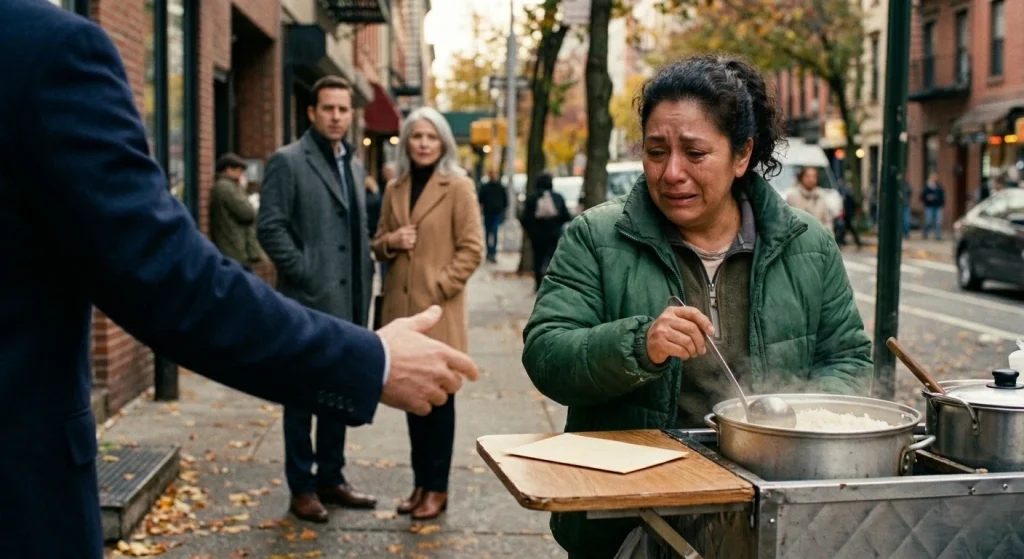

The sound came first.
Not loud. Worse than loud. Perfect. A low, velvet engine hum that had no business being on this
street—then another—then a third. People turned without thinking. Because cars like that didn’t
come here. Not to Clement Avenue, with its cracked sidewalks, faded awnings, and the
permanent smell of fried onions and damp concrete.
Shiomara Reyes heard it but didn’t look up.
She was ladling rice into a paper bowl for old Mr. Hutchins, the way she did every Tuesday and
Thursday. She’d been doing this corner for eleven years. Eleven years of the same cart, the same
folding table, the same sign—hand-painted by her daughter—that said HOT MEAL $2 / IF YOU
CAN’T PAY, EAT ANYWAY.
“Something wrong?” Mr. Hutchins asked.
“No,” she said. “Here.”
She handed him the bowl. He took it without looking at her. He was already watching the street.
The three cars rolled to a stop directly in front of her cart. One white. One black. One white again
—like punctuation. They didn’t park around the corner or down the block. They stopped right
there. Where her folding sign stood. Where the steam from her rice pot curled up into the cold
November air.
The engines cut.
Doors opened.
Shiomara set down her ladle.
Two men and a woman stepped out. The men wore suits—one deep navy, one charcoal—fitted
the way suits are fitted when money is not a question. The woman was older, silver-haired,
dressed in a camel coat that probably cost more than Shiomara’s cart and all the food in it
combined. They didn’t look around at the neighborhood. Didn’t take in the tired storefronts or
the group of teenagers watching from the bus stop. They looked only at her.
At her cart.
At her face.
Shiomara’s first thought was: lawsuit. Her second thought was: health inspector. Her third
thought—the one that made her stomach tighten—was: I don’t know these people.
Or did she?
Something about the way the woman pressed her hand to her chest. Something about the way
the younger of the two men swallowed—like he was working very hard to hold himself together.
“Can I help you?” Shiomara asked.
Her voice came out steadier than she felt.
The woman stepped forward. One step. Then another. Her eyes moved slowly across Shiomara’s
face—the way eyes move when they are searching for something they last saw a long time ago.
“You’re Shiomara,” the woman said. Not a question.
“I am.”
“You’ve been here a long time.”
“Eleven years.”
The man in the navy suit said, quietly, “We found the address through the city food permit
registry.” He paused. “It took us three months to narrow it down.”
Shiomara looked at him. He was somewhere in his mid-thirties. Strong jaw. Eyes that were darker
than his suit and currently doing something that eyes didn’t usually do in front of strangers—
filling up.
“I’m sorry,” she said. “I don’t think I know you.”
The woman’s hand was still pressed to her chest.
“You do,” she said. “You just don’t know you do.”
The second man—the one in charcoal—stepped forward then. He was a little broader than the
other one. Same age. Same careful posture. When he spoke, his voice was low and deliberate, like
someone who had rehearsed this moment so many times that the rehearsal had worn the
emotion smooth—but now that he was actually here, all of it came flooding back at once.
“Winter. About twenty-two years ago.” He stopped. Steadied himself. “There was a bridge on the
south side of Jefferson Park. Concrete pillar. Metal railing. There was a tarp.”
Shiomara went very still.
“Three kids,” he continued. “Under that tarp. It was—” he exhaled slowly— “it was the second
night. We hadn’t eaten in almost two days.”
The ladle was still in Shiomara’s hand.
She hadn’t noticed she was gripping it.
“You walked by,” the man in navy said. “And you stopped. You were pushing a cart—not this one,
smaller—and you stopped and you looked at us and you didn’t say anything for a second. Then
you started filling bowls.”
The woman’s eyes were wet now.
“There were three of us,” she said. “Triplets. We’d been separated from our mother—it’s a long
story, it doesn’t matter now—but we were alone. Nine years old. And you fed us.”
Shiomara’s throat closed.
She remembered.
Not the faces—faces change, faces grow up, faces become unrecognizable after twenty-two years
—but she remembered the moment. The bridge. The tarp. Three small bodies pressed together
for warmth, watching her with the specific, guarded hunger of children who have been
disappointed too many times to ask directly.
She had been twenty-six. She’d had twelve dollars in her pocket and half a pot of rice and black
beans on that little cart she’d bought secondhand from a woman named Dolores who was
retiring from street vending after thirty years.
She had filled three bowls.
She had sat on the cold concrete with them while they ate.
She had told them—because it was the only thing she knew to say—”Eat first. The world can
wait.”
“Oh,” Shiomara said.
It came out small. Almost nothing.
“You sat with us,” the woman said. “For almost an hour. You didn’t leave until a social worker
came.” Her voice broke on the last word. She pressed her lips together. Reset. “You gave us your
scarf. The orange one with the fringe.”
“I remember the scarf,” Shiomara said.
She hadn’t thought about it in years. She’d stopped looking for it after about a month.
“We tried to find you,” the man in charcoal said. “When we were teenagers. But we didn’t know
your name, didn’t know the neighborhood—we were in foster care by then, and the records from
that period were incomplete.” He looked at her steadily. “We never forgot you.”
“We talked about you,” the woman said. “All three of us, separately. Before we even found each
other again as adults—we each talked about you. The woman at the cart. The one who stopped.”
Shiomara realized her eyes were burning.
She set the ladle down.
“You found each other?” she asked.
“Fourteen years ago,” the man in navy said. A small, genuine smile broke through the controlled
surface of his face. “Long story. Good ending.” The smile steadied. “I’m Daniel. This is Marcus.”
He gestured to his brother. “And this is our sister, Celeste.”
“We’re not homeless anymore,” Marcus said. The understatement was so enormous it almost had
its own gravity.
Celeste—the silver-haired woman, who Shiomara was now recalibrating because she was not
old, she was maybe forty, and her hair was silver by choice or by early genetics or by something
the years had done to her—Celeste reached into the pocket of the camel coat and withdrew an
envelope.
Thick. Cream-colored. Sealed.
She held it for a moment.
“We made a promise,” she said. “The three of us, when we were still teenagers and separately
making the same promise without knowing it.” She set the envelope gently on the folding table,
next to the rice pot. The steam curled around it. “We said: if we ever made it—really made it—we
would come back.”
Shiomara looked at the envelope.
She did not reach for it.
“What did you make it to?” she asked.
It was not the question they expected.
Daniel laughed—a surprised, genuine sound. “Marcus is a civil engineer. He built water
treatment infrastructure in four states.” He glanced at his brother. “He just signed a contract in
New Mexico.”
“Daniel runs a venture capital firm,” Marcus said. “He’s insufferable at Thanksgiving but he’s
good at what he does.”
“And I’m a family court judge,” Celeste said. “District Seven.”
Shiomara sat down on the cooler she kept behind the cart.
“You’re a judge.”
“I am.”
“The kids I fed soup to under a bridge are a judge, an engineer, and a venture capitalist.”
“We are,” Celeste said. And there was something quiet and fierce in her voice—like pride that had
been forged in a very specific kind of fire.
Shiomara looked at the envelope again.
“Open it,” Daniel said.
She reached for it slowly. Her hands—the same hands that had filled three bowls twenty-two
years ago on a cold night in Jefferson Park—were trembling now in a way they hadn’t trembled
since.
She broke the seal.
Inside: a photograph.
Old. Printed on thin paper, slightly faded at the edges. Three children sitting on concrete, holding
paper bowls, steam rising in front of their faces. Behind them—barely visible but unmistakable—
a woman in a puffy green jacket and an orange scarf with fringe.
Shiomara’s vision blurred.
Beneath the photograph: a document. White paper. Official header. Her name printed in the
middle, followed by text she had to blink three times to read clearly.
A deed.
A property deed.
For a building on Marcellus Street—four blocks away. A building she had walked past a hundred
times. A three-story building that had stood empty for two years with a For Sale sign turning
gray in the window.
“The ground floor is permitted for food service,” Marcus said. “We had it inspected last month.
The kitchen equipment is already installed.”
“The second floor is a two-bedroom apartment,” Daniel said. “Move-in ready.”
“The third floor we left open,” Celeste said. “Because we didn’t know what you needed it for. But
it’s yours.”
Shiomara stared at the document.
“This is—”
“Yours,” Celeste said. Simply. Finally. “All of it.”
“I can’t—”
“You already did,” Marcus said. “Twenty-two years ago. You already did the thing that made this
possible.”
Shiomara looked up.
Mr. Hutchins was standing a few feet away, paper bowl in his hands, watching with wide eyes.
The teenagers from the bus stop had drifted closer. A woman with a stroller had stopped. Three
men from the laundromat were standing in the doorway.
Nobody was speaking.
The whole block was holding its breath.
“I just fed you,” Shiomara said. Her voice broke clean in half. “That’s all I did. I just—I had food
and you needed it. That’s all it was.”
“That’s everything,” Celeste said.
“That was everything,” Daniel said. “To us. That night. You are the reason—” his voice caught—
“you are the reason all three of us decided that when we had something, we would not walk past
the people who needed it. You showed us that was a choice a person could make. That was the
only lesson we needed.”
Shiomara pressed her hand over her mouth.
The photograph was still in her other hand.
Twenty-two years ago: three bowls of rice and black beans and one orange scarf and an hour of
sitting on cold concrete, because what else do you do when you see a child who is cold and
hungry?
You stop.
You fill the bowl.
The world can wait.
“I don’t know what to say,” she whispered.
“You don’t have to say anything,” Celeste said. She stepped forward and put her arms around
Shiomara—firmly, the way you hug someone you have been wanting to hug for twenty-two years
—and for a long moment neither of them moved.
Then Marcus stepped in.
Then Daniel.
And the street—Clement Avenue, with its cracked sidewalks and the smell of fried onions and
the teenagers watching and Mr. Hutchins still holding his paper bowl—was very, very quiet.
Two months later, the sign above the door on Marcellus Street read: SHIOMARA’S TABLE.
The ground floor seated forty. The kitchen ran from six in the morning until eight at night. The
menu was hand-painted on a chalkboard: rice, beans, soup, bread. The price was the same as
always—$2 / if you can’t pay, eat anyway.
The only difference was that now she had a real kitchen. A real door. Real heat in the winter.
On the day she opened, Daniel sat at a corner table and ate a bowl of black beans and rice and
said it was the best thing he’d ever tasted.
Celeste came every Thursday after court.
Marcus installed a whole-building water filtration system himself, on a Saturday, because he said
the building’s old pipes were criminal and he wasn’t going to let the woman who saved his life
drink bad water.
The three of them were her first regulars.
They would be her last.
Shiomara stood behind the counter on that first morning, ladle in hand, watching the line stretch
out the door and down the block. And she thought about twenty-two years ago, and the bridge,
and the tarp, and three pairs of hungry eyes watching her cart roll to a stop.
She had stopped because it was the only thing that made sense.
She had fed them because they needed it and she had it.
She had not done it to be repaid.
But some debts, it turned out, had a way of settling themselves—not because the world was fair,
but because some people refused to let it be otherwise.
The door opened. Another person stepped in.
Shiomara filled the bowl.
Original fictional stories. AI-assisted creative content.