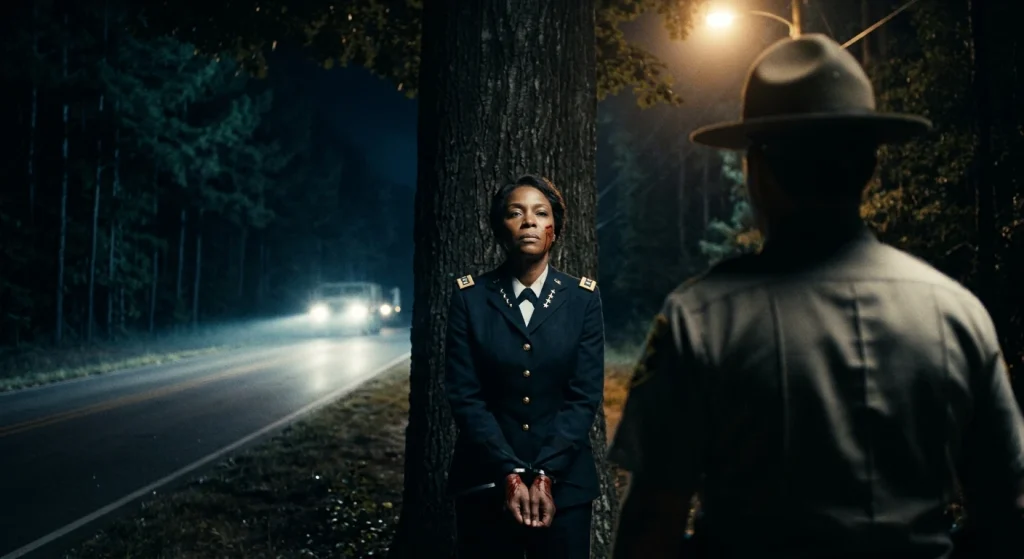

Major General Vanessa Reed had spent twenty-six years in the United States Army, and she had learned one lesson more thoroughly than any battlefield tactic: danger rarely announces itself honestly.
She was alone on a dark Georgia highway, ninety minutes from Fort Ashby, when the patrol lights appeared in her mirror.
She checked her speed. Five under the limit. She pulled over anyway.
Two deputies approached from either side. The first was tall, pale-haired, jaw set like he was already angry at her. The second was older, heavier, carrying the false ease of a man who preferred intimidation to procedure. Their patrol car sat diagonally behind hers—deliberately blocking the road, she noted. Not standard position.
“License and registration,” the tall one said.
She handed both over with her military identification. “Is there a reason I was stopped, Deputy?”
He looked at the ID, then at her, then back. Something shifted in his face that was not respect.
“You a general?” he said, with a short laugh.
“Yes.”
The older one leaned in through the passenger window. “Step out of the vehicle.”
“I’d like to know the reason for this stop first.”
“Step out.”
She did. The air was cold. Wind moved through the pine trees beyond the ditch. Vanessa stood with her shoulders squared, eyes moving carefully between both men. She recognized this kind of escalating hostility—not from official channels, but from unstable environments where authority became personal and procedure became optional.
The older deputy, Sergeant Nolan Pike, held her military ID between two fingers like it embarrassed him. The younger one, Deputy Cole Mercer, circled slowly behind her.
“You military people think you’re above everything,” Pike said.
“If this stop is legitimate,” Vanessa said, “call your supervisor. Now.”
That was the moment the mood changed.
Mercer stepped behind her without warning. Pike grabbed her wrist. Vanessa pivoted instinctively—not to fight, but to keep balance—and that was enough for them to act. Mercer slammed her against the SUV. A zip tie cut into one wrist, then the other. Gravel tore through her slacks as they forced her down.
She did not scream.
She breathed, memorized voices, faces, the smell of mud and exhaust, the exact number of seconds between each action.
They dragged her twenty feet from the road to a wide oak near the ditch line. The bark scraped through her coat as they pulled her upright and secured her wrists behind the trunk. Mercer stepped back breathing hard. Pike stood in front of her with the look of a man who had done this before and expected it to end the same way: quietly.
Cars passed on the road. One slowed. Pike waved it through. “Routine stop. Keep moving.”
Vanessa lifted her head and listened.
She heard a radio burst with the name Sheriff Hollis. She heard Mercer ask whether “the message got through.” She heard fear moving under the swagger like current under still water.
Then, far away, beyond the trees, she heard engines—heavier than any county unit should have had.
—
At Fort Ashby, her driverless command SUV had already triggered an escalation alert.
Colonel Mason Cole stared at the operations board for four seconds before he spoke. The general’s vehicle had gone stationary. Her encrypted check-in had missed. Her phone was not responding.
“Get me her location,” he said. “Now. We are not waiting.”
The operations center moved. MPs mobilized. Two tactical units were wheels-up in under eight minutes.
—
Back on the shoulder, Mercer’s phone rang.
He answered, listened, and turned white.
“What?” Pike asked.
Mercer swallowed. “They found her signal.”
“Who?”
Mercer looked toward Vanessa, then toward the darkness behind the road. “The Army.”
Vanessa straightened against the tree trunk as far as the restraints allowed. Her voice came out clear and precise.
“You had one chance to make this a traffic stop,” she said. “You chose something else.”
Then the first convoy lights came through the pines.
—
The lead vehicle was a matte-green tactical truck moving fast enough to send pine needles spiraling into the air. Behind it came two command SUVs, another truck, and military police units cutting hard light through the treeline. The quiet roadside became a wall of engines and boots and command voices in less than twenty seconds.
Mercer stepped backward and nearly went into the ditch.
Pike reached for his radio. He stopped when armed MPs spread from the lead vehicle into a perimeter with an efficiency that made his own movements look slow. There was no shouting. No confusion. Just trained people executing without hesitation—and the gap between that and what the deputies had been doing became humiliatingly obvious all at once.
Colonel Mason Cole stepped out of the second SUV before the door had fully swung open. He scanned the roadside once—the tactical positions, the deputies, the command vehicle, and finally Vanessa restrained against the oak tree—and whatever he felt went so cold it no longer needed volume.
“Secure both deputies,” he said.
Pike tried. “You can’t just roll onto county jurisdiction and—”
An MP captain cut across him. “Hands where I can see them.”
Mercer obeyed immediately.
Pike did not. He reached toward his belt and was on the ground a second later with a knee between his shoulder blades and both wrists locked. Mercer, watching that happen, went pale and ran out of options.
Mason crossed the ditch line and stopped in front of Vanessa. For one moment the whole scene narrowed to that image: a general zip-tied to a roadside oak tree on a Georgia highway in her own country.
“Ma’am,” he said quietly.
“Colonel.” Her voice was controlled despite the blood loss at both wrists. “You took too long.”
A few MPs almost smiled. Mason did not. “Yes, ma’am.”
He cut the restraints himself.
Vanessa rolled her shoulders as circulation came back. She stepped away from the tree on her own feet, waved off the medic’s offered hand, allowed them to check her wrists and the gravel scrape across her cheek. Then she asked for a field notebook before she asked for water.
That told Mason everything.
“What did you hear?” he asked.
Vanessa looked toward the deputies under guard. “Hollis was expecting something tonight. Pike said ‘the message got through.’ Mercer asked if they were too early. They knew who I was before I got out of the car. This wasn’t random.”
“Agreed.”
—
Army legal officers were on the line within minutes. The provost marshal’s office was notified. Federal jurisdiction questions came fast—the victim was a serving general officer in a marked government vehicle returning from official duty—and county authority didn’t disappear, but it no longer controlled the story.
Then Sheriff Travis Hollis arrived.
He came in fast in a black county SUV with a second patrol unit behind him. The confidence left his face the moment he saw the military perimeter. He climbed out adjusting his jacket, taking in the MPs, the command vehicles, the deputies on the ground, and Vanessa standing free beside the oak tree. He read the situation in one second and chose charm anyway.
“General,” he said, spreading his hands, “I’m sure this is a misunderstanding—”
“No,” Vanessa said. “It is not.”
He shifted toward reason. “My deputies must have believed there was a concern. We can work this out—”
Mason stepped in. “Nothing about this gets worked out without federal notification.”
That was when Hollis made his mistake.
He glanced—just once, involuntarily—toward the woods beyond the road shoulder.
Vanessa followed the look.
Half-hidden between pine trunks sat an unmarked pickup truck with its engine off and a man still inside. He ducked too late. Two MPs moved immediately. By the time the driver tried to reverse, they had him boxed. What they found inside the truck changed the temperature of the whole scene: a long-lens camera, a police-band scanner, and a manila folder containing printed photographs of vehicles entering and leaving a service road less than three miles away.
That service road, according to Vanessa’s afternoon briefing, was supposed to be empty.
It was listed as retired federal land—old storage infrastructure, officially inactive for decades. But the photographs showed traffic patterns: late-night deliveries, county vehicles, and once, unmistakably, a military contractor plate.
Hollis stopped talking.
Vanessa looked at him. “You weren’t protecting your deputies from me,” she said. “You were keeping me from seeing something.”
No one denied it.
Mercer broke first, still shaking under guard. “We were told to stall you,” he muttered. “Hold you until the route cleared.”
“Shut your mouth,” Pike said.
Mercer kept going, because fear had changed sides. “Sheriff said you’d been at the briefing, that maybe you’d take County 9 back to base. Said if you asked questions, make it messy.”
Vanessa didn’t move. “Messy enough to tie me to a tree?”
Mercer’s silence answered it.
—
Mason looked over the legal officer’s shoulder at the folder, then at Vanessa. “Whatever they’re hiding isn’t small.”
Vanessa took the folder, scanned three pages, and felt the last piece lock into place.
The service road connected to a decommissioned federal bunker site—the same location flagged that afternoon in her security briefing for unexplained contractor access irregularities. Which meant Briar Glen’s sheriff’s department had not merely assaulted a general officer.
They had interfered with an active national security investigation.
When federal agents were notified before dawn, the roadside humiliation that Pike and Mercer believed would disappear into a Georgia night became the first crack in something that would take down half the county by sunrise.
—
By 5:30 a.m., the county line outside Briar Glen looked like the edge of a federal takedown.
Unmarked sedans arrived first. Then armored investigative units. Then a mobile evidence van. FBI agents stepped out carrying hard cases and controlled expressions. Army CID coordinated with them under joint temporary authority while MPs held the perimeter and no one from Hollis’s department was allowed near a radio unsupervised.
Agent Dana Mercer—no relation to the deputy, a fact she clarified immediately and coldly—approached Hollis with a direct request for his phone, vehicle keys, and duty weapon.
“You are not under arrest at this moment,” she said. “But you are not free to leave.”
The words “at this moment” hung in the air like a blade.
Vanessa sat in the rear of a command SUV while medics documented the bruising around both wrists and cleaned the cut on her cheek. She should have gone straight to base medical. She knew that. But if she left before giving her statement, the story would grow new lies before breakfast. So she stayed, wrapped in a field jacket over torn civilian clothes, and dictated every detail: the names, the phrasing, the direction of Hollis’s glance, the timing of the phone call, the truck in the woods, the camera, the folder. All of it.
The folder turned out to be dynamite.
By midmorning, federal teams executed a search warrant at a fenced warehouse structure behind a defunct county maintenance sign three miles from the roadside. On paper the property had been inactive for years. In reality it housed diverted contractor equipment, unregistered communications gear, and crates of restricted technical components whose movement had been masked through false county storage invoices. Not apocalyptic. Not cinematic. Worse: fraud, contract theft, and corruption wrapped in the kind of local protection network that survives because it looks too ordinary to notice.
Briar Glen had not targeted Vanessa Reed at random.
They targeted her because she had attended a briefing that afternoon about missing strategic equipment and contractor routing tied to old federal sites in the region. Someone in the county’s protection circle realized her route home could pass close enough to notice movement near the warehouse road. They didn’t need to hurt her. They needed to discredit, delay, and intimidate her long enough for trucks to clear the site.
Cole Mercer and Nolan Pike had turned that order into something uglier.
By nightfall, both were charged: unlawful detention, civil rights violations, assault under color of law, falsification of law enforcement reporting, and conspiracy to obstruct a federal investigation. Sheriff Travis Hollis was arrested two days later after phone records connected him directly to the contractor intermediary found in the woods. The warehouse search triggered a procurement fraud investigation reaching across three counties and into a private logistics firm with federal defense contracts.
The national press found the story before the indictments were fully printed.
—
The public didn’t first see Vanessa as a victim.
They saw her in a photograph taken just after dawn—standing beside a military vehicle, bruised wrists visible above the cuffs of a field jacket, face marked, chin lifted, eyes fixed on something beyond the frame. It ran everywhere.
A week later she testified before a closed joint review board and then made a brief public statement outside Fort Ashby.
“I was humiliated,” she said. “I was restrained, degraded, and treated as though my rank and service meant nothing. But this is larger than what happened to me. The danger is not only that two deputies abused their power. The danger is that systems of protection—local, political, financial—helped create the belief that they could.”
That line ran on every major network.
Vanessa refused to dramatize the rest. No slogans. No posturing. She named the facts: a false stop, unlawful force, deliberate humiliation, attempted delay of an active federal matter, and the rapid response of trained personnel who chose not to hesitate when something was wrong. She named Colonel Mason Cole and the Fort Ashby response team. She did not mention fear—though privately she told Mason the worst part had not been the zip ties or the tree or the cold.
“It was how normal they thought it was,” she said.
—
Months later, Briar Glen still wore the scandal like a stain.
The sheriff’s department was reorganized under state oversight. The contractor firm lost federal eligibility. Several executives were indicted. The deputies took plea arrangements that still ended their careers and put them in federal prison. Reform came unevenly—no one pretended otherwise—but the secrecy broke. That mattered more than anything.
At Fort Ashby, Vanessa returned to duty within days. The first time she drove that stretch of road again, she didn’t go alone. Mason sat in the passenger seat and said nothing unless she needed him to. When they passed the oak tree at the ditch line, she glanced at it once and kept going.
She had learned what many people spend their lives never understanding: humiliation is only a weapon if it becomes the last word.
In Briar Glen, it did not.
What the deputies meant as a demonstration of power became the very evidence that exposed their network, collapsed their protection, and pulled a corruption operation into the light they had been so desperate to avoid. They tied a general to a tree because they believed isolation would make her small.
Instead, it summoned an army.
Justice didn’t arrive all at once. It rarely does. But it arrived—in handcuffs, in federal court, in reorganized departments and revoked contracts and prison sentences that came without appeals worth making. And on a Georgia highway outside Briar Glen, the oak tree stood the same as before: bark rough, roots deep, untouched by any of it.
The only thing that had changed was what happened underneath it.
Original fictional stories. AI-assisted creative content.