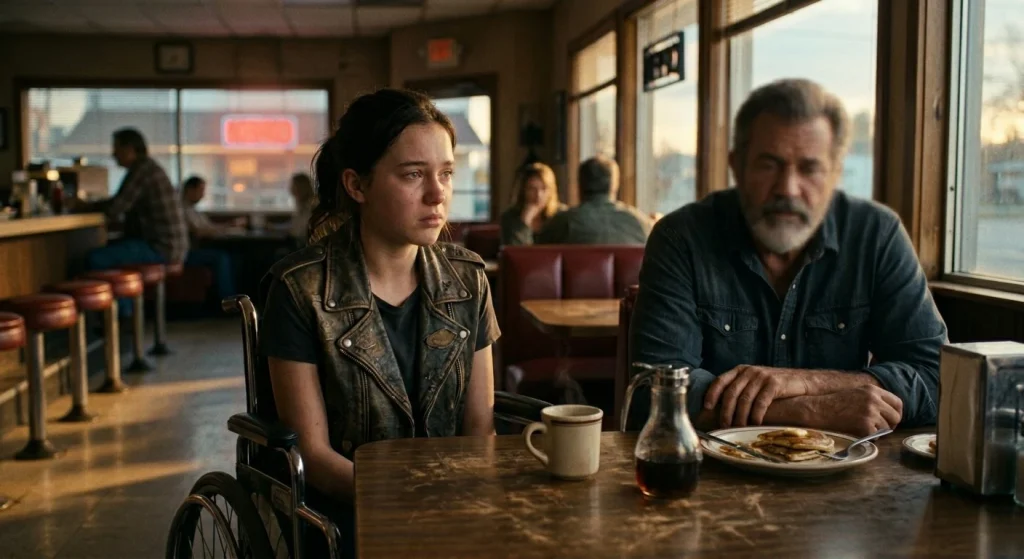

The pancakes were getting cold.
Eliza Hartwell had been staring at them for ten minutes, watching the syrup pool and thicken at
the edges. She wasn’t hungry anymore. She hadn’t really been hungry since the boys sat down.
Cedar Hollow Diner was supposed to be safe. It was the kind of place her mom called “a good
spot”—meaning quiet, meaning people minded their own business, meaning nobody would
make a big deal out of her wheelchair. She’d been coming here since she was nine.
She should have known today would be different.
“Hey, look at that one.” The voice carried from the center booth. Not even bothered to stay quiet
about it.
Eliza kept her eyes on the table.
Don’t react. Don’t give them anything.
“Bet she drove here in that thing.” Laughter. The sharp kind that wasn’t really about something
being funny.
The waitress—Donna, the name tag said—stood near the coffee station. She caught Eliza’s eye
for half a second, then looked at the counter. Her jaw tightened. She refilled a cup no one had
asked for.
Eliza understood. She didn’t blame her.
The boy who stood up first was the tallest one. Maybe sixteen, seventeen. He had the kind of easy
confidence that comes from never having been told no.
He walked past her table like he was heading to the bathroom.
His arm swung out.
The plate hit the floor—a flat, hard crack that made everyone in the diner flinch. Syrup and
pancake pieces scattered across the tile.
“Oops,” he said. He wasn’t looking at her when he said it.
His friend was already moving. Two hands grabbed her wheelchair handles from behind and
pushed—not hard, just enough. Just enough to rock her forward. Just enough to make her grab
the table edge and feel her stomach drop.
Laughter broke open across the room.
Eliza’s face burned. Her hands locked onto the armrests. She focused on a single grease stain on
the table because that was better than looking up, better than seeing all the people suddenly
very interested in their phones.
An older man in a fisherman’s hat knelt beside her. He picked up two pieces of the broken plate,
his eyes kind.
“Hey,” he said quietly. “Don’t let them get to you.”
“Thank you,” Eliza managed.
He stood up.
He went back to his seat.
And then the quiet came back—the heavy kind, the kind that meant nobody was going to do
anything.
The boys were still laughing. One of them was doing an impression of her grabbing the table. The
others howled.
Donna appeared at Eliza’s table with a rag. Her face was pale. “I’m so sorry, honey. I’ll get you a
fresh plate—”
“It’s okay,” Eliza said. Her voice came out steady. She was proud of that. “I’m not hungry.”
“Eliza—”
“Really.” She managed a smile. “It’s fine.”
It wasn’t fine.
She just didn’t want to be the girl who cried in a diner. She’d already been enough things today
that she hadn’t chosen.
Outside, she heard it before anyone else did. A low vibration in the floor. Her hands felt it through
the wheelchair frame.
Then the windows shook—just slightly.
Silverware rattled.
The boys stopped mid-sentence.
Every head in the diner turned.
The motorcycles came in one by one, filling the parking lot with a sound that wasn’t aggressive,
exactly. It was just present. Dense. Unavoidable.
The bell above the door rang.
Six of them came in. Leather vests, work boots, the kind of faces that had spent a lot of years
outdoors. They didn’t look around for attention. They just moved—steady, unhurried—toward
the long counter.
Except for the one in front.
He stopped.
He was tall, gray in the beard, maybe fifty. He stood near the entrance for a moment and simply
looked at the room. Not scanning for a threat. Just reading it. The way someone does when
they’ve learned to notice what most people train themselves not to.
The broken plate pieces still on the floor near Eliza’s table.
The tightness around Donna’s eyes.
The boys in the center booth, now very quiet.
The girl near the window, sitting with her hands in her lap and her breakfast gone.
He walked past the boys without glancing at them. That, somehow, was worse for them than if
he’d stared.
He stopped at Eliza’s table. He lowered himself to one knee—slowly, like his joints didn’t love it—
so his eyes were level with hers.
“Morning,” he said.
Not poor thing. Not are you okay. Just morning. The way you’d say it to anyone.
“Morning,” she said, because she didn’t know what else to say.
“Cole,” he offered, like they were being introduced at a normal place on a normal day.
“Eliza.”
He nodded once. He looked at the empty space where her plate had been. He looked at Donna,
who had appeared behind the counter again.
“Can we get a fresh breakfast over here? Pancakes.” He glanced at Eliza. “That right?”
She almost said you don’t have to do that. She almost said really, it’s fine. She almost made herself
smaller the way she always did.
“Yeah,” she said instead. “Pancakes.”
He put two folded bills on the table—more than it cost—and stood up.
Then he turned.
Not all the way toward the boys. Just enough. His voice didn’t rise, didn’t sharpen.
“Is there something here that still needs addressing?”
The center booth had gone very still.
The tall boy—the one who’d knocked the plate—looked at the table. His jaw worked like he was
thinking about saying something. He didn’t.
“Didn’t think so,” Cole said.
He pulled out the chair across from Eliza, looked at her. “You mind?”
She blinked. “No. Go ahead.”
He sat down. One of his guys appeared with a coffee and set it in front of him without being
asked.
The boys were on their feet now. No one announced it. No one made a scene. Wallets came out,
chairs scraped back, eyes stayed down. By the time Donna came out with a fresh plate of
pancakes, they were filing through the door. The bell rang on their way out.
Nobody watched them go.
Donna set the pancakes in front of Eliza. Her eyes were shining a little, but she kept it
professional. “Maple syrup?”
“Please,” Eliza said.
Cole looked across the table at her. “You come here a lot?”
“Every Sunday.”
“Good spot.” He wrapped both hands around his coffee cup. “It’ll be a good spot next Sunday
too.”
She understood what he meant.
They ate in the kind of quiet that doesn’t need filling—the good kind, the kind that actually feels
like rest.
At some point, one of Cole’s guys came over and sat in the next booth. Then another. They
ordered eggs and traded short sentences with each other, and after a while it just felt like the
diner was full again. Regular full. The right kind.
Eliza ate every bite of her pancakes.
When she was almost done, Cole reached into his vest—the worn one, patches from places she
didn’t recognize—and pulled it off. He leaned across the table and settled it over her shoulders,
matter-of-fact, the way you’d hand someone an umbrella.
It was heavy. But warm. The leather held heat like something that had been through a lot of
weather and come out the other side intact.
“You don’t have to make yourself small so other people feel comfortable,” he said. “You hear me?”
She looked down at the vest. Then up at him.
“Yeah,” she said. Her voice came out a little unsteady. “I hear you.”
“Good.” He finished his coffee. “Because that’s not a lesson you should have to keep learning.”
Donna swung by with the coffee pot. “Top off?”
“Always,” Cole said.
The morning light came through the windows the way it always did, settling over the worn
booths and the polished counter and the table where a girl in a biker’s vest was finishing her
breakfast.
Outside, the motorcycles waited. Inside, for the first time all morning, the quiet felt like it
belonged to everyone.
Eliza looked at the syrup pooling at the edge of her plate, the same way she had an hour ago.
Different now.
She cut another piece of pancake. She ate it.
She stayed.
Original fictional stories. AI-assisted creative content.