
The snow that morning felt like needles.
I tucked my chin down and kept walking, one arm locked around Lily’s carrier, the other gripping
the handle of a secondhand stroller. The wheels kept jamming on the ice. I had to yank hard
every few feet just to keep moving.
My cheeks were past burning. My fingers had stopped feeling anything around the second block.
“Almost there,” I told Lily, even though she was asleep. Even though she couldn’t hear me over
the wind.
I’d been telling myself the same thing for four months.
It started the way most disasters do — quietly, with paperwork, and people who sounded like
they were helping.
Adam got sick eight weeks after our wedding. A cardiac event the doctors called “unexpectedly
severe for his age.” The surgery cost more than our first year of rent. The recovery stretched from
six weeks to four months. I visited the hospital every day, learning how to read monitors, how to
ask the right questions, how to cry in the parking garage where no one could see me.
My parents stepped in.
“Let us handle things,” my mom said. “You’re exhausted. You need to focus on Adam.”
I was exhausted. I did need to focus. So I signed the papers they slid in front of me at the hospital
— documents I only half-read, in a room that smelled like antiseptic, on a day I hadn’t slept.
“Just routine stuff,” my dad said. “So we can keep the bills from piling up.”
I believed them.
The first sign that something was off came three months later, when I asked for money from the
emergency fund my grandfather had set up for me.
“The trust is tied up right now,” my mom said.
I looked it up. I couldn’t access the account online. The username didn’t work. When I called the
bank, they said my contact information on file didn’t match what I was providing.
I told my parents. My dad frowned at his coffee. “These things take time,” he said.
I asked about the Mercedes — the car my grandfather had given us as a wedding gift. It wasn’t in
our parking spot one morning, and when I asked, my mother waved a hand. “Madison needed it
temporarily. Just for a few weeks. You barely drive with Adam in the hospital.”
The weeks became months.
Now it was February, Lily was six weeks old, and I was walking to the pharmacy in a snowstorm
because formula had run out and I couldn’t ask for gas money without hearing a ten-minute
lecture on gratitude and “not acting entitled.”
My phone buzzed in my coat pocket.
I shifted the stroller handle and checked it, fingers clumsy with cold.
Mom: Don’t ask Grandpa Howard for money. He’ll just get confused. We’re handling it.
I read it twice.
Confused. Grandpa Howard had run three car dealerships for forty years. He’d taught me to read
a lease agreement before I graduated high school. He could quote interest rates from memory. He
was seventy-four and sharpened his own kitchen knives because “a dull blade is a lazy blade.”
Confused.
I stared at the message until my eyes watered from the wind.
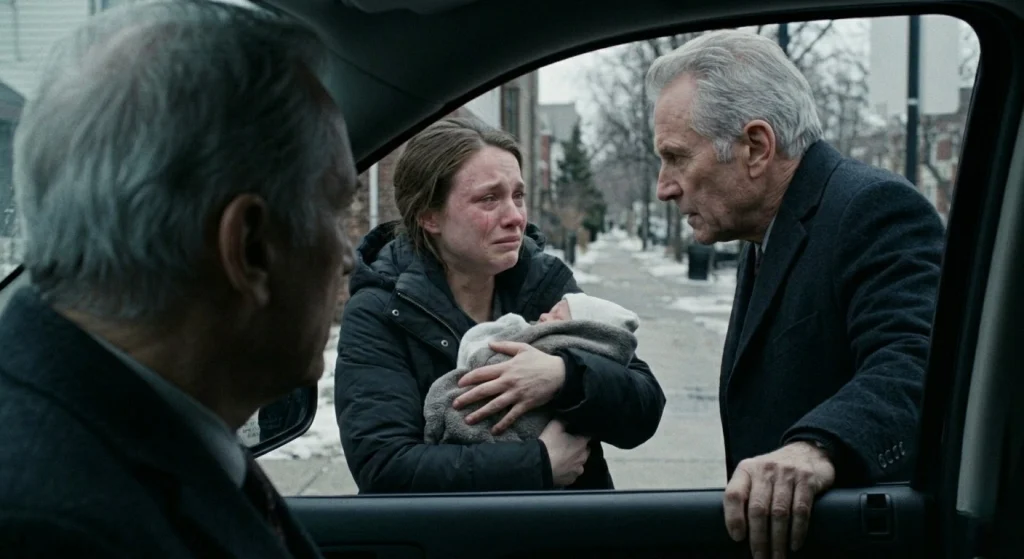
That’s when the headlights swept across the snowbank beside me.
A dark SUV slowed to a stop.
The passenger window rolled down.
I recognized him before my brain could catch up — silver hair, sharp jaw, and those eyes, the
same gray-green I saw in my own mirror every morning.
“Emily.” Grandpa Howard’s voice was low, controlled, and completely wrong. Too careful. The
voice of a man holding something back. “Why are you standing in the street in a blizzard with an
infant?”
I opened my mouth. The lie my parents had rehearsed for me — we’re fine, just a walk, we needed
air — rose up automatically.
But Lily made a small sound against my chest, and I looked down at her, and I couldn’t do it.
“I was getting formula,” I said. “We’re out.”
His eyes dropped to the stroller. The secondhand wheels. The diaper bag that had been ducttaped at the strap for two months because I couldn’t afford to replace it.
“Where is the Mercedes?” he said. “The one I gave you after the wedding.”
My throat closed.
“My sister has it.”
The silence that followed lasted three full seconds.
Then Grandpa turned to his driver. “Marcus. Lock the doors. Head to the police station.”
“Howard—” I started.
“Get in the car,” he said. “And don’t tell me anything else until you’re warm. Because I need to
think before I lose my temper.”
I’ve never seen Grandpa Howard lose his temper.
That alone terrified me.
Marcus drove with the quiet precision of someone who had navigated situations like this before.
He didn’t ask questions. He handed me a water bottle from the center console without being
asked, and when Lily started to fuss, he turned the heat up two degrees.
Grandpa stared out the window.
“I set up a trust for you two years ago,” he said, finally. “Before Adam got sick. It was for exactly
this — medical emergencies, living expenses, a buffer. Not a fortune. But enough.”
“I know,” I said. “I tried to access it. The bank said my contact information—”
“Didn’t match.” His jaw tightened. “I know.”
“You know?”
“I got a call two weeks ago from a fraud alert. A new checking account had been opened in your
name. I assumed it was a bank error. I started making calls.” He paused. “I didn’t know how bad it
was until I saw you standing on that street.”
I looked at Lily. Her eyes were closed. Her fist was pressed against her cheek, the way it always
was when she slept.
“They told me we were broke,” I said quietly.
“You’re not broke, Emily.” His voice cracked on the last word — the first time I’d ever heard
anything break in him. “You’ve been robbed.”
The police station lobby smelled like burnt coffee and damp coats.
Grandpa carried the car seat himself, as if by holding it he could undo the cold Lily had been in. I
followed in a daze, my boots leaving wet prints on the tile.
A desk officer stood when he saw Grandpa’s expression. “Sir, can I help you?”
Grandpa placed the carrier gently on the bench and set a thick folder on the counter.
“I want to report financial fraud,” he said. “I want a detective. And I want it documented that my
granddaughter was found walking in a February blizzard with a six-week-old infant because her
family stole her emergency funds.”
The officer blinked. “I’ll get Detective Ramirez.”
Detective Ramirez was in her forties, with close-cropped hair and eyes that moved like she was
cataloging everything — expressions, posture, the way you hesitated before answering.
She listened without interrupting, which made her terrifying in the best possible way.
Grandpa laid it out in order. Two years ago, he’d established a small trust in my name to cover
emergencies. He’d also paid off my student loans and purchased the Mercedes outright as a
wedding gift. AfterAdam’s surgery, when my parents offered to “handle the paperwork,” the
account’s contact information was quietly changed. A secondary checking account was opened
under my name — same name, different mailing address, different phone number.
“Her parents’ address,” Detective Ramirez said, reading from the document.
“And her sister’s phone number,” Grandpa said.
Ramirez turned to me. “Emily. Walk me through what you were told.”
I told her everything. The hospital paperwork. The “routine” signatures. The “tied up” trust. The
formula brand lectures. The months of being told we were broke while watching my family live
normally.
“They had Adam’s medical stress and my postpartum exhaustion,” I said. “Every time I asked a
question I was either dismissed or made to feel guilty for asking.”
“Classic financial coercion,” Ramirez said, almost to herself. She made a note. “Can you describe
the documents you signed at the hospital?”
“There were three pages. I remember my dad pointing to the signature lines. He said it was to
authorize payment processing so the bills wouldn’t go to collections.”
“Did you read them in full?”
I looked down. “I’d been awake for thirty-two hours. Adam had just come out of surgery.”
Ramirez nodded once, no judgment. “Okay.”
She pulled up the bank records Grandpa had brought. We went through them line by line.
The withdrawals read like a catalog of my life being quietly stripped away.
Caregiving expenses — $2,400.
That was the month I asked my parents for help with Lily’s pediatrician bills and was told to “look
for free clinics.”
Home maintenance — $1,850.
The month my sister had the apartment’s HVAC serviced. I didn’t have an apartment. My parents
did.
Vehicle purchase — $34,000.
The Mercedes. Titled in Madison’s name.
Education fund — $18,500.
My sister’s spring semester.
Family support — $6,200.
I didn’t know what that was. I suspected I didn’t want to.
My hands were shaking by the time we reached page three.
“This transfer,” Ramirez said, tapping a line near the bottom. “March of last year. A down
payment. Forty-two thousand dollars.”
“My parents bought a condo in March,” I said slowly.
Ramirez looked at Grandpa. He looked at me.
The room got very quiet.
“That’s the trust,” he said. “That’s most of it.”
I thought about Lily’s formula. The cheapest brand on the shelf. The way my mom had said, you
don’t need to be picky when I asked for a specific kind the pediatrician recommended.
“They told me to stop acting entitled,” I said.
My voice was very flat when I said it.
Grandpa stood up from his chair. He walked to the window. He stood there for a long time with
his back to us.
“Howard,” Ramirez said carefully. “I need you to stay calm while we proceed.”
“I’m calm,” he said.
He didn’t sound calm. He sounded like a man deciding something.
Ramirez left the room and came back twenty minutes later.
“We’re bringing them in,” she said. “Separately.” She looked at me. “Your sister too.”
I nodded.
“You’ll need to wait here. We’ll want you available for follow-up questions.”
“Is this—” I stopped. Tried again. “Is this going to go anywhere? Legally?”
Ramirez sat down across from me. “Unauthorized use of a financial account, forged signatures on
legal documents, identity fraud — yes, Emily. This is going to go somewhere.” She paused. “I need
to ask you something, and I need you to think before you answer.”
“Okay.”
“Is there any chance the documents you signed at the hospital were exactly what your parents
described? That this was a misunderstanding?”
I thought about it.
I thought about every time I’d tried to ask about money and been redirected. Every time I’d
brought up the trust and been told it was complicated. The way my mom’s eyes moved when she
explained things — never quite landing on mine.
“No,” I said. “There was no misunderstanding.”
My parents arrived at the station forty minutes later.
They came separately — my dad first, in his good coat, the one he wore to things he wanted to
look respectable for. My mom followed ten minutes after, purse over her shoulder, already
composed. Madison last, wearing my old Mercedes keys on a lanyard like a keychain, like a joke.
I watched them through the glass in the interview room door.
My dad saw me first. His expression shifted — not guilt, not panic, just recalibration. Like he was
already writing the version of this where he was misunderstood.
My mom looked at Grandpa Howard and made a small, tight smile. “Dad,” she started.
“Don’t,” he said.
She closed her mouth.
Madison spotted me and held my gaze for three full seconds. Her chin lifted slightly. Even now.
Even here.
I turned away from the window.
Ramirez interviewed them one at a time. I didn’t watch. I sat with Lily, feeding her the emergency
formula we’d picked up on the way, and I tried to remember the last time I’d eaten something
warm.
A young officer brought me a cup of coffee without being asked. “Detective Ramirez said to give
you this.”
“Thank you.”
“Sure.” He hesitated. “My sister had something similar happen. With an ex.” He paused. “It gets
cleaner. After.”
I nodded. I believed him. I didn’t know why, but I did.
When Ramirez brought us all into the main room together, the dynamic shifted immediately.
My parents looked smaller here. Under the fluorescents. Without the architecture of our family
home to give them height.
Ramirez placed the bank statements on the table between us.
“We’ve been through the account history,” she said. “The contact changes, the secondary
account, and the withdrawals. I’d like each of you to explain your understanding of the
authorization you had.”
My dad cleared his throat. “Emily signed documents giving us power to—”
“To process routine bill payments,” I said. “That’s what you told me.”
“Emily.” His voice went patient and tired, the voice he used when I was being difficult. “You were
in no state to—”
“To read a contract,” I said. “Because you handed it to me at midnight after my husband’s surgery
and told me it was routine.”
Ramirez held up a hand. “Sir, we’ve already confirmed with a document specialist that the
signature on the secondary account application does not match Emily’s handwriting. We’re
forwarding that to the DA as a forged signature.”
My dad’s mouth closed.
My mother turned to Grandpa. “Dad, you know how Emily gets. She’s always been dramatic.
She’s postpartum, she’s—”
“She’s sitting in a police station because she was found walking in a blizzard with a six-week-old,”
Grandpa said, “after you spent four months telling her she had no money.” He paused. “While
you drove her car. And deposited her inheritance into your checking account.”
My mother’s face did something complicated.
“We were going to pay it back,” she said.
The silence that followed was complete.
“When?” Grandpa asked.
She didn’t answer.
Madison looked at the table. For the first time since she’d walked in, the performance dropped.
She looked twenty-two. She looked like someone who had made a decision they couldn’t walk
back and had just realized it.
I didn’t feel sorry for her.
I felt sorry for who I’d thought she was.
“This one,” I said, placing my finger on a transfer. My voice was steady. I was surprised by that.
“Paid for your condo deposit. Forty-two thousand dollars.”
I looked at my dad.
“And this one.” I moved to the next page. “Covered your credit card balance in September. Eight
thousand.”
My mom.
“And this.” I turned to Madison. “Is the Mercedes payment. While you told me we couldn’t afford
a specific formula brand.”
Madison’s jaw moved. No sound came out.
“You told me we were broke,” I said. “You told me to stop acting entitled. You told me Grandpa
was getting confused.” I looked at each of them in turn. “While you were spending my money to
buy yourselves things.”
My mother tried anger. “You don’t understand how much we sacrificed—”
“For what?” Grandpa Howard’s voice came from the corner. Still controlled. Still precise. “What
sacrifice? You had a house. You had income. Emily had a sick husband and a new baby and no
car.”
My father looked at him. Something desperate moved across his face. “Howard. Come on. We’re
family.”
Grandpa looked at him for a long time.
“Family,” he said, “doesn’t freeze a mother and a baby in February to teach her humility.” His
voice dropped. “Family doesn’t steal a grandchild’s future.”
My dad looked away first.
Ramirez came back into the room with a junior officer and a set of folders.
“We’re filing today,” she said. “Unauthorized account access, forged signatures, and financial
fraud. There will also be a civil component for restitution.” She paused. “You’re each free to
contact legal representation. I’d recommend doing that immediately.”
My mother looked at me with something I hadn’t seen from her in a long time — not anger, not
dismissal, but something closer to fear.
“Emily,” she said. “You don’t have to do this.”
“You walked past me at Christmas,” I said. “Lily was two weeks old. I told you the formula was
almost gone and you said you’d ‘look into it.’ Then you went home in the car you took from me.”
She didn’t answer.
“I’m not doing this to hurt you,” I said. “I’m doing this because you didn’t stop.”
The charges were filed by end of day.
Ramirez told us the restitution process would likely take several months, but that the trust funds
could be frozen from further access immediately. Grandpa had already called his estate attorney
from the hallway, his voice low and flat, giving instructions in the calm tone of someone who had
managed crises for five decades.
After, he sat down next to me on the bench outside the interview rooms. Lily was awake now,
studying the ceiling tiles with the focused intensity she gave to everything.
“She looks like you did at that age,” he said.
“Everyone keeps saying that.”
“Everyone’s right.” He was quiet a moment. “I should have checked sooner. When I got that fraud
alert, I moved too slowly.”
“You didn’t know.”
“I should have known.” He looked down at his hands. “I trusted them to take care of you because I
asked them to.”
“You asked them to help,” I said. “That’s not the same thing.”
He looked at me then. Something shifted in his expression — a kind of release, like a held breath.
“No,” he said. “It’s not.”
That evening, he arranged temporary housing for me and Adam — a furnished apartment near
the hospital, two blocks from the physical therapy clinic Adam had started attending. Warm,
clean, with a parking spot included.
The next morning, Grandpa came by with a set of car keys.
“It’s not a replacement,” he said, handing them to me. “It’s not about the car. It’s about making
sure you never have to walk through that again.”
I turned the keys over in my hand. They were warm from his pocket.
“Thank you,” I said.
“Don’t thank me.” His voice was rougher than usual. “Just — call me. When things are hard.
Don’t walk alone in a snowstorm.”
I nodded.
“Grandpa.”
“Hmm.”
“I didn’t know it was this bad,” I said. “I kept thinking I was overreacting. That maybe we really
were broke and I was just being difficult.”
He was quiet for a moment.
“That’s what they needed you to think,” he said. “It’s how it works. They make you doubt yourself
until you stop asking questions.”
“How do you stop that from working?”
He looked at Lily, asleep in her carrier on the kitchen table, one fist pressed to her cheek.
“You find one person,” he said, “who asks the right question.”
The case moved through the system the way legal processes do — in increments, with
paperwork, with dates that kept shifting. But the trust was frozen within forty-eight hours. The
secondary account was closed. Madison’s ownership of the Mercedes was challenged through
probate, and three months later, a judge determined it had been transferred without
authorization.
My parents hired lawyers. The lawyers asked for extensions. Grandpa’s attorney didn’t grant
them.
I didn’t attend the hearings. Ramirez kept me informed by phone, in her precise, unhurried way.
“Your mother entered a plea agreement,” she told me one afternoon in April.
“And my dad?”
“He’s contesting. His attorney is arguing he acted in good faith based on your authorization.”
“The signature that doesn’t match mine.”
“He has a creative legal team.” A pause. “He’s going to lose, Emily.”
“I know.”
“I want you to know that before you hear it in a way that feels surprising.”
“Thank you.”
“How’s the baby?”
“She’s good. She started smiling last week.”
“That’s the best kind of news,” Ramirez said. And for the first time in our conversations, she
sounded like something other than a detective.
Adam came home in March.
He walked through the apartment door leaning slightly on a cane, cataloging every corner of the
space the way he did with new places — methodically, quietly, storing it.
He looked at the keys on the hook by the door.
“Whose car?”
“Mine,” I said.
He looked at me.
“I’ll explain over dinner,” I said. “It’s a long story.”
He set his cane against the wall, lowered himself carefully onto the couch, and held out his arms
for Lily.
“I’ve got time,” he said.
So I told him.
All of it. From the hospital paperwork to the blizzard to Grandpa Howard’s face in the car
window. He listened the way he always did — without interruption, without trying to solve it
before I’d finished, just listening.
When I was done, the apartment was quiet.
“Your grandfather found you,” he said finally.
“On a sidewalk. In a snowstorm.”
“Because he saw something wrong and stopped.” Adam looked at Lily. “Some people do that.”
“Not enough of them.”
“No,” he said. “But some.”
By summer, my father’s contest had failed. The restitution order covered the trust withdrawals,
the Mercedes value, and the fraudulent secondary account transactions. My parents lost the
condo — the one purchased with my inheritance — to a forced sale. Madison’s semester was
counted as a gift, which she would owe me over time under a civil agreement she hadn’t spoken
to me about since signing.
My mother tried to call me once, in June.
I let it go to voicemail.
She didn’t leave a message.
I don’t tell this story because I want sympathy.
I tell it because for four months, I walked around believing I was broke, believing I was difficult,
believing that asking for what I was owed made me entitled. I thought the cold was something I’d
earned. I thought the formula shortage was something I was supposed to figure out on my own.
I was wrong.
And it took a man driving past me on a street, slowing down, and asking one question — why
aren’t you driving the car I gave you? — to break through four months of carefully constructed
lies.
If someone in your life is making you doubt your own reality: trust the doubt. Ask the question.
Find the person who will slow down.
They exist.
Grandpa Howard exists.
And some mornings, when Lily does her little fist-to-cheek thing while she sleeps, I think about
how close it came to being different. How many more snowstorms I might have walked through if
that SUV hadn’t stopped.
Then I go start the car — the one Grandpa gave me — and I drive.
Original fictional stories. AI-assisted creative content.