
The engines came first.
A low, rolling purr that didn’t belong on Calle Mercado, where the gutters ran with mop water and the awnings sagged from last winter’s rain. Shiomara Reyes heard it before she saw anything. She was mid-ladle, yellow rice steaming into a styrofoam cup, and she paused the way you do when something feels wrong but you can’t name it yet.
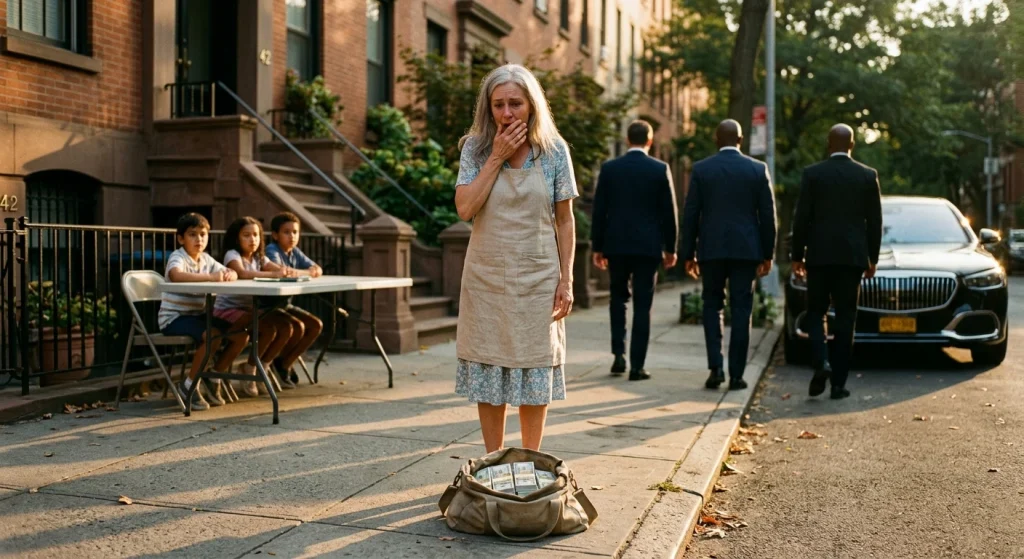
The first Maybach turned the corner..
White. Polished to the point of embarrassment. It moved slowly, like it was apologizing for existing on this block. A black one followed. Then another white one. They lined up along the curb outside her cart — her cart, the dented metal one she’d hauled from the church parking lot nineteen years ago — and the engines cut off one by one like punctuation.
Shiomara set the ladle down.
Around her, the lunch crowd went quiet. A teenager stopped chewing. Old Mr. Batista, who bought two tacos every day and never said much, actually turned around.
The car doors opened.
Three people stepped out. Two men and a woman, all of them dressed like a different city. The kind of dressed that said nothing was borrowed, nothing was on sale. The taller man, mid-thirties, dark brown suit, short beard — he moved around the front of the first car slowly, like he was measuring the distance between where he stood and where she stood. The second man, slightly shorter, deep blue suit, a tie the color of a winter lake — he swallowed hard and looked at his shoes for a second before he looked at her. The woman had gray in her hair, loose, and she wore it without apology. She pressed one hand flat against her sternum, like she was holding something in.
All three of them looked at the cart.
Then at Shiomara.
She reached for the counter instinctively. Something to hold onto.
“Good morning—” she started, but what came out was almost nothing. A breath. A ghost of the sentence.
The taller man — the one with the beard — took two steps toward her. His jaw worked like he’d rehearsed something and now couldn’t find the beginning of it.
“Are you Shiomara Reyes?” he said. His voice was careful. Like he was carrying it in both hands.
She nodded.
“My name is Daniel.” He stopped. Started again. “I used to come here. With my brother and sister. We were — we weren’t doing well. For a few years.”
She looked at him. Then at the other two. Her hand went to her mouth.
“You had a cart on Fifth and Union back then,” the woman said. Her voice was low and steady in the way people get when they’ve trained themselves not to break. “Corner spot. You used to stay past eight, even in winter.”
“I remember Fifth and Union,” Shiomara said quietly.
“We came every night for almost two years,” the second man said. Marcus. He said his name was Marcus. “You never asked us anything. You just — you gave us food. You gave us extra when you thought we weren’t looking.”
“The rice,” the woman said. Her name was Lucia. “You always added more rice.”
Shiomara’s throat closed.
She remembered the winters on Fifth and Union. She remembered a lot of kids coming through, a lot of faces she tried not to make feel seen in a way that made them feel small. She’d learned that early — you look too hard at someone who’s hurting, they disappear.
“I don’t — I’m sorry, I don’t remember faces well,” she said, and she felt terrible saying it.
“We know,” Daniel said. “You treated us the same as everyone else. That’s the thing.”
He reached into his jacket. For a second she thought it was going to be money, and she felt the old reflex rise up — the polite refusal, the I don’t need anything, the deflection she’d perfected over decades of people trying to thank her in ways that made her uncomfortable.
It wasn’t money.
It was an envelope. Thick. Legal-looking.
“We’ve been looking for you for eight months,” Lucia said. “We moved three times after those years. Daniel got into a program. Marcus got a scholarship. I — I took longer.” She exhaled slowly. “But we never stopped talking about you. Every time something good happened, we said your name.”
“We don’t want to embarrass you,” Marcus said. “We know you’re not going to want to make this into a big thing.”
Shiomara almost laughed at that. Almost.
“What is this?” she said, looking at the envelope.
“The building on the corner of Hadley and 9th,” Daniel said. “The one with the green awning. We bought it six months ago. It’s been sitting empty.”
She blinked.
“We want to put your kitchen in it,” Lucia said. “A real one. Proper ventilation, commercial range, refrigeration, the permits sorted — all of it done. Your name over the door if you want it, or no name, whichever you prefer. The building’s yours. Paid in full, no conditions, no lease.”
Shiomara stared at them.
“We don’t want anything back,” Marcus said. “No percentage. No say in how you run it. You can feed whoever you want, charge whatever you want, or nothing, same as always.”
“Inside that envelope is the deed and a letter from our lawyer explaining everything,” Daniel said. “Take your time. Have someone you trust look it over.”
The lunch crowd had gone completely silent. Mr. Batista had actually gotten up from his crate.
Shiomara looked at the envelope. Then at the three of them. There was nothing performed about them — no cameras, no phones out. Just three people standing on a broken sidewalk in expensive shoes, looking at her like she was the only thing that mattered on this street.
She thought about the winters on Fifth and Union. The way she used to make the rice stretch. The way she told herself she wasn’t doing anything remarkable because remarkable people did remarkable things, and all she was doing was cooking.
“You drove Rolls-Royces to my cart,” she said.
“We wanted you to know we were serious,” Lucia said. And then, very quietly: “We wanted you to know it worked. That what you did — it worked.”
Shiomara put her hand over her mouth for the second time. This time it wasn’t to stop a sentence.
Daniel looked like he might say something else and then decided not to. Marcus looked at the ground and back up. Lucia stood very still.
The steam from the rice had stopped. The cart had gone quiet.
“I’m going to need a minute,” Shiomara said.
“Take all the time you need,” Marcus said.
She turned around. She faced the pots and the burners and the spice jars lined up in their old plastic bins. She breathed in the saffron and the cumin and the oil, the smell of this cart and every cart before it, and she let herself feel it — all of it, the years, the cold corners, the nights she’d wondered if any of it was landing anywhere.
It was landing somewhere.
She turned back around.
“I want the name over the door,” she said.
Lucia pressed both hands to her chest. Marcus looked up at the sky like he was checking the weather. Daniel smiled — finally, fully, the way he’d been trying to for the past five minutes.
“Done,” he said.
Shiomara picked up the envelope.
In three months, the kitchen on Hadley and 9th opened with a hand-painted sign, a line around the block, and Shiomara Reyes at the stove — same brown apron, same wooden ladle, same extra scoop of rice when she thought no one was looking.
She fed 280 people on opening day.
She didn’t make a speech.
She just cooked.
Original fictional stories. AI-assisted creative content.